
Issaian Heavy Infantry
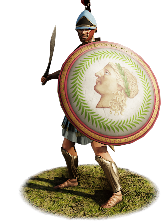
Class: heavy · Category: infantry · Men per unit: 40
Description
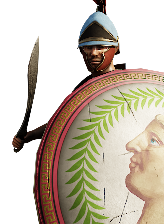
These warriors are the strongest force in the arsenal of the island polis of Issa. As such, they have been given the finest equipment: their shining helmets are from Greece, Illyria, and Italy, and represent pilos, konos, pseudo-Corinthian, and Illyrian types, with the majority being plumed or crested. Expensive clothes and bronze greaves fit the wonderfully painted linen cuirasses, some of which are reinforced with various kinds of exquisite metal armour. The round aspis shields, finally, are embellished with goddesses and civic symbols. This heavy infantry unit fights with curved kopis swords after discharging their South Italic pila, particularly lethal javelins. Chosen from the most virtuous young men of the polis, they will protect Issa against any foe.
Historical background
The city of Issa was founded by Dionysios I (r. 405-367 BC), tyrant of Syracuse, in 385 BC as a Syracusan naval basis in the Adriatic (Diod. 15.13.3, 14.2; cf. Stroheker, Dionysios (1958), pp. 123-124). Situated on the coast of the modern island of Vis, it possessed rich forests and an excellent harbour. After the death of Dionysios I and the subsequent fall of his son Dionysios II in the mid 4th century BC, Issa gained its independence, but retained close ties with Syracuse (Waterfield, Taken at the Flood (2014), p. 10). In this period, the Issaians had to re-organise their armed forces. Originally, these probably consisted of Syracusan marines (epibatai) and a militia, which would have fought as hoplites and psiloi (light infantry). Whatever the exact makeup of the army and fleet, it was apparently sufficient to safeguard the polis, for we hear of no threats to its autonomy for the next century.
The Issaians made good use of their strategic location and established sub-colonies including Salona (now Split) and Melaina Korkyra (now Korčula), with the latter probably being the ultimate foundation, around 285 BC (Syll. 141, Brunšmid, Inschriften 2-14). Together, they formed a ‘commonwealth’ under Issa’s leadership (Džino, Illyricum in Roman Politics (2010), p. 50). With this network of settlements, the Issaians were able to dominate trade in the Adriatic. By the beginning of the 3rd century, all commerce between the Greek cities in Italy and Sicily on the one side, and the towns in the Illyro-Dalmatian hinterland on the other side, passed through Issa or one of its colonies (Derow, Kleemporos (1973), pp. 125-126). Furthermore, Issa became the most important centre of ceramic production in the Adriatic and its pottery dominates the archaeological finds across the islands and the northern Balkans from the 4th to the 1st century BC (Maja Miše, Transformation and Integration. A Millennia of Political, Social, and Cultural Shifts in the Eastern Adriatic. Workshop “Current Research on Illyria and Epirus”, Trier 2024). Other exports included wine (Miše, 2024) and honey (Jelinčić Vučković et al., Dalmatian Beekeeping (2021), p. 130). This wealth allowed the Issaians to also issue their own coins, which marked their autonomy and their dominant trading position. These coins found much use throughout Illyria (Fischer-Hansen/Wilkes, The Adriatic (2004), p. 332).
Some scholars (in particular Boršić/Džino/Radić Rossi, Liburnians and Illyrian Lembs (2021), p. 21) argue that Issa did not only rule over its own trading posts Tragurion, Epetion, Salona, Melaina Korkyra, and Narona, but also exerted decisive influences on indigenous communities. Among these would be the Hyllei, who dwelled between Tragurion and the Krka river, or the inhabitants of Olyntha (Šolta), an island halfway between Issa and Salona. More safely attested is Issaian dominance over the important Sanctuary of Diomedes on Cape Ploče, which would have served to distribute goods among the pilgrims and traders who frequented the holy site (cf. Miše/Šešelj, The Late Hellenistic and early Roman fine pottery from the Sanctuaries of Diomedes in Dalmatia (2008), p. 118). The Mazin coin hoard from southern Dalmatia even included early 3rd century BC Roman bronze coins, which the Issaians had probably exported to the natives for their value as bronze (Derow (1973), p. 126).
In this context, it may come as no surprise that Italic weaponry, too, has been found on Issa. A grave from the late 4th century BC found on the city’s main cemetery even contained a pilum, the famous javelin so strongly associated with the Roman legions (Ugarković, O pogrebnim obredima u helenističkoj Isi – nalaz ranog piluma i njegovo kulturološko značenje (2017), pp. 135-172). The dating suggests that it originated in Southern Italy, rather, as one can tell from the Italic units in RIS. The rich grave suggests that the deceased had been a decorated soldier, and we have thus equipped the heavy infantry with bronze greaves, linothorakes, and aspis shields. For melee, they use the curved kopis sword, the closest Greek equivalent to the Illyrian sica (Schmitz, The Danube Frontier (2015), p. 24). On the coinage of Issa, Pseudo-Corinthian helmets appear (see, e.g.: BMC1; Stari Grad coll.1; Brunšmid Dalmatiens 11-12; Imhoof Klagenfurt 45). In 1986, the Greek archaeologist Petros Dintsis showed that these were indeed not abolished, like the proper Corinthian helmets, but used well into the mid-Hellenistic period (Dintsis, Hellenistische Helme (1986), pp. 90-95). Helmets of the Illyrian type are an obvious choice, while the simple and pragmatic pilos helmets were common throughout the Greek world (Anderson, Military Theory and Practice in the Age of Xenophon (1970), pp. 31-34). Finally, the new konos helmets were seen as a sign of military prowess in the early Hellenistic period, and are thus proper for use by an elite unit (Dintis (1986), p. 161). Thus equipped, this heavy infantry regiment can form the core of an impressive Issaian army.
Stats
| Rank in roster | ||
|---|---|---|
| Men per unit | 40 | ███······· 30% |
| Attack | 17 | █████████· 87% |
| Charge bonus | 12 | ████······ 42% |
| Defence | 45 | █████████· 87% |
| · armour | 10 | █████····· 54% |
| · defence skill | 28 | █████████· 87% |
| · shield | 7 | █████████· 91% |
| Morale | 14 | ████████·· 79% |
| Discipline | Normal | |
| Training | Highly trained | |
| Recruitment cost | 2,313 dn | ██████···· 61% |
| Upkeep per turn | 847 dn | ████████·· 82% |
| Turns to recruit | 4 |
Weapons
| Primary | Secondary | Primary | Secondary | Primary | Secondary | Primary | Secondary | ||||
|---|---|---|---|---|---|---|---|---|---|---|---|
| Attack | 17 | 13 | Charge bonus | 12 | 14 | Type | thrown · blade | melee · blade | Damage | piercing | slashing |
| Projectile | javelin | — | Range | 50 | — | Ammunition | 2 | — | Properties | Used just before charging into combat | — |
Defence
| Primary | Secondary | Primary | Secondary | Primary | Secondary | Primary | Secondary | ||||
|---|---|---|---|---|---|---|---|---|---|---|---|
| Total | 45 | — | Armour | 10 | — | Defence skill | 28 | — | Shield | 7 | — |
Condition and terrain
| Hit points | 1 | Ground: scrub / sand / forest / snow | 0 / -1 / 0 / -1 | Charge distance | 30 | Formations | Square |
Technical stats
| Time between blows (primary / secondary) | 2.5 s / 2.5 s | Extra fatigue in hot climates | 1 | Collision mass per man (1.0 is normal) | 1.17 | Spacing between men: close / loose | 1 × 1.2 m / 2 × 2.4 m |
| Default ranks | 5 |
In battle: Can sap · Very good stamina
Who can recruit it
A core roster unit for one faction, which can raise it anywhere it holds the right building:
Any faction holding one of the provinces below can field it.
Exactly what a settlement must have, route by route (4)
| Building | Also requires | Building | Also requires | Building | Also requires | Building | Also requires |
|---|---|---|---|---|---|---|---|
| Any settlement | Tier 3 Military Industrial Complex · Issaian area of recruitment · Any Government (Dependency, Indirect Rule or Direct Rule) · Tier 2 Colony not built | Direct Rule | Tier 3 Military Industrial Complex · Tier 2 Colony | Homeland | Tier 2 Military Industrial Complex | Any settlement | Tier 2 Military Industrial Complex · Issaian area of recruitment · Dependency only · Tier 1 Colony not built |
Areas of recruitment
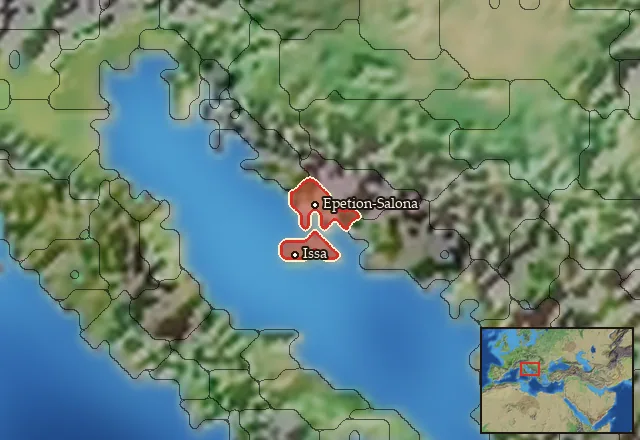
| Zone | Provinces | ||||||
|---|---|---|---|---|---|---|---|
| Issaian | 2 |