
Karian Hoplites
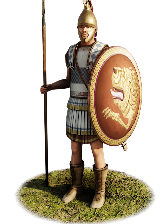
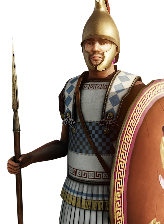
Class: spearmen · Category: infantry · Men per unit: 40
Description
Armed with round aspis shields, spears, and straight xiphos swords, these men are typical hoplites. Linothorakes, Sidon, and Phrygian helmets protect them in their red, short-sleeved tunics with dark pleats and boots. Recruited from among the Dorian and Ionian Greeks on the Carian coast and islands as well as from the natives of the Carian interior, they are a motley crew, but few can match their levels of experience and discipline.
Historical background
"And Nastes again led the Karians, uncouth of speech, who held Miletos and the mountain of Phthires, dense with its leafage, and the streams of Maiander, and the steep crests of Mykale." – Homer (Iliad, lines 2.866-869)
The people of Caria (Greek: Karia) were one of the first people known to “the Greeks”, and perhaps the one most closely intertwined with them. In the quote above, Homer (who probably lived around 700 BC) calls them βαρβαροφώνοι, “of Barbarian/uncouth speech”. At first look, the Carians are ‘othered’ and separated from the Greeks. However, this interpretation was already challenged in antiquity: the historian Thucydides (ca. 460-400 BC) stated that Homer did not yet know “barbarians” (Thuc. 1.3.3). A few centuries later, Strabo of Amaseia (ca. 63 BC - 25 AD) rejected Thucydides’ take and commented: "When the poet (=Homer) says, ‘Masthles (=Nastes) in turn led the Carians, of barbarian speech’, we have no reason to inquire how it is that, although he knew so many barbarian tribes, he speaks of the Carians alone as ‘of barbarian speech’, but nowhere speaks of ‘barbarians’." (Strab. 14.2.28C661). Apparently, the grammarian Apollodoros of Athens (ca. 180-119 BC) had tried to explain the sentence by suggesting that the Ionian Greeks particularly hated the Carians – because of their quarrel over Miletos and Priene – and thus Homer, an Ionian Greek, only used the term against the Carians in order to insult them (Apollod. apud Strab. 14.2.28C661). Strabo is not convinced by this argument either, pointing out that of ‘barbarian speech’ is not the same as ‘barbarians’, and in fact Phillippos of Theangela, a Carian Greek, had written in his Karika that the two languages were very similar (Strab. 14.2.28C662).
Therefore, he concludes, there is only one possible explanation: the Carians are the only people called βαρβαροφώνοι because of their notable accent when speaking Greek, but they were the ONLY foreigners who regularly used Greek at all in the early Archaic period. And why did they do that? Because they traded and lived across the Aegean, but mostly because they often served as mercenaries in Greek armies (Strab. 14.2.28C662-663). Modern scholarship is largely convinced that Strabo was right (Almagor, ‘Who is a barbarian?’, in: Dueck, Lindsay, and Pothecary, Strabo's Cultural Geography (2005), pp. 44-47) – not least because Greeks and Carians were often seen as basically the same people when serving or living abroad, like in Egypt (Hdt. 2.163, Diod. 1.66.12). This makes sense, as Carian and Greek history was entangled from the beginning. According to Herodotus (Hdt. 1.171), Thucydides (Thuc. 1.4), and Strabo (Strabo 14.2.28C663), Carians had once lived on all the Aegean islands before the Cretans and Ionians pushed them out. Doubtlessly, many Carians remained behind, just like Greeks lived in Caria, and our hoplites represent this mixed population.
Even though Miletos and the region around it were settled by Ionian Greeks, there were also Doric/Dorian Greeks in Caria. Lindos, Ialysos, and Kamiros on Rhodes were already mentioned in the Homeric Catalogue of Ships during the Trojan War (Hom. Il. 2.653-656), and Knidos may even have been a Mycenaean or Minoan settlement from as early as the 12th century BC (Hiller, Die frühgriechischen Texte aus mykenischer Zeit (1976), pp. 106, 109-110). Just like the Ionians had their Koinon (League) with 12 member cities and a central sanctuary, the Panionion in Priene (Hdt. 1.143.3, Strab. 14.1.20C639), the Dorian Greeks in Caria also organised themselves into a federation. Originally, this was a Hexapolis (league of six cities): Lindos, Ialysos, Kamiros, Kos, Knidos, and Halikarnassos (Hdt. 1.144.2). Their shared temple was that of the Triopian Apollo on a promontory near Knidos (Hdt. 1.144.1-2, Dion. Hal. 4.25). Regularly, games were held here in the name of the god, and the winner would receive a tripod that was to be dedicated to Apollo. One day, however, Agasikles from Halikarnassos won the competition, took the tripod home, and nailed it to a wall in his house. For this crime, the other cities decided to exclude Halikarnassos from the Hexapolis forever, and their League became a Pentapolis (“five cities”) (Hdt. 1.144.2-3). As was already suggested in the nineteenth century, the real reason may have been the adoption of increasingly Carian institutions over their Greek counterparts in Halikarnassos (Newton and Pullan, A History of Discoveries at Halicarnassus, Cnidus and Branchidae (1862), p. 13).
The Doric Pentapolis experienced many changes over time, with the most substantial being the foundation of the polis and thus a single ‘state’ of Rhodes by a synoikismos of Lindos, Ialysos, and Kamiros in 409/408 BC for mutual economic and military benefit (Zachhuber, Religious Life in Late Classical and Hellenistic Rhodes (2024), pp. 11-51). Knidos blossomed in the Hellenistic period when it fell under Ptolemaic protection (Theokr. Idyl. 17.66). It exported its vinegar as far as the Bosporan Kingdom (Athen. 2.67D; Abramzon and Kuznetsov, ‘A hoard of 4th-1st centuries BC coins from Phanagoria’, in: Povalahev, Phanagoreia und darüber hinaus (2014), pp. 167-168), was famed for reeds (Plin. nat. hist. 16.64.2) and oil (Plin. nat. hist. 15.7.2), but especially for its wine (Strab. 14.1.15C637). It was the home of the physician Ktesias, who served Artaxerxes II (r. 404-359/358 BC) and composed a well-known account on Persia. Other famous sons of Knidos were the philosopher, geographer, and astronomer Eudoxos (ca. 390-338 BC), and the historian Agatharchides (ca. 208-132/131 BC), who worked in Egypt as secretary under pharaoh Ptolemy VI (r. 180-164 & 163-145 BC). Finally, Knidos was home to the Aphrodite of (the Athenian sculptor) Praxiteles, one of the most famous artworks of all time (Plin. nat. hist. 36.20, Athen. 13.59, Ps.-Luc. Er. 15):
Paris did see me naked,
Adonis, and Anchises,
except I knew all three of them.
Where did Praxiteles see me?
–(Anth. Graec. 16.168)
The island of Kos, meanwhile, was the birthplace of Hippokrates (ca. 460-370 BC), and boasted a medical school in his tradition which for centuries thereafter continued to flourish under Ptolemaic protection. In fact, the only rivals for the medical knowledge of the Koans were the Egyptians and the Knidians (Lang, Medicine and Society in Ptolemaic Egypt (2013), pp. 117-122). Like the Knidians rejected any buyers for the Aphrodite, whether they be oligarchs or kings (Plin. nat. hist. 7.39), the Koans dismissed the order by Artaxerxes I (r. 465-424 BC) to send Hippokrates to the court of the great king (Wells, The Greek Language of Healing (2014), p. 71). Even the Babylonian priest, astronomer, and author Berossos lived on Kos and founded the first school of astrology in the Hellenistic world there around 300 BC (De Breucker, De Babyloniaca van Berossos van Babylon (2012), pp. 27-28).
There is no doubt that Koans, Knidians, Rhodians or Carians, Doric and Ionian Greeks on the Carian mainland all fought as Hoplites during the Archaic and Classical periods. The stele of Apollodides of Euromos (near Mylasa) from the Ptolemaic garrison at Sidon from around 200 BC shows that this equipment and fighting style was retained even in the Hellenistic period. Though the slab was badly damaged, it is clear that Apollodides used a roundshield, wore blood-red tunics with darker pleats and short sleeves, a spear, and probably a linothorax (Jalabert, Nouvelles Stèles Peintes de Sidon (1904), fig. 1). A Carian on the tomb of Xerxes (r. 486-465BC) at Naqsh-e Rostam wears the Greek straight sword known as the xiphos that was popular with hoplites (McCoskey, A Cultural History of Race in Antiquity (2023), p. 109). The crested helmets are typical for Caria (Alkaios Frg. 22 (Bergk) = Strab. 14.2.27C661), Hdt. 1.171.4), Sidon helmets are depicted among the Sidon garrison, and Phrygian helmets were omnipresent in 3rd century Greece and Anatolia (Sekunda and McBride, The Army of Alexander the Great (1984), p. 6). This unit thus represents the backbone of the armies of Doric Greeks, Ionian Greeks and Carians in Caria – all mixed together, as they were:
"Hekatomnos, the satrap of Caria, has in reality been disaffected for a long time now, and will openly declare himself whenever we wish. From Knidos to Sinope the coast of Asia is settled by Hellenes, and these we need not to persuade to go to war – all we have to do is not to restrain them." – Isokrates of Athens (11, Panegyricus 4, 162).
Stats
| Rank in roster | ||
|---|---|---|
| Men per unit | 40 | ███······· 30% |
| Attack | 9 | █········· 13% |
| Charge bonus | 13 | █████····· 52% |
| Defence | 37 | ██████···· 64% |
| · armour | 10 | █████····· 54% |
| · defence skill | 22 | ██████···· 61% |
| · shield | 5 | ██████···· 57% |
| Morale | 10 | ███······· 29% |
| Discipline | Low | |
| Training | Highly trained | |
| Recruitment cost | 1,595 dn | ██········ 23% |
| Upkeep per turn | 584 dn | ████······ 37% |
| Turns to recruit | 2 |
Weapons
| Primary | Secondary | Primary | Secondary | Primary | Secondary | Primary | Secondary | ||||
|---|---|---|---|---|---|---|---|---|---|---|---|
| Attack | 9 | — | Charge bonus | 13 | — | Type | melee · blade | — | Damage | piercing | — |
| Properties | Light spear (braced against cavalry charges from the front) · +8 attack against cavalry | — |
Defence
| Primary | Secondary | Primary | Secondary | Primary | Secondary | Primary | Secondary | ||||
|---|---|---|---|---|---|---|---|---|---|---|---|
| Total | 37 | — | Armour | 10 | — | Defence skill | 22 | — | Shield | 5 | — |
Condition and terrain
| Hit points | 1 | Ground: scrub / sand / forest / snow | -1 / -1 / -4 / -1 | Charge distance | 30 | Formations | Square |
Technical stats
| Time between blows (primary / secondary) | 2.5 s / — | Extra fatigue in hot climates | 1 | Collision mass per man (1.0 is normal) | 1.11 | Spacing between men: close / loose | 1 × 1.2 m / 2 × 2.4 m |
| Default ranks | 5 |
In battle: Can sap · Very good stamina
Who can recruit it
A core roster unit for one faction, which can raise it anywhere it holds the right building:
Any faction holding one of the provinces below can field it.
Exactly what a settlement must have, route by route (3)
| Building | Also requires | Building | Also requires | Building | Also requires | ||
|---|---|---|---|---|---|---|---|
| Direct Rule | Garrison Building or Tier 1 Military Industrial Complex · Tier 1 Colony | Homeland | Garrison Building or Tier 1 Military Industrial Complex | Any settlement | Garrison Building or Tier 1 Military Industrial Complex · Karian area of recruitment · not Kaunian area of recruitment · Any Government except Homeland (Dependency, Indirect Rule or Direct Rule) · not Tier 2 Colony |
Areas of recruitment

| Zone | Provinces | ||||||
|---|---|---|---|---|---|---|---|
| Karian | 3 |