
Lyttian Archers
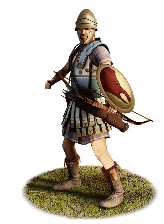
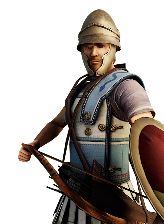
Class: missile · Category: infantry · Men per unit: 40
Description
The archers of Crete are renowned as specialist mercenaries throughout the ancient world. The political instability and endemic warfare on the island mean that a steady supply of Cretans is available for military service overseas. This is especially true for Lyttos, which was destroyed twice, in 342 BC (during the Foreign War) and in 220 BC (during the Lyttian War), both times by an army sent from Knossos. While the Lyttians kept fighting until they won in each of these wars, they remained homeless for years until their city was rebuilt. Many will have served as mercenaries abroad during this period, others did so because they were young and needed money and prestige. With their Scythian style composite bows, the Lyttian archers outrange most other bowmen, and due to their experience and skills learned from childhood, they are some of the best archers in the ancient world. In the Hellenistic period, Cretan archers were typically protected by light linothorakes with pteryges, bronze helmets (of pilos, Thracian or konos type) or petasos helmets, Cretan boots and small, round pelte shields. Should they be forced into a melee, these men will defend themselves with curved Machaira swords.
Historical background
The best evidence for Lyttian archers is the stela of Chalkokedes of Lyttos. Dated to the early 3rd century BC and found in the Antigonid military town of Demetrias in Thessaly, it depicts a bearded man wearing chiton and chlamys. He is armed with a composite bow, a helmet, and a small, round pelte shield. The inscription identifies him as Chalkokedes (alternatively: Chaitonides; the text is damaged), son of Eikarios (=Icarus) (SEG 53:523 (= Thess. Mnemeia 119,8)). Marcel Launey noted a small figure next to the soldier, a page who carries two javelins and a curved dagger or short machaira sword (Launey, Recherches sur les armées hellénistiques (1952), p. 282). This equipment is well represented by our unit, though the restrictions of TW make it impossible to give the Lyttian archers a third weapon in the form of javelins.
The stele of Chalkokedes also proves that Lyttians served abroad as mercenaries. Aside from Antigonid Macedon (Polyb.3.66.6; 4.67.6), the Ptolemies (Polyb. 5.36.4; 65.7; 31.17.8) and the Seleucids (Polyb. 5.97.10; 8.15.4;10.29.6) often made use of Cretan archer mercenaries. Other Greek states also paid for their services, e.g. Syracuse (Liv. 24.30.13; Polyb. 3.75.7), the Achaian League (Polyb. 4.55.5; 33.16.6) or the Aitolian League (Polyb. 5.14.1-3). In Sparta they were hired by the tyrant or king Nabis (r. 207-192 BC) (Polyb.12.6.8; 8.2), but a small contingent had already been employed in previous years (4.80.6). Finally, the Roman Republic (Liv. 24.30.13; Polyb. 3,75.7) had a permanent force of Cretan mercenaries under arms (Keppie, Army and Navy (1996), p. 373).
While the coins of Lyttos commonly depict a boar (e.g. BMC 15 = Sear Greek 3241 or Svoronos 71 = BMC 29: the faction symbol of Lyttos in RIS), the ship prow (e.g., Mionnet II, 229 = BMC 21-22: depicted on the shields of this unit) or an eagle (e.g., Svoronos 71; BMC 29: also on the shields of the Lyttian archers), drachmae from 350-270 BC show Artemis with a quiver (CNG 76, 625) – a reference to its archers and the great veneration of the hunter goddess in the city. Chersonesos (modern Chersonissos, a popular beach resort), the port town of Lyttos, was famous for its sanctuary of Britomartis, the eastern Cretan version of Artemis (Strab. 10.4.14C479), who was called Diktynna in western Crete (Cigaina, Der Kaiserkult bei den Kretern (2016), p. 322). In various inscriptions, oaths on Artemis, her twin brother Apollo, another divine archer, or Leto, the arrow-shooting mother of Artemis and Apollo, are frequently attested (Chaniotis, Die Verträge zwischen kretischen Poleis (1996), pp. 71-73). Aside from Zeus, who – according to the famous poet Hesiod – was born in Lyttos (Hes. Theog. 477), the three archery deities enjoyed the greatest veneration in Lyttos. This befits the important role of bowmen in Lyttian armies and the significance of the weapon in Lyttian society and politics (cf. the description of the Lyttian Agelai). The Lyttian archers were trained from childhood, possessed the best bows and arrows, and fought both for their home and their patron god or goddess. This explains their incredible efficiency and the great reputation of the Cretan archers.
Stats
| Rank in roster | ||
|---|---|---|
| Men per unit | 40 | ███······· 30% |
| Attack | 11 | ███······· 34% |
| Charge bonus | 5 | ███······· 26% |
| Defence | 25 | ███······· 28% |
| · armour | 7 | ████······ 42% |
| · defence skill | 16 | ███······· 28% |
| · shield | 2 | ███······· 25% |
| Morale | 10 | ███······· 29% |
| Discipline | Normal | |
| Training | Trained | |
| Recruitment cost | 1,808 dn | ████······ 38% |
| Upkeep per turn | 662 dn | ██████···· 56% |
| Turns to recruit | 4 |
Weapons
| Primary | Secondary | Primary | Secondary | Primary | Secondary | Primary | Secondary | ||||
|---|---|---|---|---|---|---|---|---|---|---|---|
| Attack | 11 | 8 | Charge bonus | 5 | 7 | Type | missile · archery | melee · blade | Damage | piercing | slashing |
| Projectile | arrow | — | Range | 170 | — | Ammunition | 25 | — |
Defence
| Primary | Secondary | Primary | Secondary | Primary | Secondary | Primary | Secondary | ||||
|---|---|---|---|---|---|---|---|---|---|---|---|
| Total | 25 | — | Armour | 7 | — | Defence skill | 16 | — | Shield | 2 | — |
Condition and terrain
| Hit points | 1 | Ground: scrub / sand / forest / snow | 0 / 0 / 0 / 0 | Charge distance | 30 | Formations | Square |
Technical stats
| Time between blows (primary / secondary) | 2.5 s / 2.5 s | Extra fatigue in hot climates | 0 | Collision mass per man (1.0 is normal) | 0.96 | Spacing between men: close / loose | 1.1 × 2.6 m / 1.98 × 4.68 m |
| Default ranks | 5 |
In battle: Very good stamina
Who can recruit it
A core roster unit for one faction, which can raise it anywhere it holds the right building:
A further 1 faction can raise it in the provinces below.
Exactly what a settlement must have, route by route (3)
| Building | Also requires | Building | Also requires | Building | Also requires | ||
|---|---|---|---|---|---|---|---|
| Any settlement | Tier 3 Military Industrial Complex · Lyttian area of recruitment · Any Government (Dependency, Indirect Rule or Direct Rule) · Tier 2 Colony not built | Direct Rule | Tier 3 Military Industrial Complex · Tier 2 Colony | Homeland | Tier 2 Military Industrial Complex |
Areas of recruitment
| Zone | Provinces | ||||||
|---|---|---|---|---|---|---|---|
| Lyttian | 0 |