
Milesian Horophylakes
Class: missile · Category: infantry · Men per unit: 40
Description
“Now Asterios, prince of the Cretans, married Europa and brought up her children (Rhadamantys, Minos, and Sarpedon). But when they were grown up, they quarrelled with each other; for they loved a boy called Miletos, son of Apollo by Aria, daughter of Kleochos. As the boy was more friendly to Sarpedon (the later king of Lycia), (his brother) Minos went to war and had the better of it, and the others fled. Miletos landed in Caria and there founded a city which he called Miletos after himself.”
– (Pseudo-) Apollodoros of Athens (Library, 3.2.1)
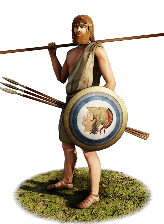
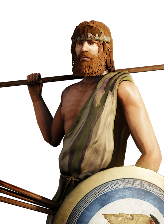
The young men of this regiment are Horophylakes or “border guards”. Their job is to patrol and guard the boundaries of the chora (territory) of the polis Miletos. Though only wearing an exomis or chiton around the body and a petasos hat or headband, every member of the horophylakes is a force to be reckoned with. They have been picked from among the Ephebes of Miletos, are masters with the javelin, and experts in swiftly moving around their round, small pelte shields. In melee, they can defend themselves with the dory, which is nothing but a more solid javelin anyway.
Historical background
After the defeat of the diadoch Lysimachos at Kouropedion in 281 BC, Miletos fell into the orbit of the Ptolemies (Marquaille, The Foreign Policy of Ptolemy II (2008), p. 46). Milesians conceivably supported the Ptolemaic invasion of neighbouring Samos, and soon, all of Ionia had sworn loyalty to Ptolemaios (Bagnall, The Administration of the Ptolemaic Possessions Outside Egypt (1976), pp. 82-88). All of Ionia – except for Miletos' arch-rival Priene, just across the Latmian gulf, which supported the Seleucids (Lund, Lysimachus (2002), p. 207). The conflict between the cities went back a long time. On the one side, the seemingly poor and small Priene with its almost communistic policies – women and slaves were sometimes allowed to participate in political meetings and everyone was considered completely equal (Cf. the 2nd century BC inscription I.Priene 5.1–2; Gray, Beyond the Classical Polis (2022), p. 212) –, on the other side, the wealthy, almost decadent Miletos with its impressive public buildings and its hedonistic elite, which invented the genre of pornography and the first mass produced dildo (Herod. Mimiamb. 6; Aristoph. Lysistrat. l. 112). Though Miletos and Priene were under the influence of the Ptolemaic respectively Seleucid monarchies in the 3rd century BC, their rivalry continued.
In 262/261 BC, Ptolemy Epigonos, the son of Arsinoe II, queen of the Ptolemaic Empire, and of the late Lysimachos, arrived in Miletos. Ptolemy was at this time the heir apparent of the kingdom and was probably dispatched to Ionia to rule over the Ptolemaic possessions in Greece and Asia Minor from here, using Miletos or Ephesos as the regional capital (Tunny. Ptolemy (2000), p. 84; Grainger, Syrian Wars (2010), p. 120). Not much later, Ptolemy II seems to have decided to appoint the later Ptolemy III as his heir instead of Ptolemy Epigonos, and his stepson reacted angrily. He conspired with Timarchos, the Aitolian commander of the mercenary force at Miletos, and brought Ephesos, Miletos and Samos under his control (Front. Strat. 3.2.11; Grainger (2010), p. 120). Epigonos' rebellion proved a grave mistake, however, because this was just the chance Antiochos II of the Seleucid Empire had waited for. He immediately invaded Ionia, defeated Timarchos in battle, and granted freedom to Miletos, which now became his ally (OGIS i. 361-362, no. 226).
The treaty and the following events as well as the decline of Seleucid central authority in the second half of the 3rd century suggest Miletos now increasingly won back its independence. Far from being traumatised by experiencing the power of the Macedonian empires, the Milesians soon resumed their own imperialist policy on a smaller scale. In the 230s BC, Cretan mercenaries were employed to expand Milesian control in the valley of the upper Maeander – as a reward, they were settled on the land and later enfranchised in the polis (Chaniotis, Age of Conquest (2018), p. 309). The next target became Myous, a polis ca. 15km northeast of Miletos, which was one of the 12 founding members of the Ionian League, together with the likes of Priene, Ephesos, Samos, and Miletos itself (Hoepfner, Ionien (2011), pp. 79-80). The once mighty city state was in decline and, in the late 3rd century BC, it was dissolved as an independent state and incorporated into the polis of Miletos through sympoliteia (enfranchisement, see: Strab. 14.1.10C636; LaBuff, Polis Expansion and Elite Power in Hellenistic Karia (2015), pp. 90-92).
While alliances with other cities in their vicinity safeguarded the new Milesian possessions, the capital of Ionia still had to enact revenge on one particular neighbour: in 494 BC, the Persians had punished Miletos by stripping it of the Milesia Hyperakria, the mountainous part of their chora (rural territory), and gave it to Pidasa, a Carian fortress town (Hdt. 6.20). Pidasa later developed into a polis-like city and joined the Delian League of Athens (ATL1, 535) before merging with Latmos in a sympoliteia in the decade 323-313 BC (SEG 47.1563). The new mini-state was a thorn in the Milesian side, and when the Seleucids were busy with the Romans in 190 BC, Miletos invaded Pidasa-Latmos. The Milesian troops won a quick victory and, by 188 BC, the war was over. All Pidasans were forced to move to Miletos, while the fortress town was garrisoned by Milesian citizens and the Hyperakria reintegrated into the Milesian chora (I. Milet 3.149). The Romans were easily persuaded to approve of Miletos' mini-empire: like Athens, Miletos still carried much prestige and its envoys had done a good job in advertising their home city (Liv. 37.16, Polyb. 21.48). It would retain much autonomy under the Republic and the emperors and continue to thrive as one of the richest cities in Western Asia.
The term Horophylakes first appears in an inscription from Chios dated to the 5th century BC. According to the text, the Horophylakes are to punish everyone who moved or damaged the border stones of the chora, the rural territory of Chios (IGA 381= Cauer ² 496). The word can be translated as “rock guards”, which fits their role as protectors of the border stones. Horophylakes then reappear in the Hellenistic period in an inscription from Miletos which sheds little light on their role aside from recording that they existed both in Miletos and Herakleia Pontike on the Black Sea ( I.Milet. 3.150, l. 89). A guard for Miletos’ city walls and chora boundaries appears in 229/228 BC, implying that some soldiers were always on guard duty (I.Milet. 3.37, l. 65). These men were probably the Horophylakes, even if patrolling in the countryside, protecting fortresses and observing the chora from walls and towers was a task that was often assigned to Ephebes, young citizens in training (Hartog, Mirror of Herodotus (1988), pp. 52-54). We can only speculate that some of the Ephebes may have been picked for the Horophylakes, but it is unclear how prestigious their work was. Certainly, the Horophylakes known from Egypt were proper members of the Ptolemaic military (PSI IV 406.8-9, 12 (Philadelphia, Fayoum, 260-258 BC)). Finally, Paraphylakes and Horophylakes appear in Attalid Asia Minor as paramilitary forces that patrol along important trade routes (SEG XXIX 1516; XLVIII 1532; XLVII 1601), and in the Roman period, they assured the safety of the rural area around Lake Karalis (now Beyşehir Lake) in Pisidia (Kurt, Roma Döneminde Beyşehir Gölü (Karalis) Çevresinin Sosyal ve Ekonomik Yapısı (2017), pp. 132-133).
In RIS, we have given the Horophylakes to Miletos and Herakleia, where they were probably important units in the armed forces of the poleis, while those in the Attalid Kingdom and Roman Empire were possibly more comparable to police forces. The Ptolemaic designation, meanwhile, may be functional rather than divisional: any troops that secured borders, be they Carian mercenaries, Egyptian archers, or Greek cavalry, could be termed Horophylakes when they were garrisoning a border fort (Bauschatz, Policing the Chora (2005), p. 54). We have decided to represent the Milesian and Herakleiote Horophylakes as elite light infantry, because they would have needed bravery, speed, and flexibility to effectively defend the long borders of the polis’ large chora. While their heads are only protected by petasos hats or headbands, they are skilled in wielding their small, round pelte shields and their heavy boots shield their knees and feet from attacks, while some men have decided to wear linen cuirasses (linothorakes). The Horophylakes are mainly skirmishers, but they can defend themselves in melee with a spear.
Stats
| Rank in roster | ||
|---|---|---|
| Men per unit | 40 | ███······· 30% |
| Attack | 13 | ██████···· 57% |
| Charge bonus | 3 | ██········ 16% |
| Defence | 29 | ████······ 40% |
| · armour | 5 | ████······ 35% |
| · defence skill | 22 | ██████···· 61% |
| · shield | 2 | ███······· 25% |
| Morale | 8 | ██········ 19% |
| Discipline | Normal | |
| Training | Trained | |
| Recruitment cost | 1,234 dn | █········· 8% |
| Upkeep per turn | 452 dn | ██········ 17% |
| Turns to recruit | 3 |
Weapons
| Primary | Secondary | Primary | Secondary | Primary | Secondary | Primary | Secondary | ||||
|---|---|---|---|---|---|---|---|---|---|---|---|
| Attack | 13 | 5 | Charge bonus | 3 | 3 | Type | thrown · archery | melee · blade | Damage | piercing | piercing |
| Projectile | javelin | — | Range | 60 | — | Ammunition | 7 | — | Properties | Thrown | — |
Defence
| Primary | Secondary | Primary | Secondary | Primary | Secondary | Primary | Secondary | ||||
|---|---|---|---|---|---|---|---|---|---|---|---|
| Total | 29 | — | Armour | 5 | — | Defence skill | 22 | — | Shield | 2 | — |
Condition and terrain
| Hit points | 1 | Modifier against mounts | horse +1 · chariot +1 · camel +1 | Ground: scrub / sand / forest / snow | 8 / 0 / 8 / 0 | Charge distance | 30 |
| Formations | Square |
Technical stats
| Time between blows (primary / secondary) | 2.5 s / 2.5 s | Extra fatigue in hot climates | 0 | Collision mass per man (1.0 is normal) | 0.93 | Spacing between men: close / loose | 1 × 2.4 m / 1.8 × 4.32 m |
| Default ranks | 5 |
In battle: Very good stamina
Who can recruit it
A core roster unit for one faction, which can raise it anywhere it holds the right building:
Any faction holding one of the provinces below can field it.
Exactly what a settlement must have, route by route (5)
| Building | Also requires | Building | Also requires | Building | Also requires | Building | Also requires |
|---|---|---|---|---|---|---|---|
| Any settlement | Tier 2 Military Industrial Complex · Milesian area of recruitment · Any Government (Dependency, Indirect Rule or Direct Rule) · Tier 2 Colony not built | Indirect Rule | Tier 2 Military Industrial Complex · Tier 1 Colony | Direct Rule | Tier 2 Military Industrial Complex · Tier 1 Colony | Homeland | Tier 2 Military Industrial Complex |
| Any settlement | Tier 2 Military Industrial Complex · Milesian area of recruitment · Dependency or Indirect Rule · Tier 1 Colony not built |
Areas of recruitment
| Zone | Provinces | ||||||
|---|---|---|---|---|---|---|---|
| Milesian | 0 |