
Phrygian Slingers
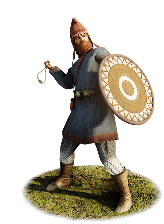

Class: missile · Category: infantry · Men per unit: 40
Description
Farmers and pastoralists often used slings while herding sheep or hunting. Although slightly better equipped than basic Greek slingers, these men are no experts by any means. The Phrygian slingers’ bullets can lay the groundwork for a great victory, but be careful not to use this unit in melee combat. These men wear long-sleeved tunics and trousers. For further protection, they rely on their round wicker shields. Since most only wear Phrygian hats of leather or fur, with actual Phrygian helmets being the exception, they are quite exposed while using their slings.
Historical background
Bullets shaped as an almond made out of lead were an invention of the late 5th century BC (Tuck, Ouch! Inscribed Greek Sling Bullets in Missouri, MVSE (1999), p. 15). They had double the range of the traditional, larger stone rocks (Xenophon, Anabasis, III.3.16), thanks tot heir smaller size, and were more aerodynamic with an effective range of up to 400 metres (Foss, ‘A bullet of Tissaphernes’, The Journal of Hellenic Studies 95 (1975), p. 27). Lead bullets retained their hitting power because of their high density. While in production, many were inscribed with the names of their owners. Although there are no accounts for any inscribed sling bullets from Phrygian slingers (Tuck (1999), p. 27), we have an example of a bullet from just to the west of Phrygia (Foss (1975), p.25). This particular lead bullet is 3,6 cm long and 2,2 cm thick and weighs 40 grams. Other bullets vary in size and weight.
When Kyros the Great of Persia conquered Phrygia in 547 BC, some Phrygians voluntarily took his side. Those who had put up some resistance were, however, disarmed and conscripted into his army as slingers (Xen. Cyr. VII.4.11). This was in part intended as a humiliation for the formerly proud kingdom:
“And of those who had been made subjects he required all who were unarmed to practise with the sling, for he considered this weapon to be the one most fitting for a slave. For in conjunction with other forces there are occasions when the presence of slingers is of very effective assistance, but by themselves alone not all the slingers in the world could stand against a very few men who came into a hand-to-hand encounter with them with weapons suited for close combat.” (Xen. Cyr. VII.4.15)
Describing the early Persian period of Phrygian history, Herodotus remarks that the Phrygians went to war in a fashion similar to that of the Paphlagonians: braided helmets, small shields, buskin boots which reached halfway up the shanks, and a similar dress (Histories, VII.72).
It is only by the early Middle Ages that archery firmly took over the primary spot as preferred long-range skirmishing weapon (Tuck (1999), p. 15). Due to the Phrygians’ agricultural activities, it is more than likely that the sling remained a common weapon among them. Moreover, during the Hellenistic period, Phrygians ‘relapsed’ from agriculture to extensive herding and steppe grazing (Thonemann, ‘Phrygia’, in: idem (ed.), Roman Phrygia: Culture and Society (2013), p. 12). This is attested by the disappearance of the Phrygian language and the abandonment of Gordion between 189 and the late 1st century BC (Thonemann (2013), p. 20). It is, thus, no surprise that during the Seleucid period the Phrygians are also mentioned as slingers. Slingers from Phrygia participated in the Battle of Magnesia (188 BC) as one of the many recruiting hotspots for the Seleucids up to that point (App. Syr. VI.32). After this lost battle, the Seleucids were prohibited from recruiting there. Eventually, the Phrygian tribes were assimilated into Greek culture.
Stats
| Rank in roster | ||
|---|---|---|
| Men per unit | 40 | ███······· 30% |
| Attack | 6 | █········· 3% |
| Charge bonus | 0 | █········· 0% |
| Defence | 11 | █········· 2% |
| · armour | 2 | █········· 13% |
| · defence skill | 7 | █········· 1% |
| · shield | 2 | ███······· 25% |
| Morale | 5 | █········· 4% |
| Discipline | Low | |
| Training | Untrained | |
| Recruitment cost | 939 dn | █········· 4% |
| Upkeep per turn | 344 dn | █········· 11% |
| Turns to recruit | 2 |
Weapons
| Primary | Secondary | Primary | Secondary | Primary | Secondary | Primary | Secondary | ||||
|---|---|---|---|---|---|---|---|---|---|---|---|
| Attack | 6 | 2 | Charge bonus | 0 | 0 | Type | missile · archery | melee · simple | Damage | blunt | piercing |
| Projectile | stone | — | Range | 150 | — | Ammunition | 35 | — |
Defence
| Primary | Secondary | Primary | Secondary | Primary | Secondary | Primary | Secondary | ||||
|---|---|---|---|---|---|---|---|---|---|---|---|
| Total | 11 | — | Armour | 2 | — | Defence skill | 7 | — | Shield | 2 | — |
Condition and terrain
| Hit points | 1 | Ground: scrub / sand / forest / snow | 0 / 0 / 0 / 0 | Charge distance | 30 | Formations | Square |
Technical stats
| Time between blows (primary / secondary) | 2.5 s / 2.5 s | Extra fatigue in hot climates | 0 | Collision mass per man (1.0 is normal) | 0.84 | Spacing between men: close / loose | 1.2 × 2.8 m / 2.16 × 5.04 m |
| Default ranks | 5 |
In battle: Very good stamina
Who can recruit it
A core roster unit for one faction, which can raise it anywhere it holds the right building:
Any faction holding one of the provinces below can field it.
Exactly what a settlement must have, route by route (4)
| Building | Also requires | Building | Also requires | Building | Also requires | Building | Also requires |
|---|---|---|---|---|---|---|---|
| Any settlement | Garrison Building or Tier 1 Military Industrial Complex · Phrygian area of recruitment · not Paphlagonian area of recruitment · Any Government (Dependency, Indirect Rule or Direct Rule) · Tier 2 Colony not built | Indirect Rule | Garrison Building or Tier 1 Military Industrial Complex · Tier 1 Colony | Direct Rule | Garrison Building or Tier 1 Military Industrial Complex · Tier 1 Colony | Homeland | Garrison Building or Tier 1 Military Industrial Complex |
Areas of recruitment
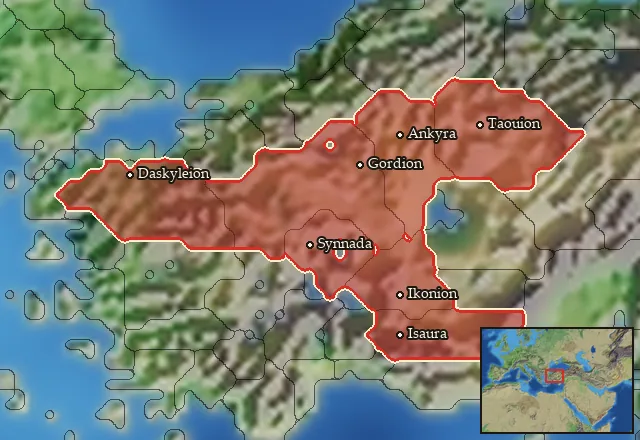
| Zone | Provinces | ||||||
|---|---|---|---|---|---|---|---|
| Phrygian | 7 |