
Scytho-Bosporan Infantry
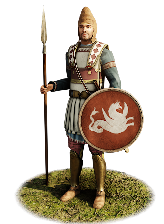
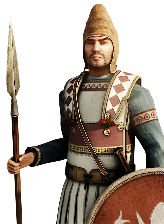
Class: spearmen · Category: infantry · Men per unit: 40
Description
In the vastness of the steppe, the bow and the horse reign, but Scythian warriors do not shy away from bloody melee either. This is especially true for those who live within the borders of the Bosporan Kingdom, with its bountiful fields and fortified Greek cities. Clad in traditional Scythian tunics with long sleeves, simple belts, trousers, and leather boots, some of these men also wear Greek linen or Scythian rawhide cuirasses for extra protection. These soldiers mainly fight as spearmen, but they carry akinakes, xiphos, and machaira swords to back up their primary weapon. While some men are brave enough to go into battle with only a headband around their forehead or a pointy cap on their heads, others choose to safeguard what brain they may have with konos, pilos, Thracian, or Attico-Thracian helmets. Those who can afford it even wear Hellenic bronze greaves over their trousers to safeguard their legs from low blows. Even their shields are a blend of Scythian and Greek military traditions. The small, round pelte is well known all along the Eastern Mediterranean, while the rounded square shield is common across the steppes of Western Eurasia. Altogether, these spearmen can hold their own against enemy infantry and cavalry alike, and demonstrate that the Scythians within the realm can make a crucial contribution to the defence of the Kimmerian Bosporos.
Historical background
Scythians formed an important part of Bosporan history. From the earliest days of Greek settlement on the northern shores of the Black Sea, they were neighbours, enemies, allies, and subjects. Already by the time of Leukon I (r. 389-349 BC) – perhaps the greatest of all Bosporan rulers – Scythian warriors had become a regular part of Bosporan armies (Polyaen. 6.9.4). The latter author, the Bithyno-Macedonian lawyer Polyainos, writes that Scythian bowmen were stationed behind the Greek hoplites so that they could shoot them if they tried to run away. This indicates that Leukon trusted his Scythian soldiers more than the Greeks, perhaps because they were paid mercenaries instead of a citizen levy. Several decades later, Leukon’s grandsons Satyros II and Eumelos fought each other for the Bosporan throne. At the largest battle of the war, near the river Thatis in the Sindike, both armies were largely made up of allies from the steppes: Satyros commanded 2,000 Greek mercenaries, 2,000 Thracian mercenaries, 22,000 Scythian footmen, and 10,000 Scythian horsemen. On the other side, Eumelos was supported by Aripharnes, king of the Sarmatian Siraces, who brought 22,000 infantry and 20,000 cavalry to the battlefield (Diod. 20.22.4). Not only did Scythians and Sarmatians contribute large numbers to each force, the percentage of Scythian infantry is also remarkably high. Following his Bosporan source, Diodoros even writes the following: “(Satyros was) [...] taking his own place in the centre of the phalanx, as is the Scythian custom” (Diod. 20.22.3).
In contemporaneous art, Scythian infantry is a common sight. On a gold comb from Solokha in the lower Dnieper region, two Scythian swordsmen with shields fight a horseman in the middle (Heinen, Antike am Rand der Steppe (2006), p. 25). The two footmen are clad in Scythian trousers, belts, boots, and long-sleeved tunics, while the one on the right also wears a pointy cap on his head. Their weapon is the Scythian akinakes, a sword with a short, double-edged, straight, almost triangular blade (Baumer, History of Central Asia I (2018), p. 181). Meanwhile, one shield is rectangular with rounded edges, while the other is a crescent shaped Greco-Thracian pelte. The Solokha comb is not the only impressive piece that informs us about Scythian infantry equipment. A rich vase from Kul-Oba, also dated to the 4th century BC, features very detailed images of soldiers resting in camp (Gajkudevič, Bosporanisches Reich (1971), p. 145 & fig. 11). They wear headbands or the same pointy caps as the guy on the gold comb, the same Scythian clothes and rounded square shields, as well as spears and/or bows. Thus, spearmen and swordsmen were probably common among the Crimean and neighbouring Scythians, many of whom became part of the Bosporan Kingdom.
As such, they also adopted Greek equipment like the straight xiphos and the curved machaira sword (cf. Mielczarek, Bosporan Army (1999), pp. 46-47), or the pelte which can be seen on the Solokha comb. The warrior to the right on the artefact also wears a Hellenic linothorax, or perhaps a scale cuirass or even one made out of rawhide, as found in Scythian graves (Mielczarek (1999), p. 53) – the same is true for the horseman in the centre of the scene. While Scythian art rarely features soldiers with helmets, archaeological research unearthed helmets of the pilos (Symonenko, Sarmatian Age Helmets (2014), fig. 9.1), konos (Symonenko (2014), fig. 9.7), and Attico-Thracian types (Symonenko (2014), fig. 2.2; Mielczarek (1999), p. 52). Lastly, greaves are part of some Scythian burials and are worn under the trousers by this unit (Polin/Daragan, The Construction and Functional Technology of Scythian Greaves [2023]).
Herodotus already talked of Scythian soldiers both mounted and on foot in the early 6th century BC (Hdt. 4.134.1), disproving the stereotype that every Scythian lived on horseback. Their children and wives lived in wagons, which made them mobile even when a majority would fight as infantry (Hdt. 4.121.1). Armed with spears and swords, these Scytho-Bosporan Infantry are a useful infantry unit that can easily match the frontlines of more sedentary peoples.
Stats
| Rank in roster | ||
|---|---|---|
| Men per unit | 40 | ███······· 30% |
| Attack | 10 | ██········ 19% |
| Charge bonus | 9 | ███······· 33% |
| Defence | 35 | ██████···· 57% |
| · armour | 7 | ████······ 42% |
| · defence skill | 26 | ████████·· 78% |
| · shield | 2 | ███······· 25% |
| Morale | 11 | ████······ 39% |
| Discipline | Normal | |
| Training | Untrained | |
| Recruitment cost | 1,655 dn | ███······· 28% |
| Upkeep per turn | 575 dn | ████······ 35% |
| Turns to recruit | 2 |
Weapons
| Primary | Secondary | Primary | Secondary | Primary | Secondary | Primary | Secondary | ||||
|---|---|---|---|---|---|---|---|---|---|---|---|
| Attack | 10 | — | Charge bonus | 9 | — | Type | melee · blade | — | Damage | piercing | — |
| Properties | Light spear (braced against cavalry charges from the front) · +8 attack against cavalry | — |
Defence
| Primary | Secondary | Primary | Secondary | Primary | Secondary | Primary | Secondary | ||||
|---|---|---|---|---|---|---|---|---|---|---|---|
| Total | 35 | — | Armour | 7 | — | Defence skill | 26 | — | Shield | 2 | — |
Condition and terrain
| Hit points | 1 | Ground: scrub / sand / forest / snow | -2 / 0 / -4 / 0 | Charge distance | 30 | Formations | Square |
Technical stats
| Time between blows (primary / secondary) | 2.5 s / — | Extra fatigue in hot climates | 0 | Collision mass per man (1.0 is normal) | 0.94 | Spacing between men: close / loose | 1 × 1.2 m / 2 × 2.4 m |
| Default ranks | 5 |
In battle: Can hide in long grass · Can sap · Very good stamina
Who can recruit it
A core roster unit for one faction, which can raise it anywhere it holds the right building:
Any faction holding one of the provinces below can field it.
Exactly what a settlement must have, route by route (4)
| Building | Also requires | Building | Also requires | Building | Also requires | Building | Also requires |
|---|---|---|---|---|---|---|---|
| Any settlement | Garrison Building or Tier 1 Military Industrial Complex · Scytho-Bosporan area of recruitment · Any Government (Dependency, Indirect Rule or Direct Rule) · Tier 2 Colony not built | Indirect Rule | Garrison Building or Tier 1 Military Industrial Complex · Tier 1 Colony | Direct Rule | Garrison Building or Tier 1 Military Industrial Complex · Tier 1 Colony | Homeland | Garrison Building or Tier 1 Military Industrial Complex |
Areas of recruitment
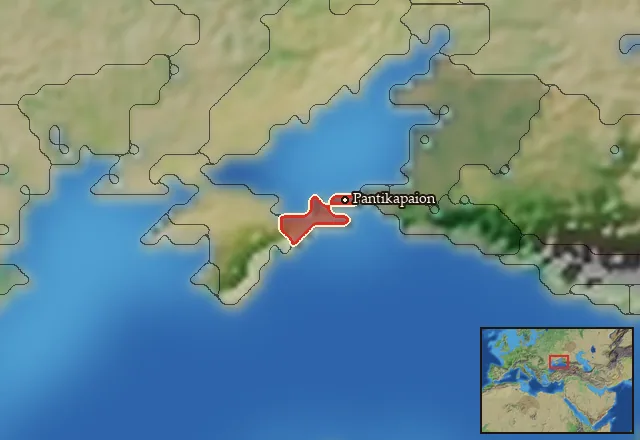
| Zone | Provinces | ||||||
|---|---|---|---|---|---|---|---|
| Scytho-bosporan | 1 |