
Thessalian Cavalry
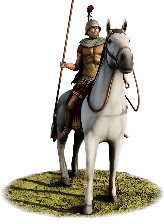
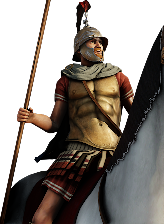
Class: heavy · Category: cavalry · Men per unit: 30
Description
The Thessalian Cavalry were one of the most important parts of the army of Alexander the Great. After his death, Thessaly remained under Macedonian control, and its horsemen are still available to the Antigonid kings. Armed with xyston lances and kopis swords for melee, and protected by bronze cuirasses as well as shining helmets, they are a true elite force. The Thessalian Cavalry were usually deployed on the left wing of the royal army, while the Hetairoi took the position on the right.
Historical background
The horses of the plains of Thessaly were long considered the best horses in all of Greece. While most poleis in the South or around the Aegean had very little cavalry forces, if any at all, before the fourth century BC, the Thessalian nobility would rarely fight on foot and was already renowned for their skill as horsemen (e.g., Hdt. 5.63). After the Peloponnesian War, with most of the city states weakened, the aristocrats of Pherai, one of the oldest cities in Thessaly, realised the advantages of their own land. The fertile valleys could sustain a relatively large population as well as a strong, permanent cavalry force, and the lack of polis traditions meant that the way to centralisation was open. Theirs was a country of wealthy landowners ruling over serfs, the Penestai, who would fight as skirmishers, but not as Hoplites (Tarn, Hellenistic Military Developments (2010), p. 56). Starting with Jason in the 370s BC and reaching its culmination under Alexander of Pherai (369-356 BC), tyrants from Pherai formed Thessaly into one of Greece’s most powerful states, at least for a while (cf. Xen. Hell. 6.4.27 seq.).
When the Thessalians were eventually overcome by Philip II of Macedon (Diod. 16.37.3), their formidable horsemen were integrated into the Argead army. Alexander took 1,800 of them on his Asian campaign (Strootman, Alexander's Thessalian Cavalry, 2011). Armed with a long xyston and riding excellent horses, the Thessalians were the perfect strike force. Alexander, however, usually deployed them in a more defensive role on the left wing, as his own Hetairoi would charge the enemy from the right wing (Strootman, 2011). With helmets, breastplates, a kopis sword and two six-foot long javelins, the Thessalians were able to defend themselves well, fighting in a diamond-like formation called the rhomboid (Ashley, Macedonian Empire (2004), p. 32). After Alexander, they seem to have permanently switched the two javelins for a xyston, the most popular cavalry weapon in the early Hellenistic age. They were protected by bronze muscle cuirasses and shining helmets.
Stats
| Rank in roster | ||
|---|---|---|
| Men per unit | 30 | █········· 8% |
| Attack | 13 | ██████···· 57% |
| Charge bonus | 32 | █████████· 94% |
| Defence | 34 | ██████···· 55% |
| · armour | 15 | ████████·· 82% |
| · defence skill | 19 | ████······ 44% |
| · shield | 0 | █········· 0% |
| Morale | 13 | ███████··· 70% |
| Discipline | Normal | |
| Training | Trained | |
| Recruitment cost | 2,600 dn | ███████··· 73% |
| Upkeep per turn | 1,047 dn | █████████· 91% |
| Turns to recruit | 4 |
Weapons
| Primary | Secondary | Primary | Secondary | Primary | Secondary | Primary | Secondary | ||||
|---|---|---|---|---|---|---|---|---|---|---|---|
| Attack | 13 | 12 | Charge bonus | 32 | 27 | Type | melee · blade | melee · blade | Damage | piercing | slashing |
Defence
| Primary | Secondary | Primary | Secondary | Primary | Secondary | Primary | Secondary | ||||
|---|---|---|---|---|---|---|---|---|---|---|---|
| Total | 34 | — | Armour | 15 | — | Defence skill | 19 | — | Shield | 0 | — |
Condition and terrain
| Hit points | 1 | Mount | heavy horse | Ground: scrub / sand / forest / snow | -5 / -1 / -8 / -1 | Charge distance | 40 |
| Formations | Square · Wedge |
Technical stats
| Time between blows (primary / secondary) | 2.5 s / 2.5 s | Extra fatigue in hot climates | 5 | Spacing between men: close / loose | 2 × 4.8 m / 3 × 7.2 m | Default ranks | 5 |
In battle: Very good stamina
Who can recruit it
A core roster unit for one faction, which can raise it anywhere it holds the right building:
Any faction holding one of the provinces below can field it.
Exactly what a settlement must have, route by route (4)
| Building | Also requires | Building | Also requires | Building | Also requires | Building | Also requires |
|---|---|---|---|---|---|---|---|
| Any settlement | Tier 3 Military Industrial Complex · Thessalian area of recruitment · Any Government (Dependency, Indirect Rule or Direct Rule) · Tier 2 Colony not built · Requires resource horses or horses supplied factionwide | Direct Rule | Tier 3 Military Industrial Complex · Tier 2 Colony · Requires resource horses or horses supplied factionwide | Homeland | Tier 2 Military Industrial Complex | Any settlement | Tier 2 Military Industrial Complex · Thessalian area of recruitment · Dependency only · Tier 1 Colony not built |
Areas of recruitment
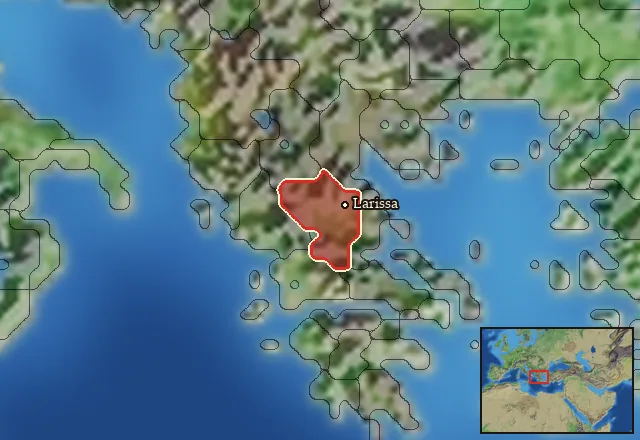
| Zone | Provinces | ||||||
|---|---|---|---|---|---|---|---|
| Thessalian | 1 |