
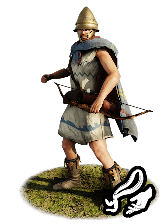
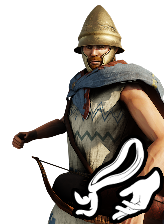
Description
The Agrianes are a Paionian tribe on the upper Strymon, to the Northwest of Macedon. They have been helping and serving the Macedonian kings ever since Philip II, and repeatedly formed a body of elite task forces together with the hypaspists and archers. Though they were almost always recruited to fulfil the role of javelinmen, the Agrianes were found among the slingers and archers in the army of Antiochos III at Raphia in 217 BC. They are armed with composite bows and the infamous Thracian sicas, protected by Pilos and Phrygian helmets, as well as painted Pelte shields. Besides this, they only wear their patterned tunics and colourful cloaks, as well as sturdy Thracian boots. They are quite skilled in archery, and though they should be protected against cavalry, they can hold their own in prolonged melee engagements with other missile and infantry units.
Historical background
The Agrianes first appear in the historical records as subjects of the mighty Odrysian king Sitalkes (second half of the 5th century BC), who at that time controlled most of Thrace. They were part of his army when he invaded Macedon in 429 BC and attacked king Perdikkas II (c. 450-413 BC; Thuc. II.96). Despite some successes for the Thracians, they eventually retreated, and Sitalkes fell in battle against the Triballi five years later (Thuc. IV.101.5). However, the Agrianes would rise to fame in the service of their previous enemies: Philip II of Macedon forged a personal bond with them and gave their warriors a special place in his army (FGH 115 Theopompos of Chios, F 145). They played a crucial role in the victorious battles of the king and, after his death, swore loyalty to his son Alexander III, who would become known as Alexander the Great. Langaros, the king of the Agrianes at the time, had already been a personal friend of Alexander when he was still a young prince and supported him in the assault on the Illyrian Autariatai, who were planning on attacking him (Arr. Anab. I.5.1-10). Langaros was rewarded with honours, and though he fell ill and died on his way home, his Agrianes followed Alexander on his campaign against Persia.
After not only repeatedly proving their worth but also excelling at the tasks and challenges they were confronted with on Alexander’s campaigns, Agrianian peltasts saw continuous service in the armies of the Diadochoi after Alexander’s death. They did not only serve the Antigonids of Macedon (Liv. 33.18.8; 14; Polyb. 2.62.2; 10.42.2; until their defeat against the Romans at Pydna in 168 BC: Liv. 42.51.5). The famous battle of Raphia between Ptolemy IV Philopator (c. 244 – 204 BC) and Antiochos III the Great (241 – 187 BC) in 217 BC saw many mercenaries, allies, Greeks, and non-Greeks from all over the territories of both forces recruited into the military to bolster the respective armies. Here, the Agrianes appear again, this time not as peltasts, but together with the Persians as slingers and archers (Pol. 5.79.6). Their equipment is not specified, though it might have been a mixture of the standard protective gear in Hellenistic armies (Pilos and Phrygian helmets), and traces of their native fashion and equipment (the famous Thracian sicas, cloaks, patterned tunics, and boots). Furthermore, they carry wicker Pelte shields with Thracian designs, not only to protect themselves during the skirmishing phase, but also to get involved in melee combat in case of emergencies, special tasks, or plugging the main line.
Stats
| Rank in roster | ||
|---|---|---|
| Men per unit | 40 | ███······· 30% |
| Attack | 11 | ███······· 34% |
| Charge bonus | 4 | ██········ 21% |
| Defence | 14 | █········· 6% |
| · armour | 3 | ██········ 21% |
| · defence skill | 11 | █········· 6% |
| · shield | 0 | █········· 0% |
| Morale | 8 | ██········ 19% |
| Discipline | Normal | |
| Training | Untrained | |
| Recruitment cost | 1,624 dn | ███······· 26% |
| Upkeep per turn | 594 dn | ████······ 39% |
| Turns to recruit | 3 |
Weapons
| Primary | Secondary | Primary | Secondary | Primary | Secondary | Primary | Secondary | ||||
|---|---|---|---|---|---|---|---|---|---|---|---|
| Attack | 11 | 4 | Charge bonus | 4 | 4 | Type | missile · archery | melee · simple | Damage | piercing | piercing |
| Projectile | arrow | — | Range | 170 | — | Ammunition | 30 | — |
Defence
| Primary | Secondary | Primary | Secondary | Primary | Secondary | Primary | Secondary | ||||
|---|---|---|---|---|---|---|---|---|---|---|---|
| Total | 14 | — | Armour | 3 | — | Defence skill | 11 | — | Shield | 0 | — |
Condition and terrain
| Hit points | 1 | Ground: scrub / sand / forest / snow | 0 / 0 / 0 / 0 | Charge distance | 30 | Formations | Square |
Technical stats
| Time between blows (primary / secondary) | 2.5 s / 2.5 s | Extra fatigue in hot climates | 0 | Collision mass per man (1.0 is normal) | 0.84 | Spacing between men: close / loose | 1.2 × 2.8 m / 2.16 × 5.04 m |
| Default ranks | 5 |
In battle: Can hide in long grass · Very good stamina
Who can recruit it
A core roster unit for one faction, which can raise it anywhere it holds the right building:
Any faction holding one of the provinces below can field it.
Exactly what a settlement must have, route by route (5)
| Building | Also requires | Building | Also requires | Building | Also requires | Building | Also requires |
|---|---|---|---|---|---|---|---|
| Any settlement | Tier 2 Military Industrial Complex · Paionian area of recruitment · Any Government (Dependency, Indirect Rule or Direct Rule) · Tier 2 Colony not built | Indirect Rule | Tier 2 Military Industrial Complex · Tier 1 Colony | Direct Rule | Tier 2 Military Industrial Complex · Tier 1 Colony | Homeland | Tier 2 Military Industrial Complex |
| Any settlement | Tier 2 Military Industrial Complex · Paionian area of recruitment · Dependency or Indirect Rule · Tier 1 Colony not built |
Areas of recruitment
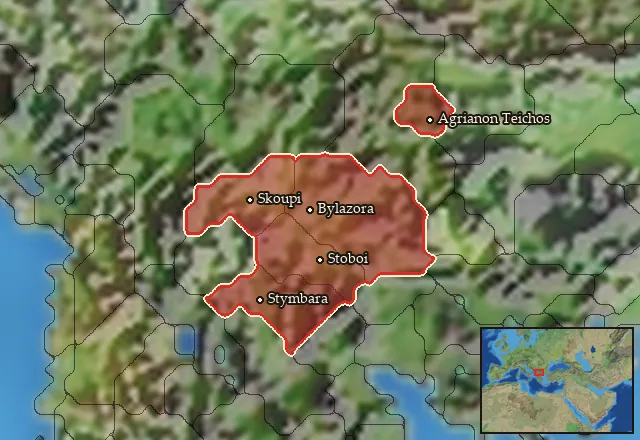
| Zone | Provinces | ||||||
|---|---|---|---|---|---|---|---|
| Paionian | 5 |