
Description
The Aitolian hoplite was a relatively rare sight on the battlefields of Classical Greece. Relying more on the skirmishing tactics of their Peltasts, the tribes of the Aitolian League did not have a need for a heavy citizen unit fighting in a pitched battle. The decentralisation of the villages around vast mountain ranges, as well as the poverty of the Aitolian people, shaped their combat style around light weapons and armour, and loose formations. Only the urbanisation of some settlements, as well as the military and political expansion of the Aitolian League during the Hellenistic Era, created the basis for the Aitolian hoplite to come into existence and – like in other poleis – become an essential part of the Aitolian armed forces.
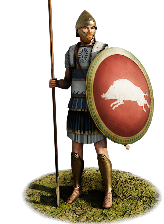
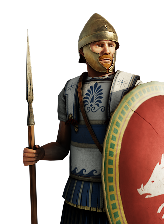
On the battlefield, the Aitolian hoplite serves the same function as the hoplites of other poleis. Operating in a close formation known as the phalanx, it will be the main part of your infantry line in most military engagements. Though these Aitolians carry the usual hoplite equipment, including the dory (a 2-3m/6-9 ft spear), the iconic round aspis (shield) decorated with different motives, a bronze Pilos helmets, a colourful linothorax, and a backup sword; their mastery of those weapons is not as good as that of other hoplites. Being used to skirmishing around the mountains, the Aitolian hoplites are incredibly brave, but lack the expertise with mass infantry clashes other Greek citizens grow up with. Thus, they may hold the ground in a battle with other hoplites, but may eventually lose one-on-one fights in a prolonged melee. Furthermore, they are easily outclassed by professional troops, picked soldiers, or numerically superior skirmishers, and should thus be supported by other unit types in any serious battle.
Historical background
In the Classical Age of Ancient Greece, Aitolia was a sparsely populated mountainous region, housing different tribes of Greeks who practiced livestock herding and piracy. The latter had not only led them to carry arms (Thuc. I, 5, 2f) but also made them very unpopular among other Greeks, who often saw them as backwards and barbaric. Their decentralised lifestyle resulted in a combat-style focused on skirmishing and harassing with javelins and stones. During the Peloponnesian War, the Messenians persuaded Demosthenes to attack the Aitolians who, due to their unprotected, scattered villages and their light armour, would supposedly have been easy to conquer (Thuc. III, 94, 3f). This plan failed, however, as the Athenians had vastly underestimated the Aitolians, whose peltasts, practicing hit-and-run tactics, evaded the heavily equipped Athenian hoplites and utterly defeated Athens at Aigition in 427 BC (Thuk. III, 98, 1-4). Though the successful use of peltasts during the Peloponnesian War led to more poleis embracing and seeing the need for light infantry in their armies, the Aitolians in turn started to adopt heavy infantry that could take on other hoplites in a direct fight.
The increasing urbanisation in some settlements of Aitolia during the Hellenistic period, as well as their growing involvement in other Greek affairs, forced the Atiolians to at least partially adopt a heavy citizen infantry of their own. One of their first mentions is as part of an alliance concluded between the Aitolian League and Akarnania, inscribed on both sides of a hollow bronze stele, found at Thermon (either dated to 271/70 BC (Grainger), or late 260s to early 250s BC (Scholten) *IG IX 12 1.3A; Syll.3 421). It describes that Akarnania, in case it is attacked, will be supported by Aitolia with one thousand infantrymen and a hundred cavalrymen (and another three thousand if additional help is required). One third of this assistance force would have to consist of Aitolian hoplites.
Aitolian hoplites were further deployed against a host of Gauls under Brennus, who invaded the Greek mainland in 280/279 BC. A great Greek coalition had assembled at Thermopylai, to stop the Gauls in their tracks, to which the Aitolians contributed 790 light troops and more than 7000 hoplites under Polyarchus, Polyphron and Lacrates, leaving only a small levy force behind in Aitolia itself (Paus. 10.20.4). When the Gauls tried to detach the Aitolians from the Greek coalition by attacking Aitolia directly and plundering Kallia, it was again a skirmisher-force made up of the home levy, men too old to serve, and women, that pursued, harassed, and drove out the Gauls (Paus. X. 23. 12-13).
Despite these events, the main association attached to "Aitolian infantry" remains one of skirmishing and hit-and-run tactics revolving around mountainous terrain. This was eluded to by the Achaian historian Polybios (IV, 11, 4) in the battle of Kaphyai in 220 BC. There, the Aitolians won a confrontation against the Achaian general Aratos of Sikyon with their light infantry and cavalry alone. Polybios asserts that their victory was in part aided by the fact that they did not fight on level ground, where the Achaians would have had the advantage. In another section, he describes the Aitolian infantry as inferior in "equipment and discipline" to what can generally be expected from Greek infantry, but their cavalry in turn being superior to other Greek cavalry (Polyb. XVIII, 22, 5). This ineffectiveness can be observed in a battle against an Illyrian relieve force during the siege of Medion, where an enemy charge routed the Aitolian hoplites, whose equipment and supplies fell into Illyrian hands (Polyb. II, 3). Nevertheless, the Aitolian League becoming an important player in Hellenistic Greece was probably in no small part achieved thanks to the establishment of a sizable hoplite force of its own.
Stats
| Rank in roster | ||
|---|---|---|
| Men per unit | 40 | ███······· 30% |
| Attack | 9 | █········· 13% |
| Charge bonus | 11 | ████······ 38% |
| Defence | 37 | ██████···· 64% |
| · armour | 10 | █████····· 54% |
| · defence skill | 22 | ██████···· 61% |
| · shield | 5 | ██████···· 57% |
| Morale | 10 | ███······· 29% |
| Discipline | Low | |
| Training | Highly trained | |
| Recruitment cost | 1,593 dn | ██········ 23% |
| Upkeep per turn | 583 dn | ████······ 36% |
| Turns to recruit | 2 |
Weapons
| Primary | Secondary | Primary | Secondary | Primary | Secondary | Primary | Secondary | ||||
|---|---|---|---|---|---|---|---|---|---|---|---|
| Attack | 9 | — | Charge bonus | 11 | — | Type | melee · blade | — | Damage | piercing | — |
| Properties | Light spear (braced against cavalry charges from the front) · +8 attack against cavalry | — |
Defence
| Primary | Secondary | Primary | Secondary | Primary | Secondary | Primary | Secondary | ||||
|---|---|---|---|---|---|---|---|---|---|---|---|
| Total | 37 | — | Armour | 10 | — | Defence skill | 22 | — | Shield | 5 | — |
Condition and terrain
| Hit points | 1 | Ground: scrub / sand / forest / snow | -1 / -1 / -4 / -1 | Charge distance | 30 | Formations | Square |
Technical stats
| Time between blows (primary / secondary) | 2.5 s / — | Extra fatigue in hot climates | 1 | Collision mass per man (1.0 is normal) | 1.12 | Spacing between men: close / loose | 1 × 1.2 m / 2 × 2.4 m |
| Default ranks | 5 |
In battle: Can sap · Very good stamina
Who can recruit it
A core roster unit for one faction, which can raise it anywhere it holds the right building:
Any faction holding one of the provinces below can field it.
Exactly what a settlement must have, route by route (4)
| Building | Also requires | Building | Also requires | Building | Also requires | Building | Also requires |
|---|---|---|---|---|---|---|---|
| Any settlement | Garrison Building or Tier 1 Military Industrial Complex · Aitolian area of recruitment · Any Government (Dependency, Indirect Rule or Direct Rule) · Tier 2 Colony not built | Indirect Rule | Garrison Building or Tier 1 Military Industrial Complex · Tier 1 Colony | Direct Rule | Garrison Building or Tier 1 Military Industrial Complex · Tier 1 Colony | Homeland | Garrison Building or Tier 1 Military Industrial Complex |
Areas of recruitment
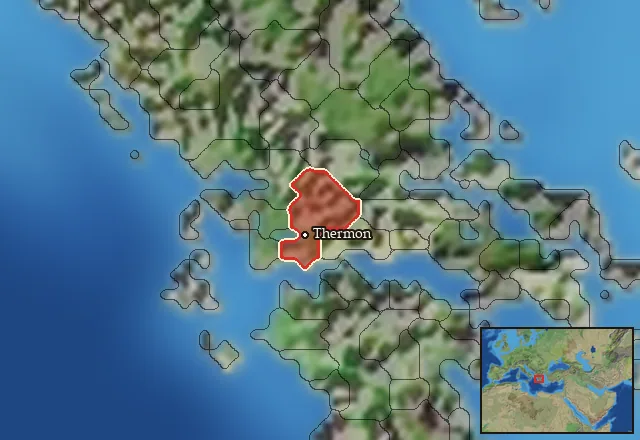
| Zone | Provinces | ||||||
|---|---|---|---|---|---|---|---|
| Aitolian | 1 |