
Bithynian Thureophoroi Cavalry
Class: light · Category: cavalry · Men per unit: 30
Reforms: Unlocked by Second wave of military innovations have arrived!, Bithynian Reforms I
Description
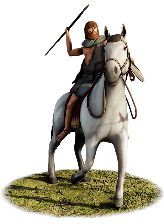
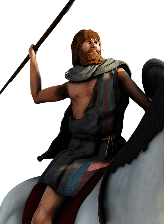
These horsemen are well protected dual purpose cavalry carrying big, oval shields. Their strength lies in skirmishing with javelins, but they can also close in on the enemy and attack with their long, trilobate Celtic swords. Phrygian, Konos, and Bithynian helmets as well as the rimless thureoi afford Bithynian Thureophoroi Cavalry protection, while cloaks mark their status as members of the hippeis class. Better trained and armed than the Hippakontistai, these horsemen represent an evolution in Bithynian cavalry warfare.
Historical background
After Nikomedes I had brought the Galatians to Asia, thureos shields soon started to appear in the Bithynian army (see the description: Bithynian Thureophoroi). Thureos wielding cavalry is first attested in the Greek speaking world by an inscription from Delos describing an Antigonid ile (squadron) in 277/276 BC (Delos, 1417, face A, col. I, ll. 24––25). Conceivably, Thureophoroi cavalry was only introduced after the respective infantry regiments had been established. Light cavalry had been a traditional strength of the Bithynians: Xenophon already emphasised the effectiveness of their javelin-throwing horsemen in battles against the unfortunate Greeks who had crossed their paths in the early 4th century BC (Xen. Hell. 3.2.3). He himself with his guard was once ambushed by a Bithynian force including skirmisher cavalry (Xen. Anab. 6.4.26), and later faced them in another battle (Anab. 6.5.25-6.5.30). Once shields were adopted in the 3rd century BC, they would have become an even more dangerous foe!
It is difficult to say when the first Thureophoroi cavalry squadrons would have been raised in Bithynia. Both footmen and horsemen with these oval shields are mainly attested on 2nd century BC grave stelae such as the Stele of Diliporis (Post, Bithynian Army (2022), p. 8). However, as both are attested much earlier elsewhere and the Galatians were Nikomedes’ allies, it is likely that they had already appeared in his lifetime. Assuming the infantry was trained first, the Thureophoroi cavalry can only have become part of the royal army in the later years of Nikomedes’ reign, which were marred by conflict. This was despite his neutrality in the early 250s BC during the so-called Tomian War.
The cities of the Pontic Pentapolis, led by Kallatis, had founded Tomis as an emporion that was supposed to monopolise Black Sea trade (Memn. 13.1). This, however, was also the goal of Byzantion, which activated the Northern League to attack the Pentapolis. Herakleia Pontike agreed to support the Byzantines, even though Kallatis was its own colony! (Russell, Byzantium and the Bosporus (2017), pp. 109-110). Sadalas, king of the Thracian Asti (IGB I, no. 307), also declared for Byzantion (IGB I² 388), while Istros supported the Pentapolis (Buzoianu/Stefan, Callatis in the 4th-3rd c. BC. (2021), p. 32). The Seleucids then got involved on the pro-Pentapolis side, while the Ptolemies sent reinforcements to the Northern League cities (Buzoianu/Stefan (2021), pp. 32-33). No info exists on the exact course of the war, but it is clear that the Byzantine navy eventually destroyed the enemy fleet. Kallatis might have been sacked, while the Herakleiote ships defended Byzantion itself against a Seleucid squadron (Memn. 13 & 15).
Nikomedes’ military did not fight in the Tomian War, but Byzantion’s victory meant that the Bosporan and Black Sea trade routes remained in its hands. A continued alliance was no doubt beneficial for Bithynia’s economy. Perhaps it was at this time that the Thureophoroi cavalry was introduced, in preparation for future conflict or as to support the allies in the Northern League when necessary. However, the main conflict originated in his own family: at the time when he followed his father to the throne (280 BC), Nikomedes had been married to a Phrygian noblewoman called Ditizele, who had borne him a son, Ziaelas, probably in the 280s. Another son, Prusias, and a daughter, Lysandra, followed (Glew, Nicomedes' Name (2005), p. 131). Later, when Nikomedes had become king, he fell out with his wife for playing jokes on him, and had her severely bitten by his fighting dog (Plin. nat. hist. 8.61.1). She eventually died of her wounds and was buried in Nikomedia in grand fashion (Arrian, Bithyniaka, FrGrHist 156 F29). Soon after, Nikomedes married a Thracian woman called Etazeta, making her his new queen. By the early 250s, Nikomedes and Etazeta had several children of their own, among them a son named Zipoites after his grandfather (Memn. 14.1). Around the time, just after the conclusion of the Tomian War, Nikomedes became increasingly ill and felt compelled to finalise his last will. Ziaelas, who had been heir apparent for more than two decades, was now replaced by Zipoites – perhaps the result of Etazeta’s scheming (Memn. 14.1). Angered and scared, Ziaelas left the kingdom and found asylum in Armenia.
Etazeta was probably disappointed that her stepson had escaped alive and convinced Nikomedes that measures had to be taken to protect their children, for the king was close to death and Zipoites and his siblings were still too young to reign independently (Memn. 14.1). Nikomedes therefore made the extraordinary decision to appoint Ptolemaios II, Antigonos Gonatas, and his allies Herakleia Pontike, Kios, and Byzantion as guardians of his minor children (Scholten, Building Hellenistic Bithynia (2019), p. 21; Memn. 14.1). Only a few weeks later, he died after a reign of about 25 years. Etazeta married Nikomedes’ surviving brother, also called Zipoites, with the approval of the people of Nikomedia (Memn. 14.2). As soon as he heard the news, Ziaelas collected a force of mercenaries and probably Armenians and marched towards the Galatians, the old allies of his father. One of the three tribes, the Tolistobogians, committed to his cause, and helped him to invade Bithynia (Memn. 14.2). The historian Memnon of Herakleia states that Etazeta and the Bithynians were able to raise an army from the guardians, but it is unclear who participated in what fashion. As Memnon was mainly interested in the deeds of his fellow citizens, he only names the Herakleiotes by name and praises their heroic bravery in the battle against Ziaelas' forces (Memn. 14.2). His claim that the Tolistobogians accordingly interpreted Herakleia Pontike as their enemy and started a counter offensive, ravaging the chora (territory) of the polis, suggests that the Herakleiotes must indeed have been heavily involved. Finally, Memnon claims that their participation in the War of the Bithynian Succession led to a favourable truce between the opposing parties. As Ziaelas is known to have ruled as king at least by 250 BC (Schottky, s.v. Ziaelas, in: DNP online), this can only mean that Etazeta and her children were spared (cf. Polyb. 4.50.1 for the young Zipoites) and Herakleia received some sort of compensation. The Thureophoroi Cavalry would have fought on the side of Etazeta, but would subsequently have been integrated into Ziaelas’ army.
In the early 2nd century BC, a rich man from Nikaia, Diliporis, had a gigantic grave stele erected for his whole family (Corsten, The Role and Status of the Indigenous Population in Bithynia (2006), p. 86). On it, Diliporis himself is portrayed as a rider, with various other weapons and soldiers spread around the illustration. Diliporis clearly wields a spear, wears a helmet and cloak, and is protected by a thureos shield (Post (2022), p. 8). His helmet has a peak with a decorated visor and has been termed the Bithynian helmet by Post and in RIS, as it is not known from any other area (the widespread Phrygian and Konos helmets have been used in this unit to add variety). Javelins have been added, since Thureophoroi cavalry elsewhere used them, while the sword stems from another monument: Ziraneilas, son of Pheilozeios, has a Celtic style trilobate sword hanging from his belt on Stele C from Kutluc in what used to be Bithynia. While Ziraneilas does not wear a thureos, his features are celticised despite the Bithynian name, and Celts were associated with thureos cavalry, so it seems to add up (Cf. Sekunda, The Introduction of Cavalry Thureophoroi into Greek Warfare (2006)).
Stats
| Rank in roster | ||
|---|---|---|
| Men per unit | 30 | █········· 8% |
| Attack | 15 | ███████··· 72% |
| Charge bonus | 21 | ████████·· 76% |
| Defence | 20 | ██········ 19% |
| · armour | 1 | █········· 0% |
| · defence skill | 14 | ██········ 18% |
| · shield | 5 | ██████···· 57% |
| Morale | 10 | ███······· 29% |
| Discipline | Normal | |
| Training | Untrained | |
| Recruitment cost | 1,638 dn | ███······· 27% |
| Upkeep per turn | 659 dn | ██████···· 56% |
| Turns to recruit | 2 |
Weapons
| Primary | Secondary | Primary | Secondary | Primary | Secondary | Primary | Secondary | ||||
|---|---|---|---|---|---|---|---|---|---|---|---|
| Attack | 15 | 10 | Charge bonus | 21 | 26 | Type | thrown · blade | melee · blade | Damage | piercing | piercing |
| Projectile | javelin | — | Range | 50 | — | Ammunition | 2 | — | Properties | Used just before charging into combat | — |
Defence
| Primary | Secondary | Primary | Secondary | Primary | Secondary | Primary | Secondary | ||||
|---|---|---|---|---|---|---|---|---|---|---|---|
| Total | 20 | — | Armour | 1 | — | Defence skill | 14 | — | Shield | 5 | — |
Condition and terrain
| Hit points | 1 | Mount | light horse | Ground: scrub / sand / forest / snow | 0 / 0 / -4 / 0 | Charge distance | 40 |
| Formations | Square |
Technical stats
| Time between blows (primary / secondary) | 2.5 s / 2.5 s | Extra fatigue in hot climates | 0 | Spacing between men: close / loose | 2 × 4.8 m / 3 × 7.2 m | Default ranks | 5 |
In battle: Very good stamina
Who can recruit it
A core roster unit for one faction, which can raise it anywhere it holds the right building:
Any faction holding one of the provinces below can field it.
Exactly what a settlement must have, route by route (4)
| Building | Also requires | Building | Also requires | Building | Also requires | Building | Also requires |
|---|---|---|---|---|---|---|---|
| Any settlement | Garrison Building or Tier 1 Military Industrial Complex · Second wave of military innovations have arrived! · Bithynian area of recruitment · Any Government (Dependency, Indirect Rule or Direct Rule) · Tier 2 Colony not built | Indirect Rule | Garrison Building or Tier 1 Military Industrial Complex · Bithynian Reforms I · Tier 1 Colony | Direct Rule | Garrison Building or Tier 1 Military Industrial Complex · Bithynian Reforms I · Tier 1 Colony | Homeland | Garrison Building or Tier 1 Military Industrial Complex · Bithynian Reforms I |
Areas of recruitment
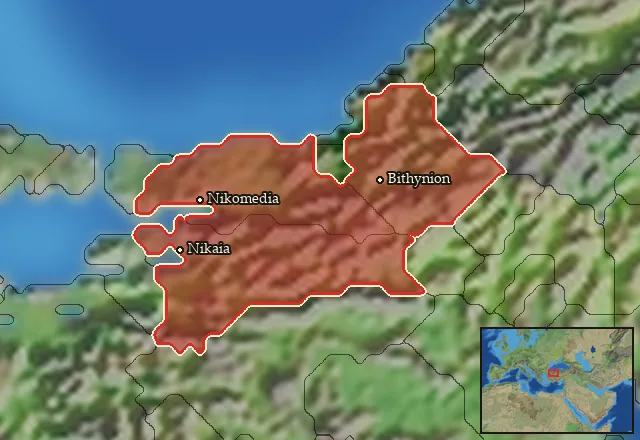
| Zone | Provinces | ||||||
|---|---|---|---|---|---|---|---|
| Bithynian | 3 |