
Description
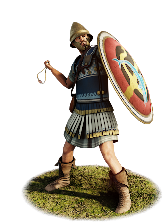
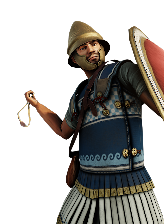
Byzantine Epibatai are the marines of Byzantion. Their mastery of the art of the sling can be devastating to your opponents. When in close combat, these Epibatai switch to large knives, called kopis. For protection, they trust on their large wooden aspides shields covered with bronze. This weaponry makes them durable both as skirmishers and as supporting infantry. To protect their bodies, they wear bronze helmets. Some of the men wear pilos and Chalcidan helmets, others prefer the Phrygian type. Hailing from a wealthy region, Byzantine Epibatai can also afford linothorax armour. While it is dangerous to wear armour at sea, on land it can certainly save the life of a skirmisher. Epibatai should open the battle by hurling objects at opposing skirmishers and archers. Thanks to their large shields, they can run inside the range of unarmoured archers and take them out in a prolonged skirmish.
Historical background
Byzantion was colonised by Doric Greeks from Megara in the first half of the 7th century BC. Polybius clearly notes its strategic location:
"The site of Byzantion is as regards the sea more favourable to security and prosperity than that of any other city in the world known to us, but as regards the land it is most disadvantageous in both respects. For, as concerning the sea, it completely blocks the mouth of the Pontus in such a manner that no one can sail in or out without the consent of the Byzantines." – (Polyb. IV.38.1-2)
Freedom of navigation was not a thing in the Hellenistic era, and in periods of hardship the Byzantines could resort to extracted fees for passage. In order to enforce such fees, they needed marines who could escort unwilling ships into the Golden Horn, the harbour of Byzantion. These Epibatai, thus, greatly contributed to the prosperity of the Byzantines.
Having strategic control of the trade between the Black Sea and the Aegean, Byzantion needed good soldier-sailors to hold off prying eyes. During the Hellenistic period, Thracians and Tylians threatened it from the land side, and as a crossing point between Macedonia and Asia Minor many Diadochi armies passed through the area. It was however in the interest of many Greek city states that the important trade between the Black Sea and the rest of the Greek world remained in neutral Greek hands. Therefore, Byzantion could count on its allies as long as trade remained untaxed (Russell, Common Benefactors of All (2016)). This is illustrated by a list of conflicts during the Hellenistic period.
Two years after the death of Alexander, one of his generals, Arrhidaios, was awarded control of Hellespontine Phrygia, a large area on the eastern side of the Propontis, today known as the Sea of Marmara. On this lucrative coastline, Arrhidaios did not control the strategic city of Kyzikos. So in the late winter of 319 BC, he set out with an army of 12,000 men to lay siege to that city. The people of Kyzikos were taken by surprise, but managed to drag out the negotiations long enough to receive help from Byzantion in the form of soldiers, more ships, and missiles (Diodorus Siculus, Library of History, XVIII, 48). They then went on the offensive, probably making use of their naval supremacy, and forced Arrhidaios to lift the siege and withdraw. Hence, those rather small cities could together make a fist against larger threats. Especially combining smaller fleets into one large force was a great asset in this part of the world. During this war, Cyzicus and Byzantion received political backing of Antigonos I Monophthalmus, who thus became invested in the wider area. Arrhidaios fled to Kios and was besieged, while Antigonos took Lydia from Kleitos the White.
In 317 BC, Antigonos continued his march westwards. When Kleitos the White tried to halt him at the Hellespont, the Battle of Byzantion ensued. In the first stage of the battle, when Byzantion remained neutral, Kleitos held back Antigonos’ fleet for a while. But Antigonos gathered reinforcements that night:
"Byzantion, which was then in alliance with Antigonos Monophtalmos, was situated nearby; from there he summoned light-armed troops (psiloi), and peltasts (peltastai), and archers (toxotai), a thousand of each. He posted them on the shore, in order to support the fleet, by annoying the enemy with javelins and arrows. This was all achieved in a single night. At day break, a shower of javelins and arrows was poured upon the enemy. While they were just arising, and scarcely awake, they were seriously injured, before they realised where the attack was coming from. Some cut their cables, and others weighed their anchors; while nothing prevailed but noise and confusion. Antigonos at the same time ordered the sixty ships to bear down upon them. Under attack both from the sea, and from land, the conquerors were obliged to yield their victory to the conquered." – (Polyaen IV.6.8).
A splendid victory for Byzantion and its allies! Satrap Lysimachos killed Kleitos the White and retained control of Thrace, while Antigonos could not march on Macedon because he had to shift his attention to troubles in the east.
When Antigonos returned in 313 BC to campaign against Lysimachos, Byzantion voted ‘to remain in tranquillity and to guard the peace and friendship they possessed toward both sides’ (Russell (2016), p. 94). Later, Byzantion, despite being surrounded by Lysimachos’ territory, did not accept any garrisons of him and was spared the worst of the later Diadochi wars. In the latter stages of his reign, Lysimachos, however, greatly angered the Greeks. After the death of this king during the Battle of Koroupedion (281 BC) the area fell into a power vacuum and the Northern League was founded (Paganoni, Forging the Crown (2019), p. 48). This was an alliance by Byzantion, Herakleia Pontike, Pontos, and Chalkedon. From time to time Kios, Tios, Kieros, Sinope, and even Bithynia were included. The Ptolemaic Kingdom gave them the necessary political backing. Ptolemy II went further, and around 275 BC he let Byzantion acquire multiple places in the Asiatic part of the Propontis (Russell (2016), pp. 105, 114-115). Byzantion was becoming a major local player and when in the 250s BC the Pontic Pentapolis had tried to establish Tomis as a rival to Byzantion, the Tomian War broke out (Russell (2016), pp. 109-110; Memn. XIII.1). Byzantion activated the Northern League. Herakleia Pontike agreed to support the Byzantines, even though Kallatis (part of the Pontic Pentapolis) was its own colony (Russell, Byzantium and the Bosporus (2017), pp. 109-110). Sadalas, king of the Thracian Asti (IGB I, no. 307), also declared for Byzantion (IGB I, no. 388), while Istros supported the Pentapolis (Buzoianu/Stefan, Callatis in the 4th-3rd c. BC. (2021), p. 32). The Seleucids then got involved on the pro-Pentapolis side, while the Ptolemies sent reinforcements to the Northern League cities (Buzoianu/Stefan (2021), pp. 32-33). No information exists on the exact course of the war, but it is clear that the Byzantine navy eventually destroyed the enemy fleet. Kallatis was perhaps sacked, while the Herakleiote ships defended Byzantion itself against a Seleucid squadron (Memn. XIII & XV).
The necessity for allies was again shown by the subsequent Celtic invasions. Byzantion, close to the Thracians, was in a particularly difficult situation (Polyb. IV.45,9). When the Gauls entered the area, Byzantion resorted to paying off the threat, up to the huge sum of 80 talents of gold. The possibility to extract income from passing ships came in handy, as the Greeks of Byzantion needed gold to pay off the Gauls of Tyle (Polyb. IV.46.3-5).
Between the 270s and 220s BC, Byzantium and Chalkedon had developed a sophisticated monetary system in response to economic pressures and tribute demands. The Byzantine mint issued local silver coinage on a reduced weight standard. Only locally minted coins or countermarked foreign coins (that contained more silver) could be used in transactions – essentially creating a closed-currency zone for the Bosporus. This dual system, backed by the Ptolemies of Egypt, allowed the cities to monetize the Bosporus through indirect taxation of up to 25%. See it as an expensive money exchange that is run by the state. Ptolemaic support - likely motivated by strategic trade interests - was vital, but ended by the 240s BC, leading to the system's collapse and later conflict (Russell (2016), pp. 117-132). Up to that point, Egyptian traders did not have to pay the tax, as Ptolemaic coins contained the same amount of silver. Byzantion, thus, sent out diplomats to other Greek states to receive funding, but without success. Only Herekleia Pontika donated gold (Russell, (2016), p. 95).
When the Byzantines, around 220 BC, resorted to levying a tax of 10% of the goods carried into the Black Sea, this caused a war with Rhodos. Rhodos, “who were considered the supreme authority in maritime matters”, suffered under this tax and asked for its abolition (Polyb. IV.47). When the Byzantines did not act on this request, Rhodos asked Prusias I of Bithynia to attack the city. He agreed to try and submit Byzantion by land, while Rhodos would take care of the sea. The Byzantines tried to receive help from Attalos of Pergamon and the Seleucid general and usurper Achaios. Byzantion seemingly did not dare to engage the Rhodians or Bithynians, instead relying on its fortresses around the Bosporus. Polybios (IV.52.7) writes that missiles were stored in these fortresses, supporting the use of ranged weapons. Prusias I made slow headway, taking some Byzantine fortresses on the Asian side of the Bosporus and Propontis. He also hired Thracians to besiege them on the European side. Political manoeuvring by the Rhodians and Ptolemy also prevented Achaios from intervening in the war (Polyb. IV.51). When things became grim for Byzantion, Cavarus, the Gallic king of Tyre who was the source of the problem, negotiated a peace deal between Bithynia and Byzantion. Not much later, Rhodos and Byzantion did the same. The peace treaty established that henceforth, no taxes on passing ships were allowed. There is also no evidence for a return to the monetary system, and it seems that Byzantion was somewhat weakened after this war. But the navy continued to function and helped, for example, the Rhodian and Pergamese navies, although outnumbered, to defeat the Macedonian navy at the Battle of Chios in 201 BC (Polyb. XVI.2). Diplomatically, the interests of Byzantion (similarly to Rhodos and Pergamon) would intertwine with those of the Romans.
The Byzantine Epibatai wear armour on land. Probably not at sea, as a linothorax a would be their undoing if they would fall into the sea (Ioannidou, Hellenic Marine Forces in Late Bronze Age Greece (2018), p. 10; Herzogenrat-Amelung, Naval Hoplites (2017), p. 47). The armour would start to suck in water and become increasingly heavy. Being a wealthy region, it is likely that linothorax armour was available to the Byzantines to a degree that even Epibatai would wear it. In addition, they wear bronze Phrygian, pilos, and Chalcidian helmets and large aspis shields. The Chalcidian helmet was known for its great visibility, while the Phrygian helmet was generally popular in the region (Obert, ‘A Brief History of Greek Helmets’, in: AncientPlanet Online Journal Vol. 2 (2012), pp. 48-50). The aspis shields were held by an armband (porpax) right before the left elbow, while the hand gripped a leather handle (antilabe). This enabled the Epibatai to support the weight (on average weighting 6.2 kg or 13.7 pounds) on both the elbow and the wrist. This mechanism also made it possible to use shield and sling at the same time. The shield was not very thick, not making it very effective against arrows and javelins (Fink, The Battle of Marathon in Scholarship (2014), pp. 31-34). Therefore, some skirmishers would prefer a smaller shield. Epibatai, however, are expected to fight in melee as light infantry, and prefer the aspis. The shields were likely painted with symbols of Poseidon, as attested on coinage.
Greek slingers used a long sling, and in war the ammunition was ideally lead shot, weighing around 0.7-1.05 ounces (20-30 grammes) but occasionally up to 1.9 ounces (55 grammes). Sling-missiles would usually be carried in the fold of the cloak, behind the shield or in special pouches. Bullets were often inscribed with the name of the commander (Echols, ‘The Ancient Slinger’ (1950), pp. 227-228). Such leaden bullets were shaped like an almond, tapering to a dull point at the end, which gave the bullet a whirling motion that increased its penetrating power. As melee weapons, they are provided with kopis swords to hack at the enemy at close quarters, the usual way of fighting on board of a triere.
Stats
| Rank in roster | ||
|---|---|---|
| Men per unit | 40 | ███······· 30% |
| Attack | 7 | █········· 6% |
| Charge bonus | 10 | ████······ 35% |
| Defence | 36 | ██████···· 61% |
| · armour | 10 | █████····· 54% |
| · defence skill | 21 | █████····· 54% |
| · shield | 5 | ██████···· 57% |
| Morale | 11 | ████······ 39% |
| Discipline | Normal | |
| Training | Trained | |
| Recruitment cost | 1,999 dn | █████····· 50% |
| Upkeep per turn | 732 dn | ███████··· 70% |
| Turns to recruit | 3 |
Weapons
Its secondary attack is the stronger one: 10 against 7.
| Primary | Secondary | Primary | Secondary | Primary | Secondary | Primary | Secondary | ||||
|---|---|---|---|---|---|---|---|---|---|---|---|
| Attack | 7 | 10 | Charge bonus | 10 | 12 | Type | missile · archery | melee · blade | Damage | blunt | piercing |
| Projectile | stone | — | Range | 150 | — | Ammunition | 27 | — |
Defence
| Primary | Secondary | Primary | Secondary | Primary | Secondary | Primary | Secondary | ||||
|---|---|---|---|---|---|---|---|---|---|---|---|
| Total | 36 | — | Armour | 10 | — | Defence skill | 21 | — | Shield | 5 | — |
Condition and terrain
| Hit points | 1 | Ground: scrub / sand / forest / snow | 0 / -1 / 0 / -1 | Charge distance | 30 | Formations | Square |
Technical stats
| Time between blows (primary / secondary) | 2.5 s / 2.5 s | Extra fatigue in hot climates | 1 | Collision mass per man (1.0 is normal) | 1.11 | Spacing between men: close / loose | 1.2 × 1.4 m / 2.4 × 2.8 m |
| Default ranks | 5 |
In battle: Can sap · Very good stamina
Who can recruit it
A core roster unit for one faction, which can raise it anywhere it holds the right building:
Any faction holding one of the provinces below can field it.
Exactly what a settlement must have, route by route (5)
| Building | Also requires | Building | Also requires | Building | Also requires | Building | Also requires |
|---|---|---|---|---|---|---|---|
| Any settlement | Trade Port · Garrison Building or Tier 1 Military Industrial Complex · Byzantine area of recruitment · Any Government (Dependency, Indirect Rule or Direct Rule) · Tier 2 Colony not built | Indirect Rule | Trade Port · Garrison Building or Tier 1 Military Industrial Complex · Tier 1 Colony | Direct Rule | Trade Port · Garrison Building or Tier 1 Military Industrial Complex · Tier 1 Colony | Homeland | Trade Port · Garrison Building or Tier 1 Military Industrial Complex |
| Any settlement | Trade Port · Garrison Building or Tier 1 Military Industrial Complex · Byzantine area of recruitment · Dependency or Indirect Rule · Tier 1 Colony not built |
Areas of recruitment
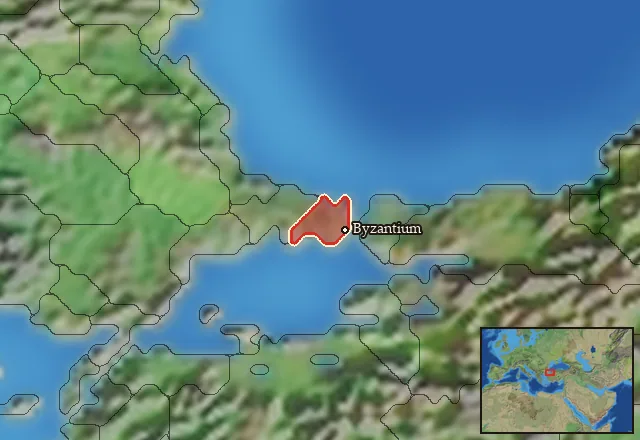
| Zone | Provinces | ||||||
|---|---|---|---|---|---|---|---|
| Byzantine | 1 |