
Description
"By the will of Ahuramazda, these skills were set upon me. [...] As a fighter of battles, I am a good fighter. As a bowman, I am a good bowman, both on foot and on horseback."
– Parts of an Achaemenid Royal Inscription (DNb)
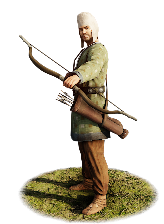
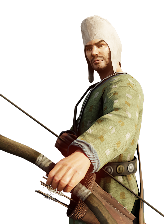
Cappadocian Archers are the most important missile troops in Cappadocia, and can counter the horse archers of their neighbours quite effectively. While composite bows and archery were already present in Asia Minor and Cappadocia before the arrival of the Persians, the latter’s view of archery as a sacred martial art and the consequent persianisation of Cappadocia strongly established archery in the region. These men wear high Phrygian caps, a headpiece prominently depicted on the coinage of Ariarathes I of Cappadocia, paired with regional tunics and practical, patterned trousers. As for weapons, they carry powerful recurved composite bows capable of piercing armour at range, alongside a sidearm dagger for close hand-to-hand defence. These archers lack heavy armour, however, their speed and ability to unleash volleys at a safe distance from their enemies turn them into a deadly threat for anyone wishing to cross Cappadocia's high plateaus, rocky ravines, or mountain passes.
Historical background
Archery was extremely important for the Achaemenid Empire, being mentioned by Darius the Great as one of his greatest skills in his Naqsh-e Rustam inscriptions. This was likely the same during and after the rule of Ariarathes I of Cappadocia, the last Achaemenid Persian governor (satrap) of the province (satrapy) of Northern Cappadocia, who served from the 340s BC to 331 BC, and became the founder of the Ariarathid dynasty, future rulers of the Kingdom of Cappadocia. (His son, Ariaramnes, later achieved independence from the Seleucid Empire and was awarded the title of "king" by Antiochus II Theos). Thus, when the Achaemenid Empire fell to Alexander the Great, and satrap Ariarathes I was later defeated and executed by the Macedonian regent Perdikkas in 322 BC, the Iranian cultural and military traditions of Cappadocia did not vanish. Instead, the surviving Ariarathid dynasty managed to re-establish control of the region. They preserved their Iranian traditions well into the Hellenistic period, such as the religious rites, court customs, and archery (Weiskopf, "CAPPADOCIA", in: Encyclopaedia Iranica IV [1990]).
Unlike the coastal regions of Asia Minor, where Greek conquerors built great poleis, Hellenistic colonisation in the Cappadocian interior took the form of fortified rural villages (kōmai), established under Eumenes of Kardia and subsequent Seleucid monarchs (Cohen, The Hellenistic Settlements in Europe, the Islands, and Asia Minor (1995), pp. 43-44). These settlements integrated Greek veterans with the native Anatolian and Iranian populations, creating a deeply militarised rural peasantry. Indeed, Weiskopf (1990) states that “Cappadocia was not urbanized in the manner of west Anatolia or Seleukis province; rather, increased settlement associated with estates, forts, or roads gave villages the “appearance” of a city.” (cf. Strab. 12.537 on Cadena). By western standards, there were only two proper cities, Mazaca and Tyana, both renamed Eusebeia as a mark of royal embellishment (meaning "piety" or "loyalty” and dedicated in honour of the Hellenistic king Ariarathes V Eusebes). From these dispersed highland communities, the Cappadocian rulers were able to recruit thousands of archers and light footmen to defend their borders against neighbouring powers.
Throughout the 3rd and 2nd centuries BC, Cappadocian bowmen saw widespread usage across the Near East. Under Kings Ariarathes III and Ariarathes IV, Cappadocian levies fought as regional allies of the Seleucid Empire, most notably 2,000 Cappadocians were present in the army of Antiochus III at the Battle of Magnesia (190 BC). As Livy (37.40.10) relates: "On the left of the phalanx were 1,500 Gallograeci infantry and 2,000 Cappadocians, similarly armed and sent by Ariarathes, next to whom were posted a miscellaneous force numbering 2,700". Later, as the kingdom became a battleground between the Pontic King Mithridates and the Romans in the 1st century BC, local archers remained essential for defending regional strongholds. As Weiskopf (1990) notes, “the landscape was protected in Achaemenid fashion by cavalry and forts (for the former see Plutarch, Eumenes, 4.2, 6.4, 12.3; Livy, 37.40; Caesar, Civil War 3.43; Appian, Civil War 2.49; Cicero, Epistula ad familiares 15.4.6). The forts formed part of estates (at Mazaca, Strabo, 12.539) or were scattered about the kingdom (Tomisa on the Euphrates, ibid., 12.535; mountain strongholds, ibid., 12.537, cf. 12.540; the nature of the officers in charge is uncertain)”.
Stats
| Rank in roster | ||
|---|---|---|
| Men per unit | 40 | ███······· 30% |
| Attack | 8 | █········· 9% |
| Charge bonus | 0 | █········· 0% |
| Defence | 9 | █········· 1% |
| · armour | 1 | █········· 0% |
| · defence skill | 8 | █········· 2% |
| · shield | 0 | █········· 0% |
| Morale | 4 | █········· 0% |
| Discipline | Low | |
| Training | Untrained | |
| Recruitment cost | 1,143 dn | █········· 6% |
| Upkeep per turn | 418 dn | ██········ 15% |
| Turns to recruit | 2 |
Weapons
| Primary | Secondary | Primary | Secondary | Primary | Secondary | Primary | Secondary | ||||
|---|---|---|---|---|---|---|---|---|---|---|---|
| Attack | 8 | 2 | Charge bonus | 0 | 0 | Type | missile · archery | melee · simple | Damage | piercing | piercing |
| Projectile | arrow | — | Range | 170 | — | Ammunition | 25 | — |
Defence
| Primary | Secondary | Primary | Secondary | Primary | Secondary | Primary | Secondary | ||||
|---|---|---|---|---|---|---|---|---|---|---|---|
| Total | 9 | — | Armour | 1 | — | Defence skill | 8 | — | Shield | 0 | — |
Condition and terrain
| Hit points | 1 | Ground: scrub / sand / forest / snow | 0 / 0 / 0 / 0 | Charge distance | 30 | Formations | Square |
Technical stats
| Time between blows (primary / secondary) | 2.5 s / 2.5 s | Extra fatigue in hot climates | 0 | Collision mass per man (1.0 is normal) | 0.83 | Spacing between men: close / loose | 1.2 × 2.8 m / 2.16 × 5.04 m |
| Default ranks | 5 |
In battle: Very good stamina
Who can recruit it
A core roster unit for one faction, which can raise it anywhere it holds the right building:
Any faction holding one of the provinces below can field it.
Exactly what a settlement must have, route by route (7)
| Building | Also requires | Building | Also requires | Building | Also requires | Building | Also requires |
|---|---|---|---|---|---|---|---|
| Any settlement | Garrison Building or Tier 1 Military Industrial Complex · Cappadocian area of recruitment · Any Government (Dependency, Indirect Rule or Direct Rule) · Tier 2 Colony not built | Indirect Rule | Garrison Building or Tier 1 Military Industrial Complex · Tier 1 Colony | Indirect Rule | Garrison Building or Tier 1 Military Industrial Complex · not Greek area of recruitment · Tier 1 Colony | Direct Rule | Garrison Building or Tier 1 Military Industrial Complex · Tier 1 Colony |
| Direct Rule | Garrison Building or Tier 1 Military Industrial Complex · not Greek area of recruitment · Tier 1 Colony | Homeland | Garrison Building or Tier 1 Military Industrial Complex | Homeland | Garrison Building or Tier 1 Military Industrial Complex · not Greek area of recruitment |
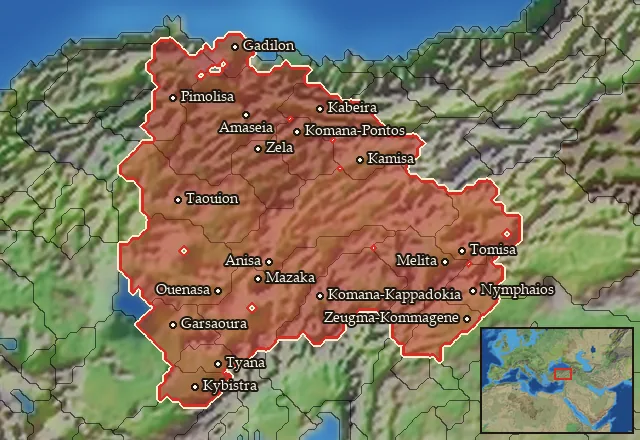
Areas of recruitment
| Zone | Provinces | ||||||
|---|---|---|---|---|---|---|---|
| Cappadocian | 19 |