
Cappadocian Thureophoroi
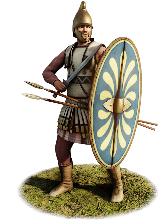
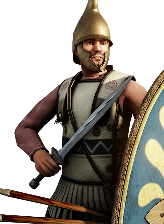
Class: light · Category: infantry · Men per unit: 40
Reforms: Unlocked by Military innovations have arrived!, Adoption of the Thureos
Description
With their strong shields and sharp swords, the Cappadocian Thureophoroi are here to stay. While not being the most experienced soldiers, they are equipped in the Galatian style, using a mix of Celtic and Phrygian helmets, as well as fashionable trousers that make every Greek in the area look away. Most of these men even wear a linothorax to keep them alive a bit longer! Should war come to Cappadocia, they can be used as flexible infantry, good for skirmishes and ambushes, capable of using the region's rugged terrain to their advantage. If needed, they can also form a tighter formation and serve in the main battle line. Their principal weapon is the javelin, and these men head into battle carrying a bundle of these, but they also expect to draw their swords for the reminder of the fight. These Cappadocian Thureophoroi carry the oval thureos, modelled after the standard Celtic shield, which they encountered during the Galatian invasion of Greece and Asia Minor in 280-275 BC.
Historical background
At the centre of the scholarly debate on Thureophoroi has always been the question if they evolved from Peltasts or Hoplites. While authors like Gabriele Esposito (Armies (2019), repeated mentions), Duncan Head (Armies (1982), p. 113), or Simon Elliot (Greeks at War (2021), p. 21) interpret them as light skirmishers who used their pace and agility to their advantage, others like Richard Taylor (Hoplite Phalanx (2021), p. 472) Edward Anson (Land Warfare (2021), p. 51), or Myke Cole (The Bronze Lie (2021), p. 351) assume that they replaced the traditional Hoplite and offered more flexibility as the main heavy infantry of Greek armies. The question cannot ultimately be resolved, but Serrati (World at War (2017), p. 186) is right in pointing at their double function: since Thureophoroi were able to fight both as mobile spearmen who defended the flanks of the phalanx and as skirmishers who could support quick attacks, they were an extremely valuable asset on the battlefield.
Though capable of fighting in hand-to-hand combat, based on what little we know about their performance in battle, the Cappadocians seemed unable to stand up for long against a pike-phalanx. This was proven right when the Macedonian general Perdiccas (322 BC) defeated, in a single campaigning season, the Achaemenid satrap of Cappadocia Ariarathes I and his large army (30,000 infantry, 15,000 cavalry) in two decisive pitched battles, capturing more than 5,000 soldiers and killing 4,000 others, allowing his supporter Eumenes to claim Ariarathes’ satrapy (Anson, Alexander's Heirs: The Age of the Successors [2014]). Perdiccas then took Ariarathes captive, tortured and killed him, and apparently impaled most of his family. Heckel (Alexander's Marshals: A Study of the Makedonian Aristocracy and the Politics of Military Leadership (2016), p. 173) notes the cruel nature of this treatment. Perdiccas likely wanted no more trouble in Cappadocia, but evidently Ariarathes I's family line survived. The gods did their poetic justice, and Perdiccas was later murdered by his officers. Thus, Cappadocia eventually fell into the dynastic orbit of the Seleucids, although the Ariarathid dynasty continues to rule and Persian religious practices persist in the region.
This unit is based on Liv. XXXVII, 40, 9, account of the Battle of Magnesia in 190 BC. The Roman historian Livy has the following to say about their forces: "ab laevo cornu phalangitis adiuncti erant Gallograeci pedites mille et quingenti et similiter his armati duo milia Cappadocum (…)” – "Next to the left flank of the phalanx, stood one thousand five hundred Gallograecian footmen, and two thousand Cappadocians, wearing the same kind of armour".
These Cappadocians were sent by the king Ariarathes IV (220-c.162), the son of the Cappadocian king Ariarathes III and his Macedonian wife Stratonice. He was a child at his accession and reigned for about 57 years. He married his cousin Antiochis, the daughter of Antiochus III the Great, king of Syria, and Laodice III, and, in consequence of this alliance, assisted Antiochus in his war against the Romans. After the defeat of Antiochus by the Romans in 190 BC, Ariarathes sued for peace in 188 BC, which he obtained on favourable terms, as his daughter, Stratonice, was betrothed to Eumenes II, king of Pergamum, whom she later married, around this time, and became an ally of the Romans. Ariarathes IV , half-Macedonian by blood, put the title "king" on his coins, and attached to his name the cognomen Philopator. He also introduced the device of Athena holding Nike, which became the standard reverse type of the Ariarathid coinage. His son Ariarathes V (c.162-130), with the cognomen Eusebes, was an ardent philhellene, and no longer wears the tiara on any of his coins. In his youth, he studied in Athens, where he became friends with the future Attalus III, the last king of Pergamum. He in his turn married a Seleucid princess, his cousin Nysa, daughter of Antiochus III; and he refounded Mazaka and Tyana as Greek poleis (Boyce and Grenet, A History of Zoroastrianism: Zoroastrianism Under Macedonian and Roman Rule (1991), pp. 267-268).
Stats
| Rank in roster | ||
|---|---|---|
| Men per unit | 40 | ███······· 30% |
| Attack | 16 | ████████·· 80% |
| Charge bonus | 11 | ████······ 38% |
| Defence | 33 | █████····· 52% |
| · armour | 8 | █████····· 47% |
| · defence skill | 20 | █████····· 48% |
| · shield | 5 | ██████···· 57% |
| Morale | 12 | ██████···· 57% |
| Discipline | Normal | |
| Training | Highly trained | |
| Recruitment cost | 1,835 dn | ████······ 40% |
| Upkeep per turn | 672 dn | ██████···· 60% |
| Turns to recruit | 3 |
Weapons
| Primary | Secondary | Primary | Secondary | Primary | Secondary | Primary | Secondary | ||||
|---|---|---|---|---|---|---|---|---|---|---|---|
| Attack | 16 | 11 | Charge bonus | 11 | 13 | Type | thrown · blade | melee · blade | Damage | piercing | slashing |
| Projectile | javelin | — | Range | 50 | — | Ammunition | 2 | — | Properties | Used just before charging into combat | — |
Defence
| Primary | Secondary | Primary | Secondary | Primary | Secondary | Primary | Secondary | ||||
|---|---|---|---|---|---|---|---|---|---|---|---|
| Total | 33 | — | Armour | 8 | — | Defence skill | 20 | — | Shield | 5 | — |
Condition and terrain
| Hit points | 1 | Ground: scrub / sand / forest / snow | 0 / -1 / 0 / -1 | Charge distance | 30 | Formations | Square |
Technical stats
| Time between blows (primary / secondary) | 2.5 s / 2.5 s | Extra fatigue in hot climates | 1 | Collision mass per man (1.0 is normal) | 1.08 | Spacing between men: close / loose | 1 × 1.2 m / 2 × 2.4 m |
| Default ranks | 5 |
In battle: Can sap · Very good stamina
Who can recruit it
A core roster unit for one faction, which can raise it anywhere it holds the right building:
Any faction holding one of the provinces below can field it.
Exactly what a settlement must have, route by route (5)
| Building | Also requires | Building | Also requires | Building | Also requires | Building | Also requires |
|---|---|---|---|---|---|---|---|
| Any settlement | Tier 2 Military Industrial Complex · Military innovations have arrived! · Cappadocian area of recruitment · Any Government (Dependency, Indirect Rule or Direct Rule) · Tier 2 Colony not built | Indirect Rule | Tier 2 Military Industrial Complex · Adoption of the Thureos · Tier 1 Colony | Direct Rule | Tier 2 Military Industrial Complex · Adoption of the Thureos · Tier 1 Colony | Homeland | Tier 2 Military Industrial Complex · Adoption of the Thureos |
| Any settlement | Tier 2 Military Industrial Complex · Military innovations have arrived! · Cappadocian area of recruitment · Dependency or Indirect Rule · Tier 1 Colony not built |
Areas of recruitment
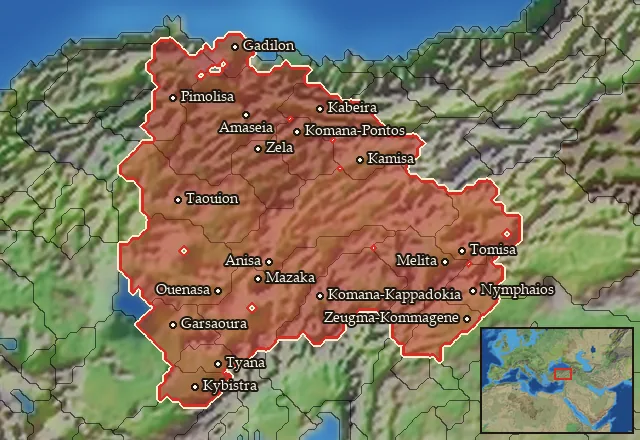
| Zone | Provinces | ||||||
|---|---|---|---|---|---|---|---|
| Cappadocian | 19 |