
Description
''In the island of Chios it is a beautiful sight to go to the gymnasia and the race-courses, and to see the young men wrestling naked with the maidens, who are also naked.'' – (Athen. 13.20E)
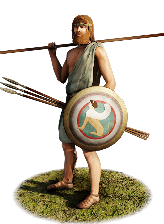
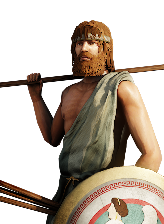
These young men are well-trained fighters who defend the island polis of Chios. Since they are usually posted in towers or forts in the countryside, it is important for them to be both fast and able to adapt to a wide variety of threats. Clad in a chiton or a simple exomis, they wear sturdy military boots and headbands to keep their long hair together – some prefer petasos hats as a protection against the sun, others can even afford a linen cuirass. At pace, they throw javelins or stab their enemies with their dory spears. Small, round pelte shields complete their equipment: young Chians are experts in swiftly moving the light shields so as to block any missile that comes their way. Proud of their traditions, the exceeding wealth and the world famous beauty of their island, these warriors would die for Chios, but they would much rather prefer to be victorious!
Historical background
''When Homer commends dark wine he often calls it fiery. For it is very potent and has the most lasting effect on the system of the drinker. Theopompos says that dark wine originated among the Chians, and that they were the first to learn how to plant and tend vines from Oinopion, son of Dionysos, who also was the founder of that island-state; and they transmitted it to other peoples.'' – (Athen. 1.26c = FGrHist 115 F 328 Thepompos of Chios)
In antiquity even more so than today, Chios was famous for many things. Its wine was one of the most widespread in the ancient world and beloved by Greeks, Romans, Thracians, Illyrians, Persians, and Scythians alike (Athen. 1.5C; Ael. 2.41; Suda s.v. iota487; Dio Chrys. Rhet. 6.13; Plin. nat. hist. 36.59). Even more famous was mastic, still the source of Chios’ wealth among the Mediterranean islands today (see in detail: Freedman, Mastic: A Mediterranean Luxury Product [2011]). Mastic was used in medicine, in the production of alcohol (the spirit mastixa can still be found in tavernas nowadays) and as an incense material. Accordingly, Thucydides called the Chians ''the richest of all Greeks'' (Thuc. 8.45.4). Another source of income was tourism, for the polychrome marble walls of the public buildings were famous throughout the world and impressed thousands of visitors – only Cicero remained typically stoic in the face of such beauty (Plin. nat. hist. 36.5.46). This affluence from the exports of wine and mastic as well as the income from tourism, coupled with a strong maritime tradition, a favourable location in the Eastern Aegean, and a debatable claim to be the home of Homer, assured Chian independence for many centuries. As Strabo put it:
''The Chians also claim Homer, setting forth as strong testimony that the men called Homeridai were descendants of Homer's family; these are mentioned by Pindar: "Whence also the Homeridai, singers of deftly woven lays, most often…'' The Chians at one time possessed also a fleet, and attained to liberty and to maritime empire. '' – (Strab. 14.1.35C645)
Another, often overlooked reason for Chios’ long autonomy, which lasted at least until the time of Vespasian, if not until the 3rd century AD (it was later part of the provincia insularum established by Vespasian: Bürchner, s.v. Chios (1), in: RE 3.2, cl. 2298), was its early organisation of an efficient militia. Chios had joined the Ionian League as one of its 12 founding members in the 7th century BC (MacSweeney, Foundation Myths and Politics in Ancient Ionia (2013), p. 191). This assured wealth and a mutual defensive alliance, which was activated during the Ionian Revolt against the yoke of Persian rule (499-494 BC). By this point, Chios was already a respectable military power. At the Battle of Lade in 494 BC, the Chians contributed 100 of the 353 Greek ships, each fitted with 40 epibatai (marines)! Accordingly, they occupied the centre of the battle line (Hdt. 6.8.1). Even though the Ionians suffered a decisive defeat, Herodotus highlights the bravery of the Chians (Hdt. 6.15.1). After the Persian Wars, Chios, like many other Greek island states, became part of Athens’ Delian League. As one of the few members, it retained its autonomy by contributing ships instead of just paying a tribute, however (Blanshard, Trapped between Athens and Chios (2007), p. 159). When Chios revolted against the Athenians in 412 BC, it still had 60 triremes under its own control (Blackman, David et al., Shipsheds of the Ancient Mediterranean (2013), p. 20).
We do not know as much about the land forces of Chios, but one specific unit is attested in inscriptions: its horophylakes. Literally the ''guards of the border stones'', the job of these men was to defend the borders of the polis. One inscription from the 5th century BC tells us that they punished everyone who moved or damaged the border stones (IGA 381= Cauer ² 496). Since Chios was an island, this institution must date back to a period when the city state of Chios did not yet control all of the island Chios. In the 3rd century BC, horophylakes are also mentioned in nearby Miletos (as well as Herakleia Pontike), another member of the Ionian League (I.Milet. 3.150, l. 89). Perhaps, they had introduced them after the example of Chios. The Milesian text specifies that part of the horophylakes' responsibility was catching runaway slaves, and in fact we have an example for that from Chios. During the early 3rd century BC, a group of slaves led by the Messenian Drimakos overwhelmed their masters and the Chians sent the horophylakes to restore order. However, we know that the ex-slaves established a free community for a while until Drimakos passed away, and the Chian authorities acknowledged his deeds after his death (Urbainczyk, Slave Revolts in Antiquity (2008), pp. 30-31). Perhaps, the horophylakes had been repulsed, or their commanders had sympathised with the slaves. With their tasks in mind, they were probably light and fast moving infantry, and such corps were often made up of ephebes, young men between 16 and 20 in training to become full citizens (Photios (Lex. s.v. Synephebos) attests this for Boiotia. See the opening quote for ephebes on Chios). Possibly these teenagers were simply not ruthless enough (yet) to go and kill the slaves when they decided to put up a fight.
In nearby Ionian Priene, the ephebes had to learn the usage of all weapons, but especially trained with javelins and bows (I. Priene 112, ll. 72-76; Kah, Das hellenistische Gymnasion (2004), p. 63). Accordingly, the Chian horophylakes in RIS are quick and agile young men armed with javelins and spears. Light clothes, sturdy boots, some helmets and some linothorakes as well as the small, round pelte shields of the peltasts complete their equipment. In battle, they can outflank the enemy or reinforce troops under pressure because of their speed. The historical horophylakes probably patrolled the countryside and the coasts, since Chios ruled over all of the island, and would have fended off or arrested raiders or intruders. In your battles, too, they can be used as scouts or to protect the flanks of heavier infantry. Make sure to keep them away from enemy cavalry, however, or combine them with your own horsemen. These boys represent Chios' fortune, and they can be its future.
Stats
| Rank in roster | ||
|---|---|---|
| Men per unit | 40 | ███······· 30% |
| Attack | 13 | ██████···· 57% |
| Charge bonus | 3 | ██········ 16% |
| Defence | 31 | █████····· 45% |
| · armour | 5 | ████······ 35% |
| · defence skill | 24 | ███████··· 68% |
| · shield | 2 | ███······· 25% |
| Morale | 8 | ██········ 19% |
| Discipline | Normal | |
| Training | Trained | |
| Recruitment cost | 1,241 dn | █········· 8% |
| Upkeep per turn | 454 dn | ██········ 17% |
| Turns to recruit | 3 |
Weapons
| Primary | Secondary | Primary | Secondary | Primary | Secondary | Primary | Secondary | ||||
|---|---|---|---|---|---|---|---|---|---|---|---|
| Attack | 13 | 4 | Charge bonus | 3 | 3 | Type | thrown · archery | melee · blade | Damage | piercing | piercing |
| Projectile | javelin | — | Range | 60 | — | Ammunition | 7 | — | Properties | Thrown | — |
Defence
| Primary | Secondary | Primary | Secondary | Primary | Secondary | Primary | Secondary | ||||
|---|---|---|---|---|---|---|---|---|---|---|---|
| Total | 31 | — | Armour | 5 | — | Defence skill | 24 | — | Shield | 2 | — |
Condition and terrain
| Hit points | 1 | Modifier against mounts | horse +3 · chariot +3 · camel +3 | Ground: scrub / sand / forest / snow | 8 / 0 / 6 / 0 | Charge distance | 30 |
| Formations | Square |
Technical stats
| Time between blows (primary / secondary) | 2.5 s / 2.5 s | Extra fatigue in hot climates | 0 | Collision mass per man (1.0 is normal) | 0.93 | Spacing between men: close / loose | 1 × 2.4 m / 1.8 × 4.32 m |
| Default ranks | 5 |
In battle: Very good stamina
Who can recruit it
A core roster unit for one faction, which can raise it anywhere it holds the right building:
Any faction holding one of the provinces below can field it.
Exactly what a settlement must have, route by route (5)
| Building | Also requires | Building | Also requires | Building | Also requires | Building | Also requires |
|---|---|---|---|---|---|---|---|
| Any settlement | Tier 2 Military Industrial Complex · Chian area of recruitment · Any Government (Dependency, Indirect Rule or Direct Rule) · Tier 2 Colony not built | Indirect Rule | Tier 2 Military Industrial Complex · Tier 1 Colony | Direct Rule | Tier 2 Military Industrial Complex · Tier 1 Colony | Homeland | Tier 2 Military Industrial Complex |
| Any settlement | Tier 2 Military Industrial Complex · Chian area of recruitment · Dependency or Indirect Rule · Tier 1 Colony not built |
Areas of recruitment
| Zone | Provinces | ||||||
|---|---|---|---|---|---|---|---|
| Chian | 0 |