
Description
“For the Perustae and Desiadates, Dalmatian tribes, who were almost unconquerable on account of the position of their strongholds in the mountains, their warlike temper, their wonderful knowledge of fighting, and, above all, the narrow passes in which they lived, were then at last pacified, not now under the mere general¬ship, but by the armed prowess of Caesar [Augustus] himself, and then only when they were almost entirely exterminated.”
– Velleius Paterculus (Compendium of Roman History, 2.115)
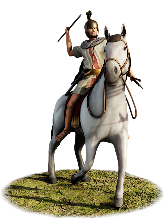
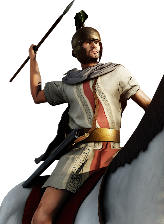
Daesitiates Cavalry are the elite horsemen of their tribe, fearful in their wroth, and swift in their wrath. They throw javelins from afar to ruin shields or impale undefended faces before charging in to carve their enemies with long Celtic style swords. They have no armour but a tunic, only using bronze Montefortino and Negau helmets to keep their heads safe. Woe to the enemy that underestimates their charge!
Historical background
The Daesitiates’ position in 270 BC was that they inhabited the southwestern part of Pannonia behind the Delmatae, a people whose culture they shared some commonalities with (Sasel Kos, Appian and Illyricum (2005), p. 378). As a Pannonian-Illyrian society, they kept tight networks of regional kinship and clientship, which allowed some social mobility within those individual networks, although rarely between separate groups or hierarchies (Dzino and Domic Kunic, Pannonians Identity-perceptions from the late Iron Age to later antiquity (2012), p. 98). This meant that often, they were fairly isolationist, and not particularly well-known in ancient writings.
The Daesitiates relative isolationism began to change due to several wars in the last century BC and first century AD. The Roman interest in Illyria had initially been one of spreading spheres of influence but by 35-33 BC, Emperor Octavian’s expedition into Pannonia had started to become one of punishment and conquest. This expedition was perhaps their first combat experience against the Daesitiates, as the Romans warred with the Pannonian Segestani and the Daisioi, which is probably misinterpretation on Appian’s part of the word Daesitiates (Dzino and Domic Kunic (2012), p. 98). This expedition was unexpectedly difficult for the Romans and Appian (App. Ill. 4.17) notes those that gave Augustus Octavian and his legates “the most trouble were the Salassi, the transalpine Iapydes, the Segestani, the Dalmatians, the Dæsitiatæ, and the Pannonians”.
While an eventual Roman success, Octavian’s expedition along with several other subsequent campaigns highlighted to the Illyrians an increasing pattern of Roman encroachment into and conquest of Illyrian lands. The situation deteriorated over the course of nearly four decades as more Illyrians were subjugated and the province of Illyria was founded. In order to stabilise their conquests, the Romans had to station 25 cohorts in walled towns, which managed to maintain peace for some 20 or so years (Wilkes, The Illyrians (1996), p. 206). Their conquest had riled up many Illyrian and Pannonian peoples and by 6 AD, the foment and unrest exploded into what would become the Great Illyrian Revolt. Tiberius, who was a consul at the time and would become Emperor in AD 14, had perhaps misjudged the Illyrians as a compliant people, and called up a large number of local troops to attack the Marcomanni in Bohomia. This backfired greatly, as the Illyrians quickly became aware of quite how many warriors they had, and decided to turn this strength against those who had imposed such harsh tributes of treasure and levies of manpower (Gruen, Cambridge Ancient History X - The Expansion Of The Empire Under Augustus (2008), p. 176).
The Illyrian reaction was an extreme one and their might was a direct threat to Roman hegemony. The Roman author Velleius Paterculus emphasises the imminent danger and extolled the Illyrian rebels to have “reached a total of more than eight hundred thousand. About two hundred thousand infantry trained to arms, and nine thousand cavalry were being assembled”. The Daesitiates by this point were led by Bato, a leader made all the more formidable along with his ally Pinnes of the Breuci due to their “knowledge of Roman discipline but also of the Roman tongue” (Velleius, Compendium of Roman History, 2.110). Their military aptitude helped them to employ skilful tactics, with the Daesitiates and Breuci co-operating on a strategic level (Sasel Kos (2005), p. 384) and their revolt involving attacks on multiple fronts all across the Balkans (Wilkes (1996), p. 207).
The Romans themselves saw that this revolt could quickly get out of hand. Suetonius (Suet. Tib. 16) notes the Illyrian Revolt as “most serious of all foreign wars since those with Carthage” and that it went on for “three years with fifteen legions and a corresponding force of auxiliaries, amid great difficulties of every kind and the utmost scarcity of supplies”. Rome had to do an emergency call up of freemen and “levies were held, from every quarter all the veterans were recalled to the standards” (Vell 2.111). The Illyrians were swift on the offensive and held most of Illyria by AD 7 until the Romans had gathered sufficient legions to counter them. Ten legions supported by seventy auxiliary cohorts, fourteen cavalry units, and no fewer than 10,000 veterans were required, the greatest force assembled since the Roman Civil War. It took them until AD 9 to beat the Dalmatians, then the Breuci, and finally Bato and the Daesitiates in a siege. Bato of the Daesitiates had proven such a challenge to the Roman Empire that he was spared in admiration by Tiberius (Gruen (2008), p. 178). While this great offensive managed to essentially reinstate Illyria as a Roman province, it was indeed a costly victory for Rome. Cassius Dio perhaps best exemplifies this feeling: “after the loss of many men and immense wealth; for ever so many legions were maintained for this campaign but very little booty was taken” (56. 1 6).
Daesitiates Cavalry have the honour of being one of the few Illyrian cavalry units that is actually discussed in ancient writings, as they are likely to have been a significant part of Velleius Paterculus’s (2.110) estimation of “nine thousand cavalry”. The unit’s equipment is featured on an urn from Ribic in modern Bosnia and Herzegovina, which shows unarmoured Illyrian cavalry with bronze helmets and swords (Dzino, Contesting Identities of pre-Roman Illyricum (2012), p. 86). The swords are of La Tene style, with long blades suitable for slashing from horseback, so help to highlight the influence of the Celts on Pannonian warmaking as their grave goods have been found as far east as Ciumesti, Romania (Almassy, Contacts between the Upper Tisza Region and the Balkans (2014), p. 240).
Stats
| Rank in roster | ||
|---|---|---|
| Men per unit | 30 | █········· 8% |
| Attack | 10 | ██········ 19% |
| Charge bonus | 13 | █████····· 52% |
| Defence | 16 | █········· 10% |
| · armour | 2 | █········· 13% |
| · defence skill | 14 | ██········ 18% |
| · shield | 0 | █········· 0% |
| Morale | 7 | █········· 10% |
| Discipline | Normal | |
| Training | Untrained | |
| Recruitment cost | 1,113 dn | █········· 6% |
| Upkeep per turn | 448 dn | ██········ 17% |
| Turns to recruit | 2 |
Weapons
| Primary | Secondary | Primary | Secondary | Primary | Secondary | Primary | Secondary | ||||
|---|---|---|---|---|---|---|---|---|---|---|---|
| Attack | 10 | 8 | Charge bonus | 13 | 13 | Type | thrown · archery | melee · blade | Damage | piercing | slashing |
| Projectile | javelin | — | Range | 60 | — | Ammunition | 7 | — | Properties | Thrown | — |
Defence
| Primary | Secondary | Primary | Secondary | Primary | Secondary | Primary | Secondary | ||||
|---|---|---|---|---|---|---|---|---|---|---|---|
| Total | 16 | — | Armour | 2 | — | Defence skill | 14 | — | Shield | 0 | — |
Condition and terrain
| Hit points | 1 | Mount | light horse | Ground: scrub / sand / forest / snow | 0 / 0 / -3 / 0 | Charge distance | 40 |
| Formations | Square |
Technical stats
| Time between blows (primary / secondary) | 2.5 s / 2.5 s | Extra fatigue in hot climates | 0 | Spacing between men: close / loose | 2 × 4.8 m / 3 × 7.2 m | Default ranks | 5 |
In battle: Very good stamina
Who can recruit it
A core roster unit for one faction, which can raise it anywhere it holds the right building:
Any faction holding one of the provinces below can field it.
Exactly what a settlement must have, route by route (4)
| Building | Also requires | Building | Also requires | Building | Also requires | Building | Also requires |
|---|---|---|---|---|---|---|---|
| Any settlement | Garrison Building or Tier 1 Military Industrial Complex · Daesitiate area of recruitment · Any Government (Dependency, Indirect Rule or Direct Rule) · Tier 2 Colony not built | Indirect Rule | Garrison Building or Tier 1 Military Industrial Complex · Tier 1 Colony | Direct Rule | Garrison Building or Tier 1 Military Industrial Complex · Tier 1 Colony | Homeland | Garrison Building or Tier 1 Military Industrial Complex |
Areas of recruitment
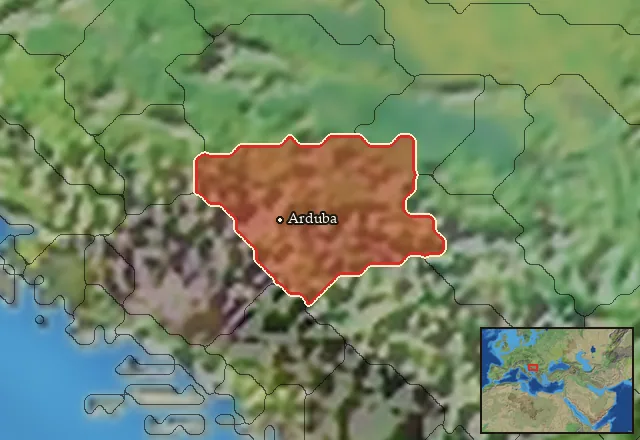
| Zone | Provinces | ||||||
|---|---|---|---|---|---|---|---|
| Daesitiate | 1 |