
Dalmatian Thureophoroi
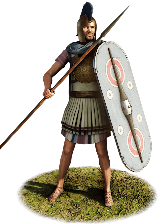
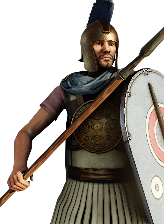
Class: spearmen · Category: infantry · Men per unit: 40
Reforms: Unlocked by Second wave of military innovations have arrived!, Illyrian Thureophoroi Reform
Description
The Delmatae are a warlike people and have been battling with and against a variety of cultures for aeons. These Dalmatian Thureophoroi carry on that proud tradition. Armed with the javelins and spears favoured by the Illyrian warrior, these Thureophoroi have been equipped with weapons and armour from various tried and tested sources. Their helmets are of Illyrian origin, both Shmarjet and Illyrian types, which provide good head and cheek coverage. However, they show the bounty of military experience in their other equipment. They hold the Thureos shield, a token of an old alliance with the Celtic Scordisci, and many cover their bodies with pectoral or Linothorax armour, having experienced first-hand in many battles against Greeks the effectiveness of such protection. The Dalmatian Thureophoroi are strong fighters and will give pause to heavier infantry, yet can skirmish quite efficiently too.
Historical background
The Delmatae were renowned for creating hill-forts, which saw use from prehistory up until the late medieval period. Their hillforts, or ‘gradina’, were often found on ridges overlooking plains and other strategic areas, or the spurs of a hill. This meant that the hill forts were often surrounded and therefore relatively well-protected by steep slopes and ravines apart from the manned defences at the neck of the spur. The predominance of the Dalmatian hillforts is displayed by archaeological sites throughout their old territory. The plain of Duvno, for example, was discovered to be encircled by 37 fortifications in a rather small area span of 20 by 9 kilometres at an altitude of 890-900 metres. Most were fairly rudimentary, with ramparts made from piled stones and wooden palisades, but some were much more developed (John Wilkes, The Illyrians (1996), p. 190). These forts were thought to have originally been a defence against the Liburni, but were later to prove influential in wars against Rome, too.
The Delmatae’s relationship with Rome was pretty complex as they had been both a friend and a foil to Rome for in the first and second centuries BC, ranging from relative friendliness to war. It’s possible that as Roman interest in coastal Illyria increased, it had negative implications for Delmatae-Roman relations. In 118 BC, consul L. Caecilus Metellus led a ‘victorious expedition’ that was even awarded a triumph against the Delmatae, when in actuality Metellus seemed to have just been received as a friend and wintered in the town of Salona (Wilkes (1996), p. 195). Roman control and influence over coastal Illyria increased gradually, especially over the Liburni, with it doubling as a springboard for Gaius Cosconius’ campaign against the Delmatae in 78-76 BC that saw the Delmatae defeated and Salona captured (Wilkes (1996), p. 196). Appian states that Delmatae may have incited another war by conquering the town of Promona from the Liburni in 50 BC, who then pleaded for Roman intervention (App. Illyricum 12). For a time, the Delmatae were beaten down and/or influenced enough into being a Roman tributary and there were no significant campaigns from the period after Gaius Cosconius’ successful war through to the end of the pro-consulship of Caesar (Barnett, Rethinking Identity, Ethnicity, And ‘Hellenization’ In Pre-Roman Liburnia (2016), p. 82).
This lull in Delmatae bellicosity was to change once more as in 48 BC, during the Roman civil war, the Delmatae were one of Julius Caesar’s areas of responsibility. This time the Delmatae were at an advantage, they chafed against Roman colonisation and, initially allying to Pompey, managed to ambush one of Caesar’s armies of 15 infantry cohorts and 3,000 cavalry commanded by ex-consul A. Gabinius at Synodion. In the ensuing battle, 5 cohorts were crushed and the Delmatae made off with 5 standards (Wilkes (1996), p. 196). The Delmatae managed to hold on to these standards for 10 years until Octavian sailed to Illyria, defeating the Iapodes and Pannonians in 35 BC, before moving on to the Delmatae. The war turned ill for them and they lost an army of 12,000 men in the citadel of Promona where their leader Verzo was killed. While the Romans began besieging other Delmatae strongholds, Testimus became the new war leader and ordered his people to disperse. They managed another fierce battle at Setovia, wounding Octavian and forcing his replacement with Statilius Taurus, but Dalmatian strength began to fail due to a winter blockade and eventually some capitulated. By 33 BC, the Romans could claim victory over the Delmatae, and it was to prove their last recorded war, one so important that it warranted celebrating as one of Octavian’s three triumphs – the others being for the Actium and Egyptian campaigns, all no mean feats (Wilkes (1996), p. 197). The Delmatae saw the region named after themselves and other than joining the great Illyrian revolt in 6 AD, went on to become an area of mass-recruitment for auxiliae and alae for the Roman Empire.
The Dalmatian Thureophoroi have some clear evidence leading to their inclusion as a unit in RIS. Culturally speaking, the Delmatae were influenced by many other Illyrians and the Celts (but did their best to reject alien Greek culture), for example, the Central Dalmation area had a combination of Illyrian and Celtic names, the upper Neretva valley around Konjic even has Celtic dressed figures on tombstones (Wilkes (1996), p. 75). There are several reasons why these Thureophoroi would have adopted the distinctive Thureos shield. As early as 156 BC, when the first conflicts with the Romans began, the Delmatae were the allies of the Celtic Scordisci and Pannonians (Dzino, The Celts In Illyricum (2008), p. 79). This would suggest direct experience in the warfare methods and equipment of the Celts and its effectiveness against the Roman war machine. In addition, the Romans themselves highlight the Delmatae’s adoption of elements of Celtic shields in the Tilurium Tropaion (a Roman victory trophy constructed after the war against the Delmatae) from the 2nd decade of the 1st century BC. The stone carving of the triumph displays a Linothorax with round metal breastplate, Thureos, javelins, spear, Shmarjet and Illyrian helmet – a diverse array of weapons and equipment for a foe to have. Furthermore, even as early as the 3rd or 2nd century BC, a stela from Borcani shows a round, pectoral armour piece as a part of the Delmataean panoply (Pijerov, Oprema Deltaskog Ratnika (2018)). This combination of arms and equipment is displayed in the present unit, some showing more Celtic or Greek influence, having Linothorax, Thureos shields, and helmets from various sources. This unit represents the later Delmataean military that was a terror to its enemies in the last centuries BC, hence being a reform unit, too.
Stats
| Rank in roster | ||
|---|---|---|
| Men per unit | 40 | ███······· 30% |
| Attack | 17 | █████████· 87% |
| Charge bonus | 14 | ██████···· 60% |
| Defence | 49 | █████████· 94% |
| · armour | 7 | ████······ 42% |
| · defence skill | 37 | ██████████ 99% |
| · shield | 5 | ██████···· 57% |
| Morale | 14 | ████████·· 79% |
| Discipline | Normal | |
| Training | Untrained | |
| Recruitment cost | 2,306 dn | ██████···· 61% |
| Upkeep per turn | 844 dn | ████████·· 81% |
| Turns to recruit | 4 |
Weapons
| Primary | Secondary | Primary | Secondary | Primary | Secondary | Primary | Secondary | ||||
|---|---|---|---|---|---|---|---|---|---|---|---|
| Attack | 17 | 13 | Charge bonus | 14 | 16 | Type | thrown · blade | melee · blade | Damage | piercing | piercing |
| Projectile | javelin | — | Range | 50 | — | Ammunition | 2 | — | Properties | Used just before charging into combat | Light spear (braced against cavalry charges from the front) · +8 attack against cavalry |
Defence
| Primary | Secondary | Primary | Secondary | Primary | Secondary | Primary | Secondary | ||||
|---|---|---|---|---|---|---|---|---|---|---|---|
| Total | 49 | — | Armour | 7 | — | Defence skill | 37 | — | Shield | 5 | — |
Condition and terrain
| Hit points | 1 | Ground: scrub / sand / forest / snow | 0 / -1 / -1 / -1 | Charge distance | 30 | Formations | Square |
Technical stats
| Time between blows (primary / secondary) | 2.5 s / 2.5 s | Extra fatigue in hot climates | 1 | Collision mass per man (1.0 is normal) | 1.09 | Spacing between men: close / loose | 1 × 1.2 m / 2 × 2.4 m |
| Default ranks | 5 |
In battle: Can hide in long grass · Can sap · Very good stamina
Who can recruit it
A core roster unit for one faction, which can raise it anywhere it holds the right building:
Any faction holding one of the provinces below can field it.
Exactly what a settlement must have, route by route (4)
| Building | Also requires | Building | Also requires | Building | Also requires | Building | Also requires |
|---|---|---|---|---|---|---|---|
| Any settlement | Tier 2 Military Industrial Complex · Second wave of military innovations have arrived! · Dalmatian area of recruitment · Any Government (Dependency, Indirect Rule or Direct Rule) · Tier 2 Colony not built | Direct Rule | Tier 2 Military Industrial Complex · Illyrian Thureophoroi Reform · Tier 2 Colony | Homeland | Tier 2 Military Industrial Complex · Illyrian Thureophoroi Reform | Any settlement | Tier 2 Military Industrial Complex · Second wave of military innovations have arrived! · Dalmatian area of recruitment · Dependency only · Tier 1 Colony not built |
Areas of recruitment
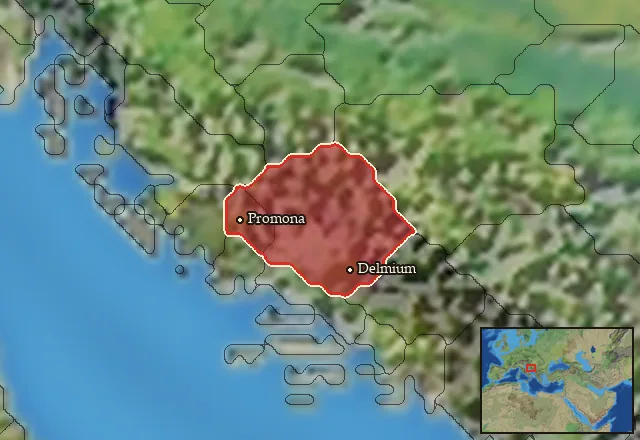
| Zone | Provinces | ||||||
|---|---|---|---|---|---|---|---|
| Dalmatian | 2 |