
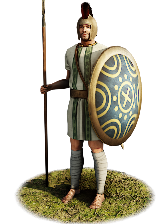
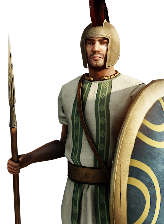
Description
These Dardanian warriors have been equipped with the Sibyna spear – a 2-2.5 metre spear of Illyrian make, a machaira blade, adopted after the campaigns against Philip and Alexander, and an Illyrian round shield. They wear some armour to protect their extremities, including bronze greaves, torques, and Illyrian helmets, with some opting for Petasoi hats or Thracian helmets. Dardanian Spearmen are otherwise relatively unarmoured, only wearing long tunics or tunics that resemble a modern kilt in shape. These spearmen are brave and dangerous warriors who will form a key part of any Dardanian battle line.
Historical background
Whether the Dardanians were an Illyrian or a Thracian people has been much debated. One view suggests that the area was originally populated with Thracians who were then exposed to direct contact with Illyrians over a long period of time (Wilkes, The Illyrians (1996), p. 85). Thracian names are generally found in eastern Dardania, from Skoupoi to Naissos, whereas Illyrian names are found to be dominant in the western areas of Mitrovica and Pec. Academic interpretations vary as to whether this shows a gradual "Thracianisation" of Dardanian Illyrians, or whether this is a Dardanianisation of conquered Thracian land, but there is also strong evidence for other central Dalmatian names being popular, and certain Dardanian names not being found anywhere else, such as Bubita, Nanea and Pasades. This makes it difficult to assign a major influence overall to any group, perhaps making it better to consider the Dardanians as having a separate onomastic province - that is to say, naming conventions of their own making (Wilkes (1996), p. 86).
Strabo portrayed the Dardanians as a primitive but somewhat cultured (at least in musical terms) group: "they are so utterly wild that they dig caves beneath their dung-hills and live there; but still, they have a taste for music and are always playing musical instruments, both flutes and strings" (Strabo 7.5, 7). This apparent and somewhat idyllic primitiveness of the Dardanians perhaps belied the fact that the Dardani were an enduring and stable ethnic presence in the central Balkans. Strabo himself noted that one of the Dardanian peoples, the Galabrii, had an old city, potentially Kale in Skopje, so it can be inferred that it was a society at a rather advanced stage of development (Sasel Kos, Peoples On The Northern Fringes Of The Greek World (2008), p. 625). Fanoula Papazoglu states that they were 'the most stable and conservative ethnic element in an area where everything was exposed to constant change' (cited in: Wilkes (1996), p. 144). The Dardanians were a constant thorn in the side of the Greeks and Macedonians. It is possible that the Illyrian King Kleitos, whom Alexander the Great defeated, was a Dardanian (Wilkes (1996), p.145).
Southern Illyrian peoples like the Dardanians were the first to experience the effects of ‘globalisation’ following an increase in trade with Greek or Hellenic states to their south (Dzino, Deconstructing ‘Illyrians’ (2008), p. 49.) Findings of Hellenistic goods decreased in the fourth to second centuries BC, mostly occurring in areas bordering Macedonia such as Dardania, with almost none found further north. This also possibly shows a loss of Athenian influence or commercial power, or a redirection of Greek interest to Southern Italy and the Adriatic (Wilkes (1996), p. 107). Despite these other material and cultural influences and the gradual erosion of Dardanian power by the Epirotes and Macedonians, they remained an independent people until Rome eventually subjugated them (Wilkes (1996), p.145).
Supporting evidence for Dardanian Spearmen and their equipment in RIS can be found in several examples of coins from Damastion. On each coin, there is an image of a Paionian cavalry man riding down a man armed with a large roundshield, a spear, and a helmet in a somewhat Greek but possibly Illyrian style. This is significant, as the Dardanians lived in the vicinity of Damastion, and the equipment is quite similar to other depictions of Illyrian spearmen.
Stats
| Rank in roster | ||
|---|---|---|
| Men per unit | 40 | ███······· 30% |
| Attack | 10 | ██········ 19% |
| Charge bonus | 13 | █████····· 52% |
| Defence | 39 | ███████··· 70% |
| · armour | 2 | █········· 13% |
| · defence skill | 30 | █████████· 93% |
| · shield | 7 | █████████· 91% |
| Morale | 11 | ████······ 39% |
| Discipline | Normal | |
| Training | Untrained | |
| Recruitment cost | 1,650 dn | ███······· 28% |
| Upkeep per turn | 604 dn | ████······ 43% |
| Turns to recruit | 2 |
Weapons
| Primary | Secondary | Primary | Secondary | Primary | Secondary | Primary | Secondary | ||||
|---|---|---|---|---|---|---|---|---|---|---|---|
| Attack | 10 | — | Charge bonus | 13 | — | Type | melee · blade | — | Damage | piercing | — |
| Properties | Light spear (braced against cavalry charges from the front) · +8 attack against cavalry | — |
Defence
| Primary | Secondary | Primary | Secondary | Primary | Secondary | Primary | Secondary | ||||
|---|---|---|---|---|---|---|---|---|---|---|---|
| Total | 39 | — | Armour | 2 | — | Defence skill | 30 | — | Shield | 7 | — |
Condition and terrain
| Hit points | 1 | Ground: scrub / sand / forest / snow | -1 / -1 / -2 / -1 | Charge distance | 30 | Formations | Square |
Technical stats
| Time between blows (primary / secondary) | 2.5 s / — | Extra fatigue in hot climates | 0 | Collision mass per man (1.0 is normal) | 0.99 | Spacing between men: close / loose | 1 × 1.2 m / 2 × 2.4 m |
| Default ranks | 5 |
In battle: Can hide in long grass · Can sap · Very good stamina
Who can recruit it
A core roster unit for one faction, which can raise it anywhere it holds the right building:
Any faction holding one of the provinces below can field it.
Exactly what a settlement must have, route by route (4)
| Building | Also requires | Building | Also requires | Building | Also requires | Building | Also requires |
|---|---|---|---|---|---|---|---|
| Any settlement | Garrison Building or Tier 1 Military Industrial Complex · Dardanian area of recruitment · Any Government (Dependency, Indirect Rule or Direct Rule) · Tier 2 Colony not built | Indirect Rule | Garrison Building or Tier 1 Military Industrial Complex · Tier 1 Colony | Direct Rule | Garrison Building or Tier 1 Military Industrial Complex · Tier 1 Colony | Homeland | Garrison Building or Tier 1 Military Industrial Complex |
Areas of recruitment
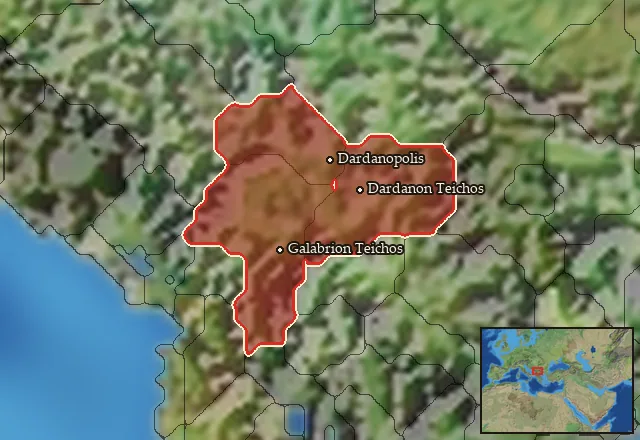
| Zone | Provinces | ||||||
|---|---|---|---|---|---|---|---|
| Dardanian | 3 |