
Description
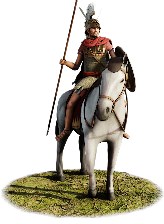
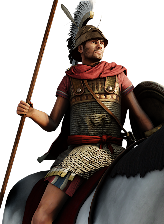
These men are part of the Etruscan aristocracy and their retainers, representing the better protected mounted arm of the Etrurian nobility. Unlike the lancers whose focus is on cycle-charging, the Etruscan heavy cavalry has traded the long lance and deadly charge for the extra protection of a shield to be able to engage in close combat for an extended period of time. Armed with thrusting spears, sidearm swords (xiphoi or machairai), and carrying round equestrian shields (aspides or flat cavalry shields), these horsemen can be trusted to hold their own in prolonged melee engagements. Their defensive equipment includes bronze helmets (such as bronze Attic-Phrygian, Chalcidian, or Montefortino types), as well as scale-reinforced linen corselets, muscle cuirasses, or mail shirts (lorica hamata). Their combination of defensive armour, lances, and shields allows them to counter enemy horsemen, withstand missile attacks, and properly support the wings of the Etruscan armies.
Historical background
In pre-Roman Central Italy, equestrian service was an exclusive privilege of the landed nobility and their personal retainers. Iconographic representations on 3rd and 2nd-century BC alabaster sarcophagi and cinerary urns from Volterra, Perugia, and Chiusi frequently portray armoured Etruscan horsemen fighting alongside infantry (Taylor, 'Etruscan Identity and Service in the Roman Army: 300–100 B.C.E.', in: AJA 121-2 (2017), pp. 289–290). Even a first-century BC urn from Volterra depicts a farewell scene with a cavalryman dressed in Roman style wearing a mail shirt and a plumed Montefortino-type helmet, demonstrating that a "Volterran noble at the end of the Roman Republic could serve (and perhaps die) as a Roman eques and still go to the afterlife as an Etruscan aristocrat" (Taylor (2017), p. 290).
This aristocracy maintained its social and religious pre-eminence throughout the Roman conquest and its aftermath. In 265 BC, when internal revolution erupted at Volsinii and freedmen had succeeded in seizing all the magistracies, making themselves senators, and setting up a democratic constitution, the Volsinian aristocracy requested Roman military intervention. This resulted in a siege that lasted twelve months, with the city eventually being stormed, razed, and rebuilt at nearby Bolsena (Staveley, 'Rome and Italy in the early third century', in: Walbank et al., The Cambridge Ancient History VII.2 (2006), p. 424). As Annalisa Calapà notes, even after the destruction of old Volsinii, local epigraphy "shows a certain degree of continuity in family names and a relative stability of the local elite", who preserved their social standing, wealth, and civic religious authority under Roman rule (Calapà, 'Sacra Volsiniensia’, in: TRAC (2013), p. 39).
In 225 BC, Roman officials tallied some 50,000 Etruscan infantry and 4,000 Etruscan cavalry as available for service to face an impending Gallic invasion. Polybius (2.24.5) gives these figures as applying to both the Etruscans and the Sabines. However, some historians hold that the Sabines are mentioned by mistake, having already been included on the rolls of Roman citizens, while others argue that Polybius mentions the Sabines because some had been mobilized along with the Etruscans as an emergency levy against the Gauls (Taylor (2017), pp. 275-276).
During the Second Punic War (218–201 BC), Hannibal seems to have attempted to detach the Etruscans from their Roman alliance, prompting Rome to take hostages and station two legions (more than 10,000 soldiers) in Etruria to guarantee regional stability (Van Son, 'The Disturbances in Etruria During the Second Punic War', in: Mnemosyne 16-3 (1963), p. 268). Despite this tension, Etruscan allied contingents fought bravely alongside Roman legions, such as the "cohort of Perusians [...] numbering 460 men reinforcing Casilinum" in 216 BC (Liv. 23.17.11).
The last gasp of Etrurian independence seems to have happened during the Social War (91–88 BC). Livy relates how the Etruscans revolted and were defeated by praetor Lucius Porcius in 89 BC (Liv. 74.5; Orosius, Histories, Book 5, Chapter 18, 17). However, Appian states that the Etruscans had only considered rebelling ,and were eventually kept loyal by the grant of citizenship: “While these events were transpiring on the Adriatic side of Italy, the inhabitants of Etruria and Umbria and other neighbouring peoples on the other side of Rome heard of them and all were excited to revolt. The Senate, fearing lest they should be surrounded by war, and unable to protect themselves, garrisoned the sea-coast from Cumae to the city with freedmen, who were then for the first time enrolled in the army on account of the scarcity of soldiers. The Senate also voted that those Italians who had adhered to their alliance should be admitted to citizenship, which was the one thing they all desired most. They sent this decree around among the Etruscans, who gladly accepted the citizenship. By this favour the Senate made the faithful more faithful, confirmed the wavering, and mollified their enemies by the hope of similar treatment” (Appian, Roman History. The Civil Wars, 1.49).
It might indeed be the case that the Etruscan and Umbrian revolt involved only a handful of communities, with the rest staying loyal or simply neutral, and that it was fully neutralized after victory in battle against the few rebellious communities as well as the granting of citizenship. Others like Dart believe that the “communities in Etruria and Umbria withheld their support for the insurgents initially only to be the first to be granted citizenship, albeit begrudgingly, by the Republic as an emergency measure, through the lex Iulia in 90 BC”. Dart further comments that the “incorporation of most of Italy into the citizen body was a reluctant measure taken by the Romans to alleviate the threat of further unrest, though it should be noted that such a concession proved highly effective at safeguarding the loyalty of these communities. Thereafter violence in Italy focused upon interfactional Roman conflict” (Dart, The Social War (2016), pp. 44-45). In some cases, Etruscan culture disappeared. For example, in the city of Veii, which after the war against Rome became depopulated and saw various veteran settlements established in the area in the late Republican period (Calapà (2013), p. 45). Nevertheless, it remained strong in other parts of Etruria, thanks to the prestige of Volsinii as a prominent religious centre of the Etruscan League, whose sacred ceremonies were revitalized during the Imperial Age. This may have contributed to the persistence and the vitality of traditional cult places, such as the sanctuary of Nortia and possibly the fanum Voltumnae (Calapà (2013), p. 45).
Stats
| Rank in roster | ||
|---|---|---|
| Men per unit | 30 | █········· 8% |
| Attack | 11 | ███······· 34% |
| Charge bonus | 29 | █████████· 88% |
| Defence | 36 | ██████···· 61% |
| · armour | 14 | ████████·· 78% |
| · defence skill | 18 | ████······ 38% |
| · shield | 4 | █████····· 48% |
| Morale | 12 | ██████···· 57% |
| Discipline | Normal | |
| Training | Trained | |
| Recruitment cost | 2,529 dn | ███████··· 72% |
| Upkeep per turn | 1,018 dn | █████████· 89% |
| Turns to recruit | 4 |
Weapons
| Primary | Secondary | Primary | Secondary | Primary | Secondary | Primary | Secondary | ||||
|---|---|---|---|---|---|---|---|---|---|---|---|
| Attack | 11 | 11 | Charge bonus | 29 | 25 | Type | melee · blade | melee · blade | Damage | piercing | piercing |
Defence
| Primary | Secondary | Primary | Secondary | Primary | Secondary | Primary | Secondary | ||||
|---|---|---|---|---|---|---|---|---|---|---|---|
| Total | 36 | — | Armour | 14 | — | Defence skill | 18 | — | Shield | 4 | — |
Condition and terrain
| Hit points | 1 | Mount | heavy horse | Ground: scrub / sand / forest / snow | -3 / -1 / -8 / -1 | Charge distance | 40 |
| Formations | Square · Wedge |
Technical stats
| Time between blows (primary / secondary) | 2.5 s / 2.5 s | Extra fatigue in hot climates | 4 | Spacing between men: close / loose | 2 × 4.8 m / 3 × 7.2 m | Default ranks | 5 |
In battle: Good stamina
Who can recruit it
A core roster unit for one faction, which can raise it anywhere it holds the right building:
Any faction holding one of the provinces below can field it.
Exactly what a settlement must have, route by route (3)
| Building | Also requires | Building | Also requires | Building | Also requires | ||
|---|---|---|---|---|---|---|---|
| Direct Rule | Tier 3 Military Industrial Complex · Tier 2 Colony · Requires resource horses or horses supplied factionwide | Homeland | Tier 2 Military Industrial Complex | Any settlement | Tier 2 Military Industrial Complex · Requires resource horses or horses supplied factionwide · Etruscan area of recruitment · Dependency only · Tier 1 Colony not built |
Areas of recruitment
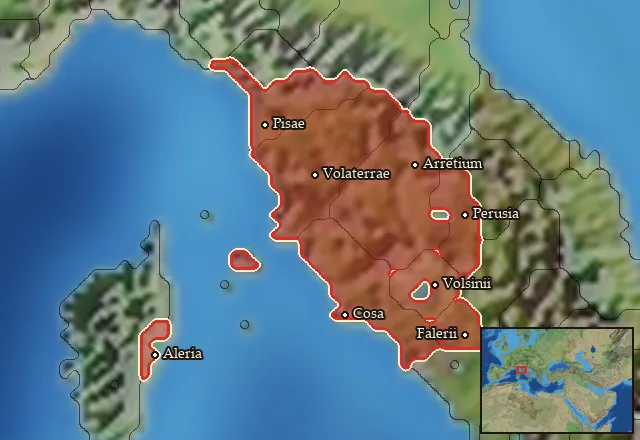
| Zone | Provinces | ||||||
|---|---|---|---|---|---|---|---|
| Etruscan | 8 |