
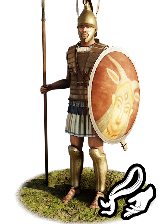
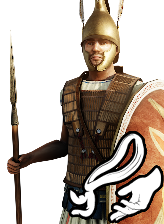
Description
“The other consul was routed by the Faliscans and Tarquinienses in his first engagement. The panic was chiefly due to this, that their priests, bearing serpents and blazing torches before them, came rushing on like Furies, and utterly dismayed the Roman soldiers with the extraordinary sight.” – Livy, History of Rome (7.17)
These Faliscan Hoplites represent the citizen infantry levied from the Ager Faliscus in the River Treja valley. Settled around their capital of Falerii and major regional centres such as Narce (ancient Fescennium or Thevnalthia), Vignanello, and Corchiano, these aristocratic warriors and their retainers go to war in the classic hoplite panoply. They march to battle holding large, bronze Argive shields (aspides), long thrusting spears (dorata), and sidearm short swords (xiphoi), but also use heavy javelins. Protected by muscle or lamellar cuirasses, composite linothorakes, bronze greaves on both legs, and Montefortino, Chalcidian, or Attic-Phrygian helmets, they form a strong, heavily armoured arm, capable of holding the line against their enemies for a long time. Being at the crossroads of the Etruscan, Latin, and Sabellian cultures, these men are accustomed to war and excel at maintaining a cohesive line of spears while repelling enemy infantry charges.
Historical background
The Ager Faliscus occupied the geographical basin of the River Treja valley, bordered by the River Tiber to the east (separating the Faliscans from Sabine and Umbrian territories), Mount Soracte to the southeast (sacred to Pater Soranus), and the Ciminian Forest to the west (Tabolli and Neri, 'The Faliscans and the Capenates', in: Farney and Bradley (eds.), The Peoples of Ancient Italy (2017), pp. 559–567). Its capital city, Falerii, exercised hegemony over the entire valley. Culturally and linguistically, the Faliscans maintained a distinct identity. While the Faliscan language shared common Latin origins, their writing, onomastics, and material culture was strongly influenced by the South Etruscan, Sabine, and South Italic cultures. Mythological tradition traced the founding of Falerii to Halesus, a descendant of Agamemnon and common ancestor to the Veientine king Morrius (Ov. Amor. 3.13.31; Serv. ad Verg. Aen. 7.695; Tabolli and Neri (2017), pp. 560, 563). As Ovid (Amores 3.13.31) states: “The procession's face is Argive; with Agamemnon slain, both crime and wealth flee from Halaesus, and now a fugitive from wandering lands and straits, he built walls of happiness with a high hand. He taught his own Juno the Faliscans.” Thus, “driven from home by the tragic doom of Atrides, Halaesus had come, after whom the Faliscan land deems that it takes its name” (Ovid, Fasti 4.63).
Following the fall of the neighbouring city of Veii in 396 BC, which the Faliscans actively supported in its struggle against Roman hegemony, the Romans quickly reduced them to submission (in 395 and 394, respectively: Liv. 5.24–27; Cornell, 'Rome and Latium to 390 B.C.', in: Walbank et al., The Cambridge Ancient History VII.2 (2006), p. 300). Nevertheless, the Faliscans continued to resist Roman expansion for over a century. In 293 BC, the consul Spurius Carvilius Maximus defeated them in battle, forcing Falerii to sign a peace treaty and to pay an indemnity: “In these actions the enemy lost 2,400 killed and 2,000 prisoners. The Faliscans sued for peace, and he granted them a truce for one year on condition of their supplying a year's pay to his troops, and an indemnity of 100,000 ases of bronze coinage” (Liv. 10.46.12; Tabolli and Neri (2017), p. 567).
The final act of Faliscan independence occurred in 241 BC, immediately following the First Punic War, when Falerii started another rebellion against Rome (Polyb. 1.65.2; Liv. Per. 19; Tabolli and Neri (2017), p. 567). Polybius tells us that after the war with Carthage ended, ‘‘at Rome there followed civil war against the Falisci, but this they brought to a speedy and favourable conclusion, taking Falerii in a few days”. Their resistance thus ended when two Roman consular armies razed the fortified capital of the Faliscans, forcibly relocated the surviving population to the unfortified lowland site of Falerii Novi along the newly constructed Via Amerina, and confiscating half of their territory (Staveley, 'Rome and Italy in the early third century', in: Walbank et al., The Cambridge Ancient History VII.2 (2006), p. 431; Tabolli and Neri (2017), p. 567). More than 15,000 Faliscans died in the brief conflict, and Rome confiscated their weapons, horses, household goods, and slaves (D.C. ap. Zonaras 8.18; Tabolli and Neri (2017), p. 567). Regarding the reasons for such an act of violence from Rome, the “pretext for the attack was some unspecified act of non-compliance with the instructions of Roman officials which could well have been wholly justified by the expiry of the fifty-year treaty that had been contracted between the two states in 293, but it is evident that Rome's true motive for her action was to strengthen her hold upon Etruria by meting out to Falerii similar treatment to that which had been meted out before the war to her western neighbours, and to bring the community into the commonwealth on the basis of a permanent foedus” (Walbank et al. (2006), p. 431).
While their independence ended and from then on, they remained subjects to Rome, Greek military influences derived from the Faliscans continued to be recognized by later historians. Writing in the late 1st century BC during his visit to Italy, Dionysius of Halicarnassus recorded that Falerii and Fescennium preserved a hoplite-armed tradition down to his own day: "In these cities there survived for a very long time many of the ancient customs formerly in use among the Greeks, such as the fashion of their arms of war, like Argolic bucklers and spears; and whenever they sent out an army beyond their borders, either to begin a war or to resist an invasion, certain holy men, unarmed, went ahead of the rest bearing the terms of peace" (Dion. Hal. Ant. Rom. 1.21.1). Thus, even as the neighbouring Central Italic peoples adopted the larger thureos shields and looser infantry formations, the Faliscans stuck to their classic hoplite equipment, possibly as a mark of their cultural identity and proud military tradition.
Stats
| Rank in roster | ||
|---|---|---|
| Men per unit | 40 | ███······· 30% |
| Attack | 16 | ████████·· 80% |
| Charge bonus | 14 | ██████···· 60% |
| Defence | 45 | █████████· 87% |
| · armour | 10 | █████····· 54% |
| · defence skill | 30 | █████████· 93% |
| · shield | 5 | ██████···· 57% |
| Morale | 12 | ██████···· 57% |
| Discipline | Normal | |
| Training | Highly trained | |
| Recruitment cost | 1,837 dn | ████······ 40% |
| Upkeep per turn | 672 dn | ██████···· 60% |
| Turns to recruit | 2 |
Weapons
| Primary | Secondary | Primary | Secondary | Primary | Secondary | Primary | Secondary | ||||
|---|---|---|---|---|---|---|---|---|---|---|---|
| Attack | 16 | 11 | Charge bonus | 14 | 16 | Type | thrown · blade | melee · blade | Damage | piercing | piercing |
| Projectile | javelin | — | Range | 50 | — | Ammunition | 2 | — | Properties | Used just before charging into combat | Light spear (braced against cavalry charges from the front) · +8 attack against cavalry |
Defence
| Primary | Secondary | Primary | Secondary | Primary | Secondary | Primary | Secondary | ||||
|---|---|---|---|---|---|---|---|---|---|---|---|
| Total | 45 | — | Armour | 10 | — | Defence skill | 30 | — | Shield | 5 | — |
Condition and terrain
| Hit points | 1 | Ground: scrub / sand / forest / snow | 0 / -1 / -1 / -1 | Charge distance | 30 | Formations | Square |
Technical stats
| Time between blows (primary / secondary) | 2.5 s / 2.5 s | Extra fatigue in hot climates | 3 | Collision mass per man (1.0 is normal) | 1.27 | Spacing between men: close / loose | 1 × 1.05 m / 2 × 2.4 m |
| Default ranks | 5 |
In battle: Can sap · Good stamina
Who can recruit it
No faction has this on its core roster: it can be raised only in the provinces below.
Any faction holding one of the provinces below can field it.
Exactly what a settlement must have, route by route (1)
| Building | Also requires | ||||||
|---|---|---|---|---|---|---|---|
| Any settlement | Tier 2 Military Industrial Complex · Faliscan area of recruitment · Dependency only · Tier 1 Colony not built |
Areas of recruitment
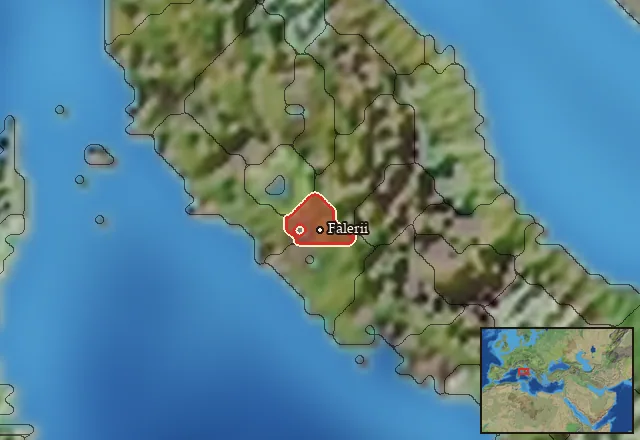
| Zone | Provinces | ||||||
|---|---|---|---|---|---|---|---|
| Faliscan | 1 |