
Description
"And beyond others thou lovest the nymph of Gortyn, Britomartis, slayer of stags, the goodly archer; for love of whom was Minos of old distraught and roamed the hills of Crete.” – Kallimachos of Kyrene (Hymn to Artemis, ll. 189-191)
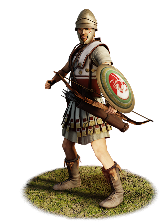
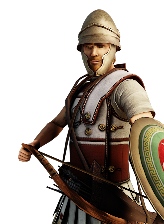
The archers of Crete are renowned throughout the ancient world. Lifelong training and permanent practice in the never-ending wars on the island make them highly sought after mercenaries, who appear in armies from Mesopotamia to Iberia. The Gortynians enjoy an especially famous reputation for the precision and lethality of their arrows. With their Scythian style composite bows, the Gortynian archers outrange most other bowmen. In the Hellenistic period, Cretan archers were typically protected by light linothorakes with pteryges, bronze helmets (of pilos, Thracian or konos type) or petasos helmets, Cretan boots, and small, round pelte shields. Should they be forced into a melee, these men are able to defend themselves with curved machaira swords.
Historical background
Archery, bows, and arrows played a vital role in Gortynian society. Like other Cretan cities, its population included an element of Eteokretans (probably Minoans) who had lived on the island long before the arrival of the Greeks. In the chora (territory) of Gortyn, they were called Amyklaioi, similar to the famous community of Mycenaeans who became Spartan Perioikoi. This suggests a relation between the two groups, and in fact both venerated the god Amyklaios, who was depicted with helmet, spear, and bow (Willetts, The Law Code of Gortyn (1967), p. 61). Some contest this and think Amyklaios’ sanctuary was part of the chora of nearby Phaistos (Watrous/Haidzi-Vallianou, Creation of a Greek City State (2004), p. 346), but Phaistos probably lost territory to Gortyn in later years and it was conquered around 150 BC (Chaniotis, Das antike Kreta (2004), p. 83). As the quote above shows, the hunter goddess Britomartis, the eastern Cretan version of Artemis, was also very popular in Gortyn, and in the 7th century BC, the Gortynians constructed a large temple for Apollo Pythios – another archery god, who became the main deity of the polis around 200 BC (Perlman, Gortyn (Part I) (2000), p. 88).
As Gortynian archers often served abroad, they also brought new cultural and religious ideas with them when they returned. In the 2nd century BC, the Gortynian mercenary officer Pyroos dedicated a shrine to Isis after he had completed his service for Ptolemy VI (RICIS 203/0601-0602). Ptolemaic garrisons in the Cyclades will have first established the veneration of Isis, the Egyptian goddess of (re-)birth and magic, in the Aegean, and Cretans who had served in the Ptolemaic army will then have helped spread these beliefs. Arguably, the cult of Isis had been intentionally Hellenised by the Egyptian priests in the early 3rd century BC to facilitate its wide adoption in Greek-speaking lands (Versluys, Visual Style and Constructing Identity (2020), p. 145). Other deities soon followed, however, as the Ptolemaic ally sponsored the erection of an Egyptian temple complex for Isis, Sarapis, and Anubis, which was completed around 160 BC (Kleibl, Die Wasserkrypten (2003), pp. 82-84).
Cretan mercenary archers did not only serve the Ptolemies, however: they are attested in armies all across the Mediterranean and will thus have encountered many different cultures and ideas. Their employers included Antigonid Macedon (Polyb.3.66.6; 4.67.6), the Seleucids (Polyb. 5.97.10; 8.15.4;10.29.6), Syracuse (Liv. 24.30.13; Polyb. 3.75.7), the Achaian League (Polyb. 4.55.5; 33.16.6), the Aitolian League (Polyb. 5.14.1-3), Sparta (Polyb. 4.80.6; 12.6.8; 8.2), and Rome (Liv. 24.30.13; Polyb. 3,75.7). In Rome, the Gortynians and other Cretans left behind such an impression that they entered the cultural horizon of the Romans. Virgil, the ‘Roman Homer’, invented a priest of the Phrygian goddess Kybele by the name of Chloreus, who is the main character of the 11th book of the Aeneid. This man, the “[...] most beautifully and brilliantly dressed character in the poem" (West, Chloreus and Camilla (1985), p. 22) is remarkably described in the following words: "He himself, shining with deep colours and foreign purple, fired Gortynian arrows from a Lycian bow: the weapon was golden on his shoulder, and golden the seer's helm" (Virg. Aen. 11.772-775). In the Thebaid of Statius, a Roman epic composed in the 90s AD and focussed on a mythological war about Thebes, Ares assembles an army whose men equip themselves with various weapons: "Some try shapely helms and the brazen mail of mighty corselets, and fit to their breasts tunics that creak with the mouldering iron, others bend Gortynian bows" (Stat. Theb. 3.585-588). There would be even more examples, but these shall suffice to demonstrate that Gortynian mercenary archers were agents of cultural exchange in both ways. None of this would have worked if they had not been excellent soldiers, however: their precision, efficiency, agility, and bravery were a match for everyone, and they remained highly respected warriors well into Roman imperial times.
Stats
| Rank in roster | ||
|---|---|---|
| Men per unit | 40 | ███······· 30% |
| Attack | 11 | ███······· 34% |
| Charge bonus | 5 | ███······· 26% |
| Defence | 25 | ███······· 28% |
| · armour | 7 | ████······ 42% |
| · defence skill | 16 | ███······· 28% |
| · shield | 2 | ███······· 25% |
| Morale | 10 | ███······· 29% |
| Discipline | Normal | |
| Training | Trained | |
| Recruitment cost | 1,808 dn | ████······ 38% |
| Upkeep per turn | 662 dn | ██████···· 56% |
| Turns to recruit | 4 |
Weapons
| Primary | Secondary | Primary | Secondary | Primary | Secondary | Primary | Secondary | ||||
|---|---|---|---|---|---|---|---|---|---|---|---|
| Attack | 11 | 8 | Charge bonus | 5 | 7 | Type | missile · archery | melee · blade | Damage | piercing | slashing |
| Projectile | arrow | — | Range | 170 | — | Ammunition | 25 | — |
Defence
| Primary | Secondary | Primary | Secondary | Primary | Secondary | Primary | Secondary | ||||
|---|---|---|---|---|---|---|---|---|---|---|---|
| Total | 25 | — | Armour | 7 | — | Defence skill | 16 | — | Shield | 2 | — |
Condition and terrain
| Hit points | 1 | Ground: scrub / sand / forest / snow | 0 / 0 / 0 / 0 | Charge distance | 30 | Formations | Square |
Technical stats
| Time between blows (primary / secondary) | 2.5 s / 2.5 s | Extra fatigue in hot climates | 0 | Collision mass per man (1.0 is normal) | 0.96 | Spacing between men: close / loose | 1.1 × 2.6 m / 1.98 × 4.68 m |
| Default ranks | 5 |
In battle: Very good stamina
Who can recruit it
A core roster unit for one faction, which can raise it anywhere it holds the right building:
A further 1 faction can raise it in the provinces below.
Exactly what a settlement must have, route by route (3)
| Building | Also requires | Building | Also requires | Building | Also requires | ||
|---|---|---|---|---|---|---|---|
| Any settlement | Tier 3 Military Industrial Complex · Gortynian area of recruitment · Any Government (Dependency, Indirect Rule or Direct Rule) · Tier 2 Colony not built | Direct Rule | Tier 3 Military Industrial Complex · Tier 2 Colony | Homeland | Tier 2 Military Industrial Complex |
Areas of recruitment
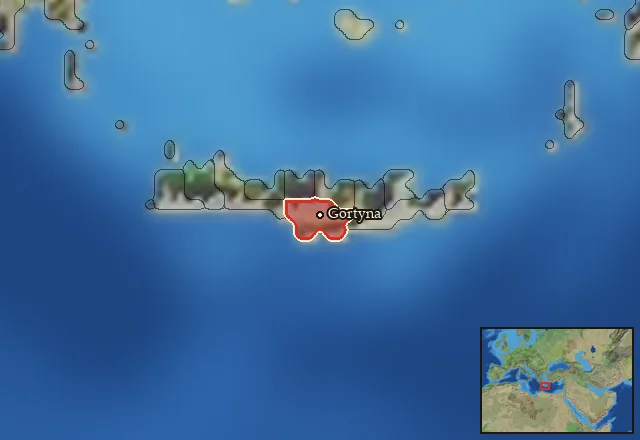
| Zone | Provinces | ||||||
|---|---|---|---|---|---|---|---|
| Gortynian | 1 |