
Herakleiote Epibatai
Class: missile · Category: infantry · Men per unit: 40
Description
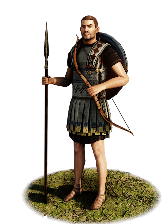
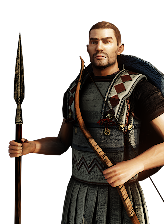
The epibatai of Herakleia are well-trained marines, who are renowned throughout the Greek world. Their equipment combines expedience with resourcefulness. Over their blue or red tunics, which helps their comrades to recognise them, they wear light but reliable linen cuirasses. Some of these linothorakes are reinforced with small metal plates or scales, but only over the chest area. Overly heavy armour would mean certain death when falling over the railing on the open sea. For the same reason, these epibatai have done away with helmets. Instead, they use a big, round, wooden aspis shield which can block most missiles or blows. Since the marines are also trained in shooting arrows, they sometimes wear their aspides slung across their backs. In melee, the Herakleiote Epibatai rely on spears, just like hoplites. Thus armed, they can also serve as utility infantry on land.
Historical background
"Few of the hundreds of ancient Greek cities were of more than local significance. Herakleia Pontike was one of those few. From the time of her foundation about 560 BC until the Roman conquest in 70 BC ended her history as an independent state, Herakleia played a leading role in the political affairs of northern Anatolia and the Black Sea basin. Moreover, from her foundation until her capture by the Ottoman Sultan Murad I in 1360 AD, a period of almost eighteen hundred years, Herakleia was an important outpost of Hellenism. Throughout her long history, Herakleia, virtually alone of the Pontic cities, produced a series of intellectuals who made notable contributions to the development of Greek thought, men such as the philosophers Herakleides Pontikos and Chamaileon and the mathematicians Bryson and Amyklas."
– (Burstein, Stanley, Outpost of Hellenism. The Emergence of Heraclea on the Black Sea (1974), p. IX).
The history of Herakleia was always connected to the sea. Founded by colonists from faraway Megara around 560 BC, it possessed an excellent harbour and rich fishing grounds, relying on a fleet to defend its coasts (Xen. Anab. 6,2,1; Ephor. fr. 44a; Arr. Peripl. p. eux. 18). Its naval skills were also applied when the Herakleiotes established their own (sub-)colony, Kallatis, on the western coast of the Black Sea (Ps.-Skymn. 758-759; Memn. 13.1). When the initial democracy had been supplanted by an oligarchy, Herakleia also started expanding over the adjacent coastal towns (Aristot. Pol. 5.1304b1; Graham, The Colonial Expansion of Greece (1982), p. 124). A second major colony, Chersonesos on the coast of western Crimea, followed around 400 BC (Strab. 7.4.2.C308). Kallatis (modern Mangalia) would later gain prominence as a leading city of the Pontic Pentapolis, while Chersonesos (now Sevastopol) remained largely independent until the early medieval period.
In the 4th century BC, the Herakleiote fleet had reached an impressive size and would play a starring role in the Theodosian War. Theodosia (currently Feodosia or Teodosiia) was a Milesian colony in southern Crimea, and the monarchs of the Kimmerian Bosporos coveted its harbour and fertile soils. In 392 BC, Satyros I attacked the city for the first time, but he died under its great walls three years later (Harpokration, s.v. Theodosia). His son, Leukon I, succeeded him as ruler of the Bosporan realm, and was keen to avenge his father. He launched a surprise assault on Theodosia, but Herakleia dispatched a small contingent under the admiral Tynnichos, which arrived in time to save the city by employing a ruse (Polyain. 5.23). Herakleia intervened because it felt Bosporan westward expansion threatened Chersonesos, and the war was probably part of a wider conflict between Ionian Greeks (Olbia, Bosporans) and Dorian Greeks (Chersonesos, Herakleia) over the northern Black Sea (Saprykin, Heracleia Pontica (1997), p. 123). The Herakleiotes then officially allied with Theodosia and assembled a fleet of 40 ships which attacked Bosporan territory and remained victorious when landing its epibatai, upon which many of Leukon's subjects rebelled (Aristot. 2.2.8, Polyain. 6.9.3-4). Even Phanagoreia, the second city of the Bosporan kingdom, eventually switched sides and came to an agreement with Herakleia (Burstein, The War between Heraclea Pontica and Leucon I of Bosporus (1974), p. 402). The Herakleiote navy and its epibatai had won a triumphant victory.
In the 360s BC, however, stasis broke out in Herakleia, when several oligarchic parties were at odds with each other. Eventually, a nobleman called Klearchos seized the opportunity, overthrowing the old elite and liquidating his enemies before establishing a tyranny (Iust. 16.4.10–16.5.4; Polyain. 2.30.1–2). While Herakleia was thus distracted, Leukon struck and conquered Theodosia. The conflict with the Herakleiotes was apparently settled amicably, for we hear of no further Bosporan attempts to encroach on Chersonesos (Dem. 20 (Against Leptines).33; Burstein (1974), pp. 415-416). These developments in Herakleia had no diminishing effect on the quality of its navy, however. In the mid 4th century BC, Aristotle wrote:
“The marines (epibatai) are free men and are a part of the infantry, and it is they who have command and control the crew; and if there exists a mass of villagers and tillers of the soil, there is bound to be no lack of sailors too. In fact we see this state of thing existing even now in some places, for instance in the city of Herakleia; the Herakleiotes man a large fleet of triremes, although they possess a city of but moderate size as compared with others.”
– (Aristot. Pol. 7.5.7.1327b10–16)
A main fleet of 40 triremes, which defeated the Bosporans during the First Theodosian War, was retained by Klearchos and his son Dionysios, and still existed in the 3rd century BC when the RIS campaign starts (Memn. 15.1). In 280 BC, Herakleia also owned an Oktera-Leontophora with 1,600 rowers! Apparently, these were arranged in 40 rows of oarsmen, with 40 men per oar (Saprykin (1997), p. 165). While the military value of this ship was probably minimal, it is an example of a number of absurdly huge Hellenistic vessels that symbolised the might of their owners – the government of Pontic Herakleia, in this case.
After the Seleucid soldier Malakon from Herakleia had stabbed Lysimachos in the battle of Kouroupedion in 280 BC (App. Syr. 64), the city feared Seleucid attack, despite the death of Seleukos I soon after his victory. Accordingly, the Herakleiotes founded the Northern League as an anti-Seleucid coalition, which was joined by Byzantion, Bithynia, Tieion, Chalkedon, Kieros, and Kios (McGing (2018), p. 17; Kaye, The Attalids of Pergamon (2023), p. 188). Antigonos Gonatas may have been a member for a year in 279 BC (Saprykin (1997), pp. 166-167) and Mithridates I of Pontos perhaps for two until 278 BC (Saprykin, The Pontic Kingdom and the Seleucids (2020), p. 227; Saprykin (1997), pp. 171-172). Ptolemy II and Sinope were separate allies of the League in the following years (Saprykin (1997), pp. 174-176). In any case, the Herakleiote navy will have been vital in keeping together and defending this wide array of city states and kingdoms, and it certainly secured Herakleia’s influence over the smaller members. For instance, during the Tomian War in the 250s, the Herakleiote fleet protected its ally Byzantion, which was fighting the Seleucids and the Pontic Pentapolis, against a Seleucid squadron (Memn. 13 & 15).
The historical overview has illustrated how significant the epibatai were in safeguarding Herakleia’s position as a regional power in the Black Sea area. Silver didrachms minted between 345 and 337 BC show Herakles (who else) placing an aspis shield on a trophy (SNG BM 1605-1608; Sear SG 3778). On later silver coinage from the early 3rd century BC, Herakles is depicted with his bow (SNG BMC 1632; cf. Sear SG 3787 for bronze issues from the 2nd and 1st century BC with similar iconography). Greek ships usually carried both archers and epibatai with spears (Zaccarini, Thucydides' Narrative on Naval Warfare (2015), pp. 211-212), but since there are no actual sea battles in RTW, our Herakleiote Epibatai combine both weapons. Linen cuirasses and the lack of helmets make sense, as the marines would not have been keen to drown when falling off their ships, but small metal scales reinforce their armour to make them a more efficient force. Finally, the aspides worn on the back are just damn cool.
Stats
| Rank in roster | ||
|---|---|---|
| Men per unit | 40 | ███······· 30% |
| Attack | 9 | █········· 13% |
| Charge bonus | 8 | ███······· 31% |
| Defence | 39 | ███████··· 70% |
| · armour | 7 | ████······ 42% |
| · defence skill | 27 | █████████· 85% |
| · shield | 5 | ██████···· 57% |
| Morale | 12 | ██████···· 57% |
| Discipline | Normal | |
| Training | Highly trained | |
| Recruitment cost | 2,127 dn | ██████···· 55% |
| Upkeep per turn | 778 dn | ████████·· 75% |
| Turns to recruit | 3 |
Weapons
Its secondary attack is the stronger one: 12 against 9.
| Primary | Secondary | Primary | Secondary | Primary | Secondary | Primary | Secondary | ||||
|---|---|---|---|---|---|---|---|---|---|---|---|
| Attack | 9 | 12 | Charge bonus | 8 | 10 | Type | missile · archery | melee · blade | Damage | piercing | piercing |
| Projectile | arrow | — | Range | 170 | — | Ammunition | 25 | — | Properties | Used just before charging into combat | Light spear (braced against cavalry charges from the front) · +8 attack against cavalry |
Defence
| Primary | Secondary | Primary | Secondary | Primary | Secondary | Primary | Secondary | ||||
|---|---|---|---|---|---|---|---|---|---|---|---|
| Total | 39 | — | Armour | 7 | — | Defence skill | 27 | — | Shield | 5 | — |
Condition and terrain
| Hit points | 1 | Ground: scrub / sand / forest / snow | 0 / -1 / -1 / -1 | Charge distance | 30 | Formations | Square |
Technical stats
| Time between blows (primary / secondary) | 2.5 s / 2.5 s | Extra fatigue in hot climates | 1 | Collision mass per man (1.0 is normal) | 1.08 | Spacing between men: close / loose | 1 × 1.2 m / 2 × 2.4 m |
| Default ranks | 5 |
In battle: Can sap · Very good stamina
Who can recruit it
A core roster unit for one faction, which can raise it anywhere it holds the right building:
Any faction holding one of the provinces below can field it.
Exactly what a settlement must have, route by route (5)
| Building | Also requires | Building | Also requires | Building | Also requires | Building | Also requires |
|---|---|---|---|---|---|---|---|
| Any settlement | Trade Port · Garrison Building or Tier 1 Military Industrial Complex · Herakleiote area of recruitment · Any Government (Dependency, Indirect Rule or Direct Rule) · Tier 2 Colony not built | Indirect Rule | Trade Port · Garrison Building or Tier 1 Military Industrial Complex · Tier 1 Colony | Direct Rule | Trade Port · Garrison Building or Tier 1 Military Industrial Complex · Tier 1 Colony | Homeland | Trade Port · Garrison Building or Tier 1 Military Industrial Complex |
| Any settlement | Trade Port · Garrison Building or Tier 1 Military Industrial Complex · Herakleiote area of recruitment · Dependency or Indirect Rule · Tier 1 Colony not built |
Areas of recruitment
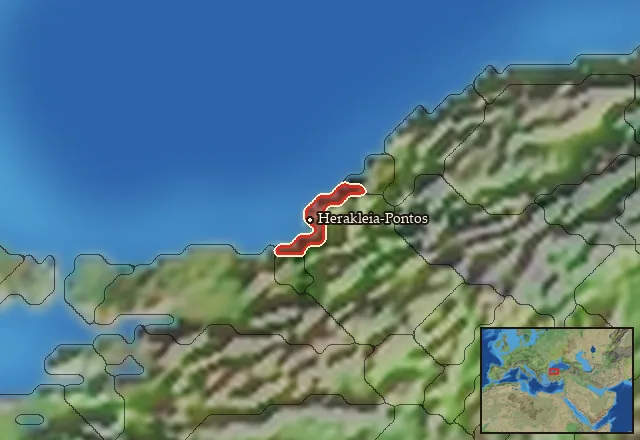
| Zone | Provinces | ||||||
|---|---|---|---|---|---|---|---|
| Herakleiote | 1 |