
Northern Illyrian Cavalry
Class: missile · Category: cavalry · Men per unit: 30
Description
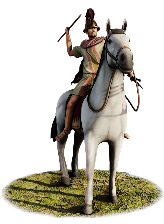
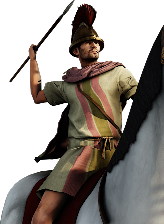
Northern Illyrian Cavalry is an unusually equipped hybrid cavalry unit. They use javelins to skirmish as Illyrians are wont to do, but also have massive, curved Machaira swords, capable of causing huge wounds when carving through unprotected enemies. This would suggest that these men are capable shock cavalry, yet they lack shields or armour, only wearing Negau and Montefortino helmets for protection. Therefore, they can be a brutal unit when used against exposed enemies, but should actively avoid enemy missile fire.
Historical background
The effects of La Tene culture, that of the Celts, were felt all over the lands of Illyria by the 3rd century BC and continued to proliferate well into the early centuries AD. The Iapodes are a good example of how this confused their contemporaries as to who was Celtic and who was Illyrian, as they made use of La Tene equipment but still displayed their own Illyric tattooing habits (Dzino, “The people who are Illyrians and Celts”, in: Arheoloski Vestnik 59 (2008), pp. 415-424). This led Strabo to describe them as “a nation now mixed with the Illyrians, and Kelts” (Strab. 4.6.10), which is a rather broad interpretation of what it is to be either of those rather large and diverse ethnic groups. Pliny the Eldar (HN 3. 25) notes that the Iapodes and Liburnians were the only peoples to live in the Scardona district, so it is probable that they had a lot of cultural exchange between them, too. To the Roman or Greek, it appears that to be Illyrian was mostly a stereotype applied to Illyria and the peoples who dwelt within it. It is rather unsurprising the Illyrians were pigeonholed this way, as the term ‘Celt’ was also liberally applied to people living in temperate Europe who displayed similar cultural trends, styles, and customs yet also did not consider themselves a monolithic identity (Dzino (2008), p. 419). Those designated as barbarian often had common uncivilised traits, with typical literary themes including living in mountainous areas, having dispersed settlements, and relishing in warfare (Sasel Kos, Peoples on the northern fringes of the Greek world. Illyria as seen by Strabo (2008), p. 622), all of which are traits found among various groups of Illyrians.
La Tene material findings are widespread, either directly within or close to many areas of what we consider Northern Illyrian lands, with similar styled bronze fibulae and finger-rings being found from Southern Moravia to the Northern Balkans. Warrior graves in southeastern Alpine and Pannonian areas contain equipment very similar to that found in the necropoleis of the Scordisci dated to the Belgrade 2 phase. La Tene D1 equipment dated to the last third of the second and the first half of the first century BC found in Podravina, Croatia, includes a variety of weapons, helmets, and horse harnesses (Gustin, The Eastern Celts. The Communities between the Alps and the Black Sea (2012), pp. 87-88). From these few examples, we can see that the degree of exposure to the new methods of Celtic warfare, equipment, and general culture was at a high level for most of the areas inhabited by the Northern Illyrians. As such, in RIS we represent the La Tene influence with Montefortino and Negau helmets. This unit’s lack of shields is inspired directly by the Prozor piece from the 2nd century BC, which represents some Illyrian cavalrymen and features the aforementioned Celtic-style helmets, javelins, tunics, with no shields at all (Drechsler-Bižić, "Nekropola prahistorijskih Japoda u Prozoru kod Otočca", in: Vjesnik Arheološkog muzeja u Zagrebu 6–7 (1972), pp. 1-46).
Perhaps the most interesting aspect of the Prozor piece, and this unit, is not derived from La Tene at all, but is entirely Northern Illyrian in origin. The Machaira was a long sabre-like blade that ended with a large angular curve at the hilt that was originally made from bronze, and later iron. This weapon was prevalent for both the Iapodic and Liburian groups on the eastern Adriatic coast and was initially emblematic of the Beserabi culture of the 8th century BC (Mac Gonagle, The Balkan Celtic Machaira (2016), p.1). The Machaira blades used by this unit are based on the Ljubljanica type, found in a moor near the River Ljubljanica, and saw use by both Celts and Illyrians (Mac Gonagle (2016), p. 2), clearly indicating that material culture exchanges were not always one-sided, either!
Stats
| Rank in roster | ||
|---|---|---|
| Men per unit | 30 | █········· 8% |
| Attack | 10 | ██········ 19% |
| Charge bonus | 13 | █████····· 52% |
| Defence | 14 | █········· 6% |
| · armour | 2 | █········· 13% |
| · defence skill | 12 | █········· 9% |
| · shield | 0 | █········· 0% |
| Morale | 7 | █········· 10% |
| Discipline | Normal | |
| Training | Untrained | |
| Recruitment cost | 1,246 dn | █········· 9% |
| Upkeep per turn | 502 dn | ██········ 20% |
| Turns to recruit | 2 |
Weapons
| Primary | Secondary | Primary | Secondary | Primary | Secondary | Primary | Secondary | ||||
|---|---|---|---|---|---|---|---|---|---|---|---|
| Attack | 10 | 4 | Charge bonus | 13 | 14 | Type | thrown · archery | melee · blade | Damage | piercing | slashing |
| Projectile | javelin | — | Range | 60 | — | Ammunition | 7 | — | Properties | Thrown | Armour-piercing (counts only half the target's armour) |
Defence
| Primary | Secondary | Primary | Secondary | Primary | Secondary | Primary | Secondary | ||||
|---|---|---|---|---|---|---|---|---|---|---|---|
| Total | 14 | — | Armour | 2 | — | Defence skill | 12 | — | Shield | 0 | — |
Condition and terrain
| Hit points | 1 | Mount | light horse | Ground: scrub / sand / forest / snow | 0 / 0 / -3 / 0 | Charge distance | 40 |
| Formations | Square |
Technical stats
| Time between blows (primary / secondary) | 2.5 s / 2.5 s | Extra fatigue in hot climates | 0 | Spacing between men: close / loose | 2 × 4.8 m / 3.6 × 6.72 m | Default ranks | 5 |
In battle: Can form Cantabrian circle · Very good stamina
Who can recruit it
A core roster unit for 2 factions, each able to raise it anywhere they hold the right building:
Any faction holding one of the provinces below can field it.
Exactly what a settlement must have, route by route (4)
| Building | Also requires | Building | Also requires | Building | Also requires | Building | Also requires |
|---|---|---|---|---|---|---|---|
| Any settlement | Garrison Building or Tier 1 Military Industrial Complex · Northern Illyrian area of recruitment · Any Government (Dependency, Indirect Rule or Direct Rule) · Tier 2 Colony not built | Indirect Rule | Garrison Building or Tier 1 Military Industrial Complex · Tier 1 Colony | Direct Rule | Garrison Building or Tier 1 Military Industrial Complex · Tier 1 Colony | Homeland | Garrison Building or Tier 1 Military Industrial Complex |
Areas of recruitment
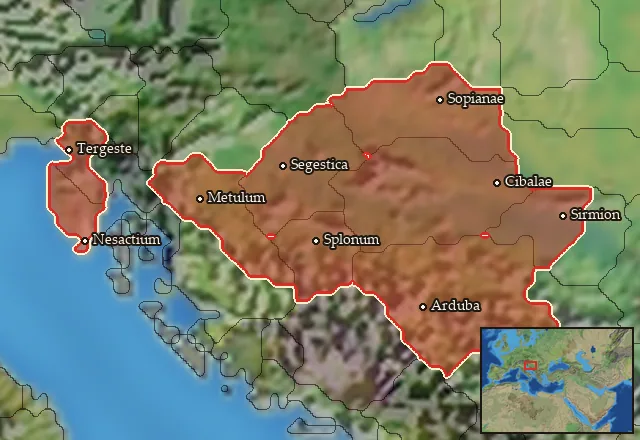
| Zone | Provinces | ||||||
|---|---|---|---|---|---|---|---|
| Northern illyrian | 9 |