
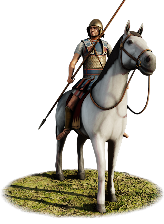
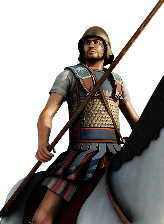
Description
Kabylian Lancers are a heavy cavalry unit, made up of the Macedonian landowners and Thracian nobles around the influential city of Kabyle. Armed with Phrygian and Thracian helmets, sturdy cuirasses, and long lances, they strike fear into the enemy when preparing for a devastating charge. Their deadly xiphoi are then used to cut down fleeing enemies, or anyone who tries to offer resistance.
Historical background
Kabyle was one of the biggest and most influential cities of Hellenistic Thrace, though it is relatively obscure in the written sources that have been preserved. Its first appearance occurs in reference to Philip II of Macedon’s invasion of Thrace. After the death of the Odrysian king Kotys, the Odrysian kingdom split into three parts. The ascension of king Philip II in Macedon occurred about 359 BC, around the same time. Though an anti-Macedonian alliance was formed by Athens, Paionia, the Illyrian kingdom of Bardyllis, and the Odrysians, Philip managed to buy peace from the latter and defeated all others. He then played off the Odrysian rulers against one another and – bit by bit – invaded their territories (Delev, Thrace from Kotys I to Koroupedion (2015), pp. 49-50). After a second invasion in the mid-40s of the 4th century BC, the Thracian kings united against the new danger from the west. The third war (342-340 BC) is only attested in Demosthenes. Though initial progress was slow (Delev, Kotys (2015), p. 50), Philip had successfully managed to take Drongilos, Kabyle and Masteira (Dem. 8.44) and eventually started fortifying them (Dem. 10.15). Archaeologically, Kabyle was already a notable city under the Odrysians and might even have had a local retail marketplace on the agora during the 5th century BC (Delev et al., Ancient Thrace. Myth and Reality (2017), p. 75). After the war, Philip imposed a tribute on the Thracians and installed garrisons, cities, and colonies in important areas, like Philippopolis and Kabyle (Delev, Kotys (2015), p. 51).
Alexander III succeeded Philip, invaded Persia, and died in 323 BC, leaving his giant empire to a number of successors. After a long period of civil wars between the diadochoi, a few of them established themselves as powerful kings over their satrapies and surrounding areas, and among them was Lysimachos in Thrace (361-281 BC). His death at Koroupedion against Seleukos Nikator (258-281 BC) in 281 BC was followed by the murder of Seleukos at the hands of Ptolemy Keraunos (319-279 BC) and an invasion of Macedon, Paionia, and Thrace by a massive Celtic army. The latter split into three parts, with one section under Kerethrios (Lonorios and Lutarios in Liv. XXXVIII.16) attacking the Thracians, who were just busy ousting the Lysimachians (Paus. X.19.7; Pol. XVIII.51.4). All remaining stability in Thrace was shattered, and the Celts that stayed in Thrace established a new kingdom at Tylis (Pol. IV.46.1) while different Thracian dynasts vied for control over their respective regions.
The coinage of a certain King Spartokos falls into that time period, who might have already been a notable ruler before the death of Lysimachos but started minting his own bronze coinage with βασιλέως Σπαρτόκου (‘King Spartokos’) in the city of Kabyle soon thereafter (Delev, Koroupedion (2015), p. 62). His Alexander-type tetradrachms imply not only political autonomy of his Kabylian territory, but also a claim of ruling over a Hellenistic-style kingdom of Thrace, symbolised by his use of Macedonian dynast-iconography of Herakles mixed with Kabylian iconography of Artemis Phosphoros, the patron goddess of Kabyle (Dimitrova, Fifth-fourth century BC Odrysian burial rites (2017), p. 110). An inscription of Seuthopolis (IGBulg. III, 1731), dated before the coinage of Spartokos, reveals the decentralization of the Odrysian realm of Seuthes III centred around Seuthopolis. He was reduced in power to such an extent that he was forced to diplomatically interact with other Thracian rulers like Spartokos on eye-level (Peter, Die Münzen thrakischer Dynasten (1997), p. 174; p. 203). Both Seuthes and Spartokos do not carry the title of "King" in the inscription, which is why it is dated to the rulership of Lysimachos. The death of Seuthes and Lysimachos allowed Spartokos to claim the title of "King of Thrace”, a position he presumably lost with the destruction of Thrace at the hands of the Celts in the early 270s BC (Peter (1997), pp. 206-207).
The title of "King of Thrace" is then handed around between a number of dynasts of unclear origin, maybe even existing at the same time, among them Kotys and his son Rheskuporis (mid-3rd century BC?) around Apollonia, another "Kotys, son of Rhaizdos" in a Delphic decree (270s-260s BC), and a certain Sadalas from a Mesambrian decree (Astaian dynast between 280 BC and the 2nd half of the 3rd century BC). In this chaos, Kabyle continued demonstrating its wealth and influence throughout the 3rd century BC by minting not only royal coinage for the elusive figure of Skostokos (also mid-3rd century BC) and for the last Tylian king Kavaros (220 BC, even mentioned by Polybios IV.46.3; Delev, Koroupedion (2015), pp. 62-63), but also an autonomous coinage of its own. After the end of the Tylian kingdom, Philip V of Macedon (238-179 BC) built a large fleet in the docks of the Chalkidiki for an invasion of eastern Thrace, likely described in lost sections of Polybios (indicated by Stephanus Byzantius). This invasion probably affected Kabyle, the Astai, Adrane, the Digerrioi, and the "plain of Ares" (Pol. XIII.10; Delev, Koroupedion (2015), p. 64). Kabyle became irrelevant in the following two centuries, probably being reduced to one of many cities embroiled in the numerous wars between Thracian dynasts, the Macedonians, and eventually the Romans. It was part of one of Rome’s many Thracian client kingdoms in the area (namely the Odrysians, Sapaioi, and Astai). The eventual annexation of parts of Thrace by Emperor Claudius after the death of the last king Rhoimetalkes (44 AD) led to a provincial administration of Thracian territory and the establishment of an auxiliary military camp at Kabyle (Lozanov, Roman Thrace (2015), p. 80).
The equipment of the Kabylian horsemen is inspired by the coins of King Skostokos, showing him with a helmet, possibly muscle cuirass, and overhand lance (CN 11198; 5192). Furthermore, he carries a xiphos as a secondary weapon, since one has been found together with iron strigils for horses at the tumuli of Kaloyanovo and Topolchane in the hinterland of Kabyle, dated to the 4th or 3rd century BC, which further contained a gold pectoral, gold appliqués, spearheads, and other bronze objects (Emilov, Galatians and Cabyle (2005), p. 329; Dimitrova (2017), p. 111). Heavily armoured Thracian cavalry was already known by the time of Xenophon’s mercenary service at the head of the "Ten Thousand" (Xen. Anab. VII.3.40), where King Seuthes II is accompanied by "cavalry armed with breastplates”. The Phrygian-style helmets, meanwhile, became popular in Thrace in the course of the 4th-3rd centuries BC, as can be seen on the Alexandrovo tomb (dated to the 4th century BC) and the Kazanlak tomb, dated to the 3rd century BC (Meyboom, The Tomb of Kazanlak reconsidered (2010), p. 393).
Stats
| Rank in roster | ||
|---|---|---|
| Men per unit | 30 | █········· 8% |
| Attack | 11 | ███······· 34% |
| Charge bonus | 27 | █████████· 85% |
| Defence | 29 | ████······ 40% |
| · armour | 11 | ██████···· 64% |
| · defence skill | 18 | ████······ 38% |
| · shield | 0 | █········· 0% |
| Morale | 11 | ████······ 39% |
| Discipline | Normal | |
| Training | Untrained | |
| Recruitment cost | 1,945 dn | █████····· 47% |
| Upkeep per turn | 783 dn | ████████·· 76% |
| Turns to recruit | 3 |
Weapons
| Primary | Secondary | Primary | Secondary | Primary | Secondary | Primary | Secondary | ||||
|---|---|---|---|---|---|---|---|---|---|---|---|
| Attack | 11 | 11 | Charge bonus | 27 | 25 | Type | melee · blade | melee · blade | Damage | piercing | slashing |
Defence
| Primary | Secondary | Primary | Secondary | Primary | Secondary | Primary | Secondary | ||||
|---|---|---|---|---|---|---|---|---|---|---|---|
| Total | 29 | — | Armour | 11 | — | Defence skill | 18 | — | Shield | 0 | — |
Condition and terrain
| Hit points | 1 | Mount | medium horse | Ground: scrub / sand / forest / snow | -2 / -1 / -7 / -1 | Charge distance | 40 |
| Formations | Square |
Technical stats
| Time between blows (primary / secondary) | 2.5 s / 2.5 s | Extra fatigue in hot climates | 2 | Spacing between men: close / loose | 2 × 4.8 m / 3 × 7.2 m | Default ranks | 5 |
In battle: Good stamina
Who can recruit it
A core roster unit for one faction, which can raise it anywhere it holds the right building:
Any faction holding one of the provinces below can field it.
Exactly what a settlement must have, route by route (5)
| Building | Also requires | Building | Also requires | Building | Also requires | Building | Also requires |
|---|---|---|---|---|---|---|---|
| Any settlement | Tier 2 Military Industrial Complex · Kabylean area of recruitment · Any Government (Dependency, Indirect Rule or Direct Rule) · Tier 2 Colony not built · Requires resource horses or horses supplied factionwide | Indirect Rule | Tier 2 Military Industrial Complex · Tier 1 Colony · Requires resource horses or horses supplied factionwide | Direct Rule | Tier 2 Military Industrial Complex · Tier 1 Colony · Requires resource horses or horses supplied factionwide | Homeland | Tier 2 Military Industrial Complex |
| Any settlement | Tier 2 Military Industrial Complex · Kabylean area of recruitment · Dependency or Indirect Rule · Tier 1 Colony not built |
Areas of recruitment
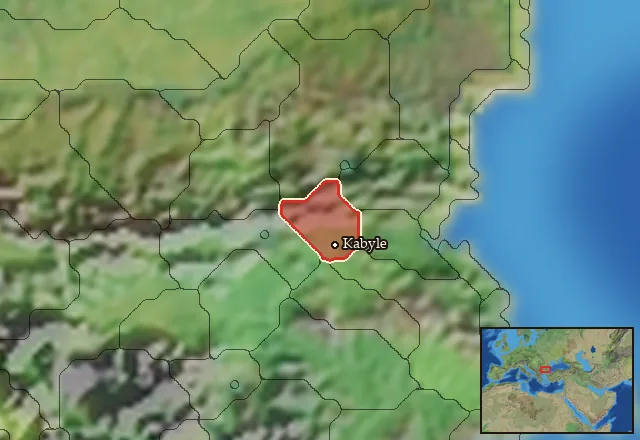
| Zone | Provinces | ||||||
|---|---|---|---|---|---|---|---|
| Kabylean | 1 |