
Description
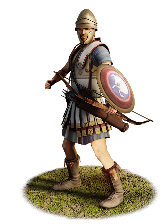
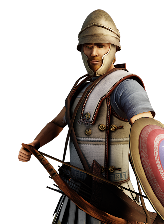
The ancient archers of Crete are among the most famous in history. Armed with Scythian style composite bows, which outrange most other weapons, curved machaira swords for melee, linothorakes with pteryges, bronze helmets (of pilos, Thracian or konos type) or petasos hats, as well as round pelte shields, Knossian Archers are a force to be reckoned with. These men have trained with bow and arrows since childhood, and they honour the divine archer twins Apollo and Artemis. Their city, Knossos, has a proud history of wealth, strength and glory in war, and these soldiers will do everything to live up to that reputation.
Historical background
Archers are already attested in Minoan Knossos during the Late Bronze Age (Warren, Minoan Stone Vases (1969): Rhyton Type A HM 257). They were in fact so popular that Toxotas (literally “archer”) became a common given name in subsequent centuries (Webster, From Mycenae to Homer (2014), p. 104). In the Dorian period (from ca. 800-700 BC), archery retained its vital place in Knossian and Cretan society. Like in other Cretan cities, the twin deities Apollo and Artemis, both of them known for their exceptional skills at archery, were popular motifs on the coins of Knossos. Thus, in the early 3rd century BC, Apollo Karneios, a form of the god based on the ancient Dorian ram deity Karneios, appears on the reverse of Knossian drachmae (Lindgreen II, 1722). This version possibly replaced an earlier series of silver coinage with laureate Apollo on the obverse and Zeus sitting on the labyrinth of Daidalos on the reverse (Svoronos 88, ca. 400-350 BC). In the 2nd century BC, the city magistrate Polchos had a laureate head of Apollo minted on the obverse of the coins during his tenure, combined with the classical labyrinth on the reverse (BMC 41). Finally, after the Roman conquest of the island, a draped Artemis features on Knossian drachmae (RPC 909, ca. 37-34 BC).
This religious connection is not just testified by numismatic evidence, however. From and especially during the Archaic period, arrowheads were often offered as gifts to the gods in the sanctuaries of Knossos and other Cretan cities (Perlman, Of Battle, Booty, and (Citizen) Women (2010), p. 100). Archery was an important part of Knossian education and the military training of young citizens (see the description of the Knossian Agelai), and fallen Knossians were commonly depicted as bowmen on their grave stelae. The Archaeological Museum of Heraklion has one particularly beautiful stela of a young Knossian archer in heroic nudity which the author of this description saw with his own eyes. The efficiency and skills of Cretan archers left quite an impression on their enemies and convinced various powers across the ancient Mediterranean to hire them as mercenaries (see the description of the generic Cretan Archers). Knossian archers also fought in Greece for their ally, the Aitolian League, around 220 BC (Polyb. 4.55.5), as well as alongside the Spartans against the Achaians and Rome in the 190s BC (Liv. 37.60 mentions Roman captives in Knossos a few years later). Kallimachos of Kyrene, the famous court poet and librarian of Ptolemy II and Ptolemy III, accordingly heaped excessive praise on the archers of Crete (Callim. Hymn 3.81-83). Later, in the Thebaid of Statius, a Roman poet of the 90s AD, “Menestheus receives a Knossian bow and errant shafts” (Stat. Theb. 6.723), and in the Dionysiaka of Nonnos, a Graeco-Egyptian author of the 5th century AD, “The lot fell to Asterios; and he taking aim straight at the mast in front of him, with his Knossian bow and the string pulled back from it, let fly the first shot, and hit the string” (Non. Dion. 13.724-727).
Stelae such as the one mentioned above show the Knossian archers with Scythian style composite bows, which were superior to most other ranged weapons in the Mediterranean. They are protected by linothorakes, as depicted for the Greek bowmen on the 4th century Nereid Monument from Xanthos (now in the British Museum), bronze pelte shields (cf. Xen. An. 5.2.29-30, Polyb. 10.29.6), and bronze helmets, mostly of the pilos type (as on the stele of the Lyttian archer Chaitonides in the 2nd century BC (Launey, Recherches sur les armées hellénistiques (1952), p. 282). For melee, they were armed with curved machaira swords (cf. Launey 1952, 282 for the same stela). As shoes the Knossian bowmen wear Cretan boots (like displayed on the Stele of Diodotos son of Palron, a Cretan from Hyrtakina, see: Sekunda, The Ptolemaic Army (1995), pl. 10e).
Stats
| Rank in roster | ||
|---|---|---|
| Men per unit | 40 | ███······· 30% |
| Attack | 11 | ███······· 34% |
| Charge bonus | 5 | ███······· 26% |
| Defence | 25 | ███······· 28% |
| · armour | 7 | ████······ 42% |
| · defence skill | 16 | ███······· 28% |
| · shield | 2 | ███······· 25% |
| Morale | 10 | ███······· 29% |
| Discipline | Normal | |
| Training | Trained | |
| Recruitment cost | 1,808 dn | ████······ 38% |
| Upkeep per turn | 662 dn | ██████···· 56% |
| Turns to recruit | 4 |
Weapons
| Primary | Secondary | Primary | Secondary | Primary | Secondary | Primary | Secondary | ||||
|---|---|---|---|---|---|---|---|---|---|---|---|
| Attack | 11 | 8 | Charge bonus | 5 | 7 | Type | missile · archery | melee · blade | Damage | piercing | slashing |
| Projectile | arrow | — | Range | 170 | — | Ammunition | 25 | — |
Defence
| Primary | Secondary | Primary | Secondary | Primary | Secondary | Primary | Secondary | ||||
|---|---|---|---|---|---|---|---|---|---|---|---|
| Total | 25 | — | Armour | 7 | — | Defence skill | 16 | — | Shield | 2 | — |
Condition and terrain
| Hit points | 1 | Ground: scrub / sand / forest / snow | 0 / 0 / 0 / 0 | Charge distance | 30 | Formations | Square |
Technical stats
| Time between blows (primary / secondary) | 2.5 s / 2.5 s | Extra fatigue in hot climates | 0 | Collision mass per man (1.0 is normal) | 0.96 | Spacing between men: close / loose | 1.1 × 2.6 m / 1.98 × 4.68 m |
| Default ranks | 5 |
In battle: Very good stamina
Who can recruit it
A core roster unit for one faction, which can raise it anywhere it holds the right building:
A further 1 faction can raise it in the provinces below.
Exactly what a settlement must have, route by route (3)
| Building | Also requires | Building | Also requires | Building | Also requires | ||
|---|---|---|---|---|---|---|---|
| Any settlement | Tier 3 Military Industrial Complex · Knossian area of recruitment · Any Government (Dependency, Indirect Rule or Direct Rule) · Tier 2 Colony not built | Direct Rule | Tier 3 Military Industrial Complex · Tier 2 Colony | Homeland | Tier 2 Military Industrial Complex |
Areas of recruitment
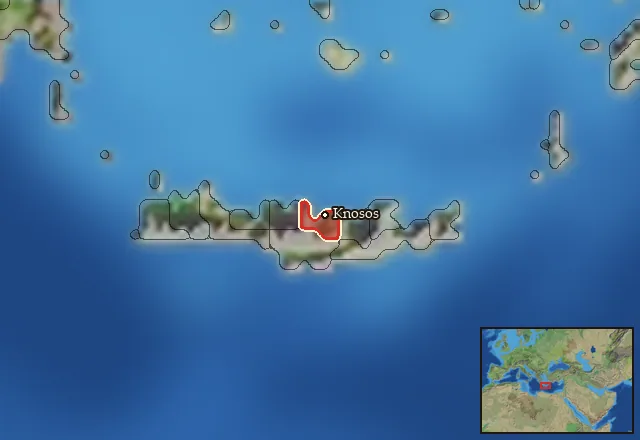
| Zone | Provinces | ||||||
|---|---|---|---|---|---|---|---|
| Knossian | 1 |