
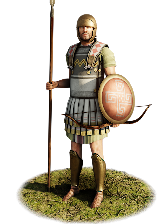
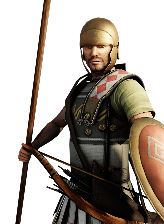
Description
This military unit is a so-called agela (literally "herd") and consists of teenagers who have sworn their life to their leader, a young man from the elite of Knossos. This erastes or philetor (literally "lover”) founded the unit when he ritually abducted a boy from the lower classes, the kleinos (“the famous”) or parastathentes (“by-stander”). The friends of the kleinos would have defended him, and after their staged defeat, they eventually joined philetor and kleinos in hunting wild goats in the barren mountains of Crete. This institution forces the sons of Knossian citizens to learn to survive in the wild and to adapt to fighting with bow, sling, and spear. Somewhat similar to the Spartan Krypteia, it shapes male Cretans into warriors at a young age. In battle, they fight as archers and use the superior Cretan composite bow, but they are also skilled in defending themselves in melee with spear and round pelte shield. Though some of these teenage boys only wear a chiton (tunic) or exomis (half tunic), others can afford a linothorax (linen cuirass) and all are additionally protected by Attic helmets as well as greaves. They are thus much better armed and better prepared for battle than other ephebes in the Greek world.
Historical background
Ancient Crete, pretty much like modern Crete, was a land of old and peculiar traditions. One of these traditions was the ritual kidnapping of young men, which fulfilled an important role in forging networks and binding the different classes of Cretan society together. A young man from the highest class, the erastes or philetor (literally "lover”), chose a younger boy from the lower classes, the kleinos (“the famous”) or parastathentes (“by-stander”), for his good character, not for his looks (Strab. 10.4.21C483=Ephoros FGrHist 70 F149.21). Both the boy and his friends would usually be 17 years old at this point (Hesych. s.v. apagelos). If family and friends of the kleinos considered the erastes an honourable man, they decided that the boy's mates would only offer token resistance (Dynes and Donny, Homosexuality in Ancient Greece (1992), p. 129). The erastes took his ‘victim’ to the mountains and spent time with him to forge a relationship that often involved drinking, physical training, and sex. Eventually, the kleinos received as presents an ox, a drinking cup and a soldier’s cloak (Aristot. fr. 611.15, Dynes/Donny (1992), p. 129). Afterwards, the friends of the kleinos would join the pair and, once the kleinos had sacrificed the oxen to the gods and given the meat to his erastes and companions, they would form a hunting party together (Seelentag, Der Abschluß der Ephebie (2009), p. 157). Their usual prey were wild goats, the most popular target for Cretans ever since the Minoan period (Eiring, The Knossos Hunt, 2004). The Ptolemaic poet Kallimachos of Kyrene (Epigr. 62/63) mentions that Cretan hunters had brought the goats on the holy island of Delos near extinction by the 3rd century BC!
Thus, the teenagers learned to fight with spear and bow and formed a bond: later in life, the boy and his mates would follow the former erastes as their leader, fighting as both archers and hoplites (Ael. De Nat. An. 4.1, Ephoros F149.21; Chrimes, Ancient Sparta (1999), pp. 224-226). The erastes was a member of the Hippeis class and could fight on horseback (Chrimes (1999), p. 227), but while they were young, the whole band would fight as infantry (Perlman, Imagining Crete (2005), p. 308). Their regiments were called agelai (“herds”) and each agela was commanded by the erstwhile erastes (Chaniotis, Age of Conquest (2018), p. 331). The boys would return to their hetaira, the family group of their fathers, at the end of the two year-experience, in order to complete their education. In a grand festival called Hyperboia in Knossos, they were made full citizens (Seelentag (2009), pp. 154-157). The festival always took place in the month Hyperboios (as is already described in an inscription from Dreros in northeast Crete, dating to the 7th century BC: Van Effenterre, bilingue (1946), p. 597), which was consecrated to Zeus (Seelentag (2009), pp. 154-155). Zeus, of course, was the main god of the island, and visitors today will probably go and see one of the caves associated with his early life – so did I, in fact (the cave of Psychro in the territory of ancient Lyttos, if you are wondering). Furthermore, Zeus was the father of Rhadamanthys, who allegedly brought the first laws to Crete, and his brother Minos, the legendary ruler of Knossos (Diod. 4.60.3). His wife Pasiphae famously gave birth to the minotaur until the poor guy was slain by Theseus of Athens in the labyrinth that had been built by Daidalos, the dad of another son who died too early. After his death, Minos, Rhadamanthys and their half brother Aiakaos became judges in the underworld (Hom. Od. 11.568–571). While the cruel Minos was a controversial figure, the labyrinth was seen as a wonder of the world, and though it was lost already by the Archaic period when the Greeks started to write again (the Minoans used the so-called Linear B script, while the Mycenaeans had Linear A), it remained well-known and ever popular. Most of Knossos’ coins from the Classic and Hellenistic period (ca. 500 BC-1st century AD) depict the labyrinth in various forms. One can well imagine the citizens of Knossos trying to solve their individual labyrinth and comparing solutions with others on the street!
Hellenistic Knossos certainly needed its Agelai, for it was almost always at war and expanded, in various alliances with or wars against Gortyn, Kydonia, Lyttos and the other major poleis of the island like Polyrrhenia or Lato. One example may suffice to illustrate why authors like the Achaian Polybios (ca. 200-118 BC) condemned the Cretans as liars and robbers (cf. Polyb. 6.46). Before we come to the example, let us briefly pause on this image. The stereotype seems to have existed already by 600 BC, when the Knossian philosopher Epimenides penned the infamous Epimenides paradox (Fr. I 3B1 Diels-Kranz), which, though directly addressing Zeus, sounds much like an ironic comment on the opinions of other Greeks:
They fashioned a tomb for thee, O holy and high one
The Cretans, always liars, evil beasts, idle bellies!
But thou art not dead: thou livest and abidest forever,
For in thee we live and move and have our being.
In the 3rd century BC, the famous Ptolemaic poet Kallimachos added his own take on this (Hymn I to Zeus, 5-9):
O Zeus, some say that thou wert born on the hills of Ida;
Others, O Zeus, say in Arcadia;
Did these or those, O Father lie? – "Cretans are ever liars".
Yea, a tomb, O Lord, for thee the Cretans builded;
But thou didst not die, for thou art for ever.
The Cretans, then, had thought Zeus dead, and buried him in a grave in the Ida mountains between Knossos and Gortyn. This blasphemy was their crime, but the paradox concerns another point: the Cretans, says Epimenides, were liars, evil and idle, but Epimenides is himself a Cretan, so surely he must be lying! But that means his statement reads: "The Cretans, always speaking the truth”, and yet Epimenides does not! Paul the Apostle, St. Paul himself, later comments on the whole question, and agrees that the Cretans ARE liars (Paul, Ep. Titus 1:12-14). Thus, in any case, the Cretans had a bad press, and the Knossians especially so, but we shall now return to the facts and see that maybe, just maybe, there was a base for it.
In 170 BC, the ambitious Kydonia in western Crete decided to attack its own ally Apollonia on the southwestern coast of the island. This was bad enough, and in fact it awoke the anger of Knossos and Gortyn. While the Kydoniats achieved a quick victory and annexed Apollonia with its territory, Knossos and Gortyn renewed an alliance from 50 years earlier, declared war on Kydonia, and invaded the territory of Apollonia. In the ensuing battle, the coalition prevailed, and the Kydoniats conceded defeat. Knossians and Gortynains disagreed on what to do with Apollonia, however, and immediately went to war with each other over the area in question! From 169-168 BC, the bloody conflict cost many lives, until Gortyn achieved a decisive victory. To appease the Knossians and to escape their anger, they suggested to form a new coalition and to attack Rhaukos, a town situated between the two grand poleis. To avoid a repeat of the Apollonian War, the Gortynians suggested an equal share of the booty. Rhaukos stood no chance against its neighbours and after it had been roundly defeated, Knossos and Gortyn built a new border exactly through the centre of the city, dividing it forever! (cf. Chaniotis, Das antike Kreta (2004), pp. 82-83, for the reconstruction). Knossos had thus annexed Lykastos, Diationion, Tylissos – where I once met a friendly cat – and Rhaukos since the late 4th century BC, creating one of the largest territories any Greek polis ever controlled (Chaniotis (2004), p. 83). Yet, this one case already shows that the means that got them there were not exactly honourable or clean handed. At the end of the day, they were the true heirs of Minos, and since they will have seen that the king, despite all his misgivings, had eventually been given a high post in the underworld, why wouldn’t they act like him, too?
The Agelai will have been a valuable addition to Knossian armies in this period. Since they trained while hunting, we have designed them as a mixed archer/light Hoplite unit, with Cretan composite bows, Phrygian and Attic helmets, linothorakes, round pelte shields, spears, and bronze greaves. Various depictions of Cretan youths at war are known and help to inspire this unit, among them an ephebe from the 1st century BC who mourns the death of his comrades (now in the Archaeological Museum of Heraklion) and a fallen Knossian archer from the 5th century BC, who is depicted on his grave stela in heroic nudity (also in the Archaeological Museum of Heraklion). Therefore, some of the soldiers of the Agela in RIS wear a chiton, some only an exomis, but considering that they were still somewhat of an elite corps (especially the Erastai themselves), a few are also protected by the linen cuirasses.
Stats
| Rank in roster | ||
|---|---|---|
| Men per unit | 40 | ███······· 30% |
| Attack | 9 | █········· 13% |
| Charge bonus | 1 | █········· 4% |
| Defence | 25 | ███······· 28% |
| · armour | 7 | ████······ 42% |
| · defence skill | 16 | ███······· 28% |
| · shield | 2 | ███······· 25% |
| Morale | 6 | █········· 6% |
| Discipline | Low | |
| Training | Untrained | |
| Recruitment cost | 1,389 dn | █········· 12% |
| Upkeep per turn | 508 dn | ██········ 21% |
| Turns to recruit | 2 |
Weapons
| Primary | Secondary | Primary | Secondary | Primary | Secondary | Primary | Secondary | ||||
|---|---|---|---|---|---|---|---|---|---|---|---|
| Attack | 9 | 4 | Charge bonus | 1 | 1 | Type | missile · archery | melee · blade | Damage | piercing | piercing |
| Projectile | arrow | — | Range | 170 | — | Ammunition | 25 | — |
Defence
| Primary | Secondary | Primary | Secondary | Primary | Secondary | Primary | Secondary | ||||
|---|---|---|---|---|---|---|---|---|---|---|---|
| Total | 25 | — | Armour | 7 | — | Defence skill | 16 | — | Shield | 2 | — |
Condition and terrain
| Hit points | 1 | Modifier against mounts | horse +1 · chariot +1 · camel +1 | Ground: scrub / sand / forest / snow | 0 / 0 / 0 / 0 | Charge distance | 30 |
| Formations | Square |
Technical stats
| Time between blows (primary / secondary) | 2.5 s / 2.5 s | Extra fatigue in hot climates | 0 | Collision mass per man (1.0 is normal) | 0.97 | Spacing between men: close / loose | 1.2 × 2.8 m / 2.16 × 5.04 m |
| Default ranks | 5 |
In battle: Very good stamina
Who can recruit it
A core roster unit for one faction, which can raise it anywhere it holds the right building:
Any faction holding one of the provinces below can field it.
Exactly what a settlement must have, route by route (4)
| Building | Also requires | Building | Also requires | Building | Also requires | Building | Also requires |
|---|---|---|---|---|---|---|---|
| Any settlement | Garrison Building or Tier 1 Military Industrial Complex · Knossian area of recruitment · Any Government (Dependency, Indirect Rule or Direct Rule) · Tier 2 Colony not built | Indirect Rule | Garrison Building or Tier 1 Military Industrial Complex · Tier 1 Colony | Direct Rule | Garrison Building or Tier 1 Military Industrial Complex · Tier 1 Colony | Homeland | Garrison Building or Tier 1 Military Industrial Complex |
Areas of recruitment
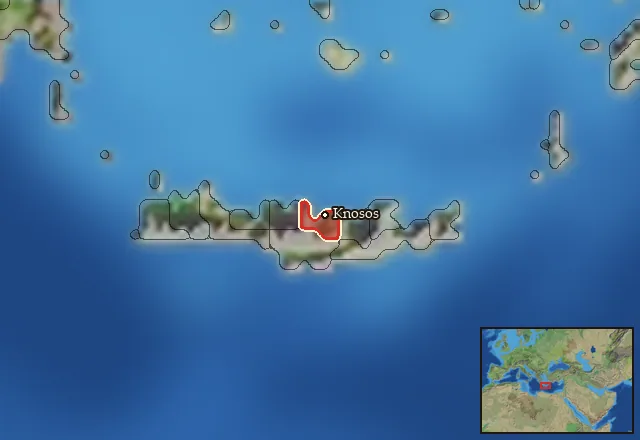
| Zone | Provinces | ||||||
|---|---|---|---|---|---|---|---|
| Knossian | 1 |