
Knossian Hippeis
Class: heavy · Category: cavalry · Men per unit: 30
Reforms: No longer recruitable after Knossian Reforms · Becomes a newer unit with Knossian Reforms
Description
"My bridal bower was Naxos, O Theseus my treacherous bridegroom! I have lost both father and bridegroom: alas my love! I see not Minos, I behold not Theseus; have left my own Knossos, but I have not seen your Athens; both father and fatherland are lost. O unhappy me!” – Princess Ariadne of Knossos, in the Dionysiaka of Nonnos of Panopolis (47.375)
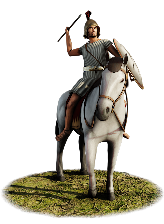
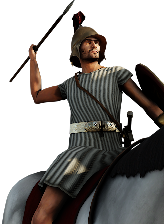
These horsemen are the nobles of Knossos, the most famous city of Crete. As is standard for Greek cavalry, they wear Boiotian helmets (some of them plumed) and a Xyston (lance). Less typical is the use of javelins as a secondary weapon, and unique is the Cretan practice to wear the Aspis shield of the Hoplite. These mounted Hoplites have done away with their body armour for greater agility and pace, but their finely manufactured golden belts, which depict hunting scenes, are evidence of their noble origin. Knossos has always been an oligarchic society, having been ruled by famous kings like Minos in the past, and its wealthiest citizens still retain valuable privileges to this day. Well equipped for skirmishes, melee and relentless pursuits, they are the city’s most formidable force.
Historical background
Knossos is undoubtedly one of the most famous cities of the ancient world. When a merchant from Iraklio/Heraklion, more or less the modern Knossos (cf. Dimopoulo/Wilson/Day, The Earlier Prepalatial Settlement of Poros-Katsambas (2007)), found the site of the Minoan city in the late 19th century, it awoke the interest of learned elites across Europe. Heinrich Schliemann had recently unearthed Troy and Mycene and that the Cretan merchant was ironically called Minos Kalokairinos will have additionally attracted men like the American journalist William J. Stillman and the English archaeologist Arthur Evans. Having arrived on the island in the 1890s, Evans started digging at Knossos in 1900 (Pars, Göttlich aber war Kreta (1965), pp. 133-136). He soon uncovered the site of a palace complex which could only have been the site of the palace of Minos. Surely it had to be, right? Evans himself had a big hand in reconstructing parts of the coloured walls of the palace, the throne of Minos and the wall paintings. Yet, rather than trying to be historically accurate, he followed his own preferences based on early 20th century British art. We may never know if this was the site of Minos’ palace – I myself, when visiting the site, was surprised that it is located in the shadow of a hill instead of being perched on its top like an acropolis – and how it originally looked (cf. Beard, Builder of Ruins, in: Id., Confronting the Classics (2013)). And yet, we have Evans to thank for a renewed interest in Knossos and ancient Crete, which still lures visitors to the island today, and many of them visit not only Knossos, but also Gortyn, Phaistos (another Minoan city near Gortyn) and Malia (a Minoan palace settlement near a popular beach) – while other sites like Tylissos were frequented by larger numbers of cats than humans…
Everybody knows the myths of Minos and the minotaur, Daidalos and Ikaros, Theseus and Ariadne, and the fact that Greek mythology afforded such a prominent place to Knossos also secured its eternal fame and glory. But what do we know about the historical Knossos in the "Greek" period, after the Minoans were gone? In the epics of Homer, who most likely lived in the 8th century BC, Knossos was still known as "a great and large city" (Hom. Od. 19.178). Now Doric in character, it had retained much of the urban territory of the Minoan residence, even though it had lost much of the kingdom's rural area. In the 5th century BC, Knossos forged an alliance with Tylissos (the site of the cats mentioned above), which, being situated only about 15km west of Knossos, used to be one of the towns under its control during the Bronze Age (cf. StV 2.147-148). Knossos’ realm was not only reduced by the emergence of new, independent Poleis like Tylissos: its biggest issue was the rise of Lyttos, Gortyn and Kydonia, which were to become its rivals as part of the four grand powers on Crete. While Gortyn is not populated anymore (aside from Italian archaeologists) and Lyttos but a mere village these days (albeit with a gigantic church), Knossos can be partly equated with Herakleion, the island’s capital, and Kydonia is Chania, the island’s second city. But the greatest honour was bestowed on the four Poleis in early 2023, when they were chosen as the four Cretan factions in RIS. A short passage in Strabo’s Geography, composed in the time of Augustus, illuminates why:
"There are several cities in Crete, but the greatest and most famous are three: Knossos, Gortyna and Kydonia. The praises of Knossos are hymned above the rest both by Homer, who calls it "great" and "the kingdom of Minos" (cf. (Hom. Od. 19.178), and by the later poets. Furthermore, it continued for a long time to win the first honours; then it was humbled and deprived of many of its prerogatives, and its superior rank passed over to Gortyna and Lyktos; but later it again recovered its olden dignity as the metropolis. Knossos is situated in a plain, its original circuit being thirty stadia (ca. 5.5km), between the Lyktian and Gortynian territories, being two hundred stadia (ca. 35km) distant from Gortyna, and a hundred and twenty (ca. 21 km) from Lyttos, which the poet named Lyktos (cf. (Hom. Il. 2.647. 17.611). Knossos is twenty-five stadia (ca. 4.5km) from the northern sea, Gortyna is ninety (ca. 16km) from the Libyan Sea, and Lyktos itself is eighty (ca. 14.5km) from the Libyan. And Knossos has Herakleion as its seaport.” – (Strab. 10.4.7C476)
While there is a bit of a mismatch between Lyttos and Kydonia here (Lyttos is originally not named as one of the three big cities, but Kydonia is not mentioned anymore afterwards), the Pontic historian and geographer is right about Knossos: its fortunes rose and fell continually during the historical period of Greek antiquity. In 344 BC, the city had recovered so much of its former strength that its nobility decided to destroy the irritating Lyttos. A mercenary army from central Greece, led by the Phokian renegade Phalaikos, was hired to support the Cretan army, and, after a short campaign, Lyttos fell. Most of its inhabitants escaped, however, and secured the help of their Spartan brothers, who invaded Crete in force: Knossos was defeated and Lyttos quickly rebuilt (Diod. 16.62.2-4). The next attempt at getting rid of the Lyttians was better planned. Smaller cities like Lykastos and Diationion were annexed, non-aggression pacts with Kydonia and Gortyn forged, and, by the last third of the third century BC, Lyttos stood alone in the face of Knossian supremacy (cf. Chaniotis, Das antike Kreta (2004), p. 83; Polyb. 4.53.4). The Knossians had recently established a permanent coalition with all the other cities, and, in 221/220 BC, the so-called Lyttian War began. Despite their superiority in numbers, weapons, and material, the grand alliance soon started to fall apart. After months, Polyrrhenia, Keraia, Lappa, Horion and Arkadia had abandoned the Knossian side (Polyb. 4.53.5). While the Knossians made some progress on their campaign, the Gortynians, too, began to hesitate, for the younger citizens of the polis had expressed their sympathies for Lyttos at an assembly. When their elder compatriots reminded them that they had promised to support their ally Knossos, a stasis ("civil war") broke out (Polyb. 4.53.6). Once the news reached Knossos, their officials were shocked, and they reacted by immediately dispatching a messenger to the Aitolian League, their ally in mainland Greece. The Aitolians duly transported 1,000 fresh soldiers to Crete, in return for which the Knossians would later provide Aitolia with archers (Polyb. 4.55.5).
Reinforced by Aitolians and troops from Dreros in northeastern Crete (cf. Chaniotis, War in the Hellenistic World (2005), p. 47), the Knossian army now attacked Gortyn, seized the citadel, and exiled or executed the leaders of the young men (Polyb. 4.53.6). This was a huge victory, and when the Lyttians tried to seize the moment by sending their whole force into Knossian territory, the Knossians hurried to Lyttos, which was almost completely bereft of defenders. The Knossians boldly attacked the walls and stormed them at first attempt, routing the Lyttian troops. Only women and children remained, and the Knossians took them back to their city, while setting Lyttos on fire (Polyb. 4.54.1-2). When the Lyttian field army finally returned, they immediately realised they were too late and cried rivers of tears (Polyb. 4.54.3-6). The destruction of Lyttos was a watershed moment in the history of Crete. Even today, every Cretan knows of this triumph or tragedy – whoever you side with – and the author of these lines saw the ashes of Lyttos in the Archaeological Museum of Heraklion.
Yet, the war did not end here: Knossos was edging towards complete victory when its council convinced the Rhodians to attack Eleutherna, a city northwest of Phaistos that had seemingly sided with Lyttos (Polyb. 4.53.1-2). Meanwhile, Lyttos, Lappa and Polyrrhenia had concluded an alliance with the heirs of Alexander: Philip V, king of Macedon, declared his support for their coalition, and his own close ally, the Achaian league, followed suit. They immediately dispatched 300 Greek soldiers and 400 Illyrian mercenaries, while more soldiers and ships were to follow (Polyb. 4.55.1-2, Plut. Philopoimen 7.1-2). These forces soon encircled various cities in western Crete, among them Kydonia and Aptera, and compelled them to desert the Knossians (Polyb. 4.55.4). Next, the surviving Gortynian youngsters seized Phaistos as well as Lebena and Matalon, the harbours of Gortyn (Polyb. 4.55.6, Chaniotis (2004), p. 82). The war continued until 216 BC, when Philip V used his influence and authority to declare Crete a Macedonian protectorate and effect overall peace (cf. Polyb. 7.14.4). The youngsters had eventually freed Gortyn, and the Knossian super-coalition was now history (Chaniotis (2004), p. 82).
Though Knossos had been defeated, it remained a major player, and that it had managed to unite almost the whole island under its leadership in the first place says a lot about its renown and potential. The basis of such influence and power lay not least in its army. Synonymous with ancient Crete are its archers, and while the existence of slingers, javelinmen and infantry has never been doubted, most historians are sceptical that cavalry played a major role in the various Cretan wars (i.e., Perlman, Imagining Crete (2005), p. 308). They feel vindicated because exactly this was claimed by Plato (Leg. 625c–d). And yet, such a view ignores the testimony of Ephoros of Kyme (ca. 400-330 BC), one of the most respected and famous historians of antiquity. According to him (FGrHist 70 F149§18), the Hippeis (“horse owners”) of Crete, unlike those of Sparta, were cavalrymen. This is further confirmed by the many horsemen in archaic Cretan art (most of them are now in the Archaeological Museum of Crete where I saw them) and by the fact that several Cretan poleis provided cavalry to Eumenes II of Pergamon (r. 197-159 BC) in the early 2nd century BC (IC IV179). On a stela from the shrine of Glaukos and Kounabi in Eltyna, probably in Knossian territory, a rider carries a rimmed Aspis shield, uncharacteristic for Greek cavalry before the 2nd century BC (see the description of Aspidophoroi). The image could hail from the 3rd century, however, as the archaeologists suggest in the description of the object in the basement of the Archaeological Museum of Heraklion. While the horseman wears only a quilted tunic on his body, he is equipped with a Boiotian helmet, a spear and two javelins. This is how we have armed the Knossian Hippeis in RIS, who also serve as the bodyguard unit of the Knossian faction.
Stats
| Rank in roster | ||
|---|---|---|
| Men per unit | 30 | █········· 8% |
| Attack | 15 | ███████··· 72% |
| Charge bonus | 22 | ████████·· 77% |
| Defence | 30 | ████······ 43% |
| · armour | 11 | ██████···· 64% |
| · defence skill | 14 | ██········ 18% |
| · shield | 5 | ██████···· 57% |
| Morale | 10 | ███······· 29% |
| Discipline | Normal | |
| Training | Highly trained | |
| Recruitment cost | 1,776 dn | ████······ 35% |
| Upkeep per turn | 715 dn | ███████··· 68% |
| Turns to recruit | 3 |
Weapons
| Primary | Secondary | Primary | Secondary | Primary | Secondary | Primary | Secondary | ||||
|---|---|---|---|---|---|---|---|---|---|---|---|
| Attack | 15 | 10 | Charge bonus | 22 | 27 | Type | thrown · blade | melee · blade | Damage | piercing | piercing |
| Projectile | javelin | — | Range | 50 | — | Ammunition | 2 | — | Properties | Used just before charging into combat | — |
Defence
| Primary | Secondary | Primary | Secondary | Primary | Secondary | Primary | Secondary | ||||
|---|---|---|---|---|---|---|---|---|---|---|---|
| Total | 30 | — | Armour | 11 | — | Defence skill | 14 | — | Shield | 5 | — |
Condition and terrain
| Hit points | 1 | Mount | light horse | Ground: scrub / sand / forest / snow | 0 / -1 / -4 / -1 | Charge distance | 40 |
| Formations | Square |
Technical stats
| Time between blows (primary / secondary) | 2.5 s / 2.5 s | Extra fatigue in hot climates | 2 | Spacing between men: close / loose | 2 × 4.8 m / 3 × 7.2 m | Default ranks | 5 |
In battle: Very good stamina
Who can recruit it
A core roster unit for one faction, which can raise it anywhere it holds the right building:
Any faction holding one of the provinces below can field it.
Exactly what a settlement must have, route by route (5)
| Building | Also requires | Building | Also requires | Building | Also requires | Building | Also requires |
|---|---|---|---|---|---|---|---|
| Any settlement | Tier 2 Military Industrial Complex · Knossian area of recruitment · Any Government (Dependency, Indirect Rule or Direct Rule) · Tier 2 Colony not built · Requires resource horses or horses supplied factionwide | Indirect Rule | Tier 2 Military Industrial Complex · not Knossian Reforms · Tier 1 Colony · Requires resource horses or horses supplied factionwide | Direct Rule | Tier 2 Military Industrial Complex · not Knossian Reforms · Tier 1 Colony · Requires resource horses or horses supplied factionwide | Homeland | Tier 2 Military Industrial Complex · not Knossian Reforms |
| Any settlement | Tier 2 Military Industrial Complex · Knossian area of recruitment · Dependency or Indirect Rule · Tier 1 Colony not built |
Areas of recruitment
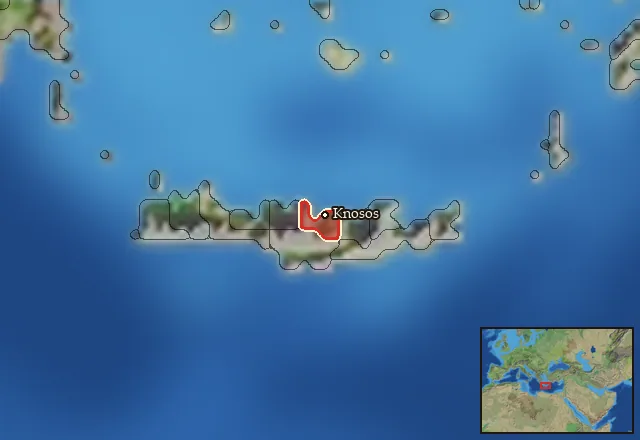
| Zone | Provinces | ||||||
|---|---|---|---|---|---|---|---|
| Knossian | 1 |