
Description
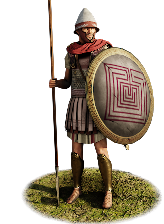
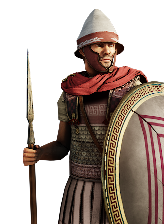
These Hoplites are the citizen force of Knossos, the most famous city of Crete. They are traditionally equipped with muscle cuirasses, additional belly plates, bronze greaves, simple pilos and more elaborate Attic helmets, and wear finely woven cloaks. Fighting in the phalanx with spears like their forefathers, they are a reliable force for the polis and can draw on their xiphos swords in melee.
Historical background
The Archaeological Museum of Heraklion has a series of grave stelae from the ancient Cretan city of Prinias or Rhizinia, which was located ca. 25 km southeast of Knossos. They all show hoplites in full panoply, with crested helmets, round shields, spears and swords. These stelae, which the author of these lines saw with his own eyes, are among the earliest attestations of Greek hoplites (but also see Pautasso, Prinias I (2023), p. 212). Finkelstein (The Philistines in the Bible (2002)) suggested that Cretan hoplites served as mercenaries together with Carians, Ionians and Lydians in the Saite army in 7th and 6th century BC Philistia. Such an idea is partly based on the 6th century BC “Song of Hybrias”, whose author boasts to have been armed with sword, spear, and shield – so at least back then, many Cretans fought as hoplites (PMG 909). In the Classical period, a bronze plaque from the sanctuary of Hermes at Syma Viannou shows another hoplite, probably from Lyttos, which controlled this sacred place (Chaniotis, Heiligtum und Stadtgemeinde (2001), pp. 324-325). Finally, in the Hellenistic period, we find an epitaph from Gaza, written in elegiac form for a late Cretan mercenary named Charmadas, describing how his home town Anōpolis in southwest Crete was subdued by its enemies (Knossians?) by spears (SEG 8.269, ll. ll–12). Other grave inscriptions from the Hellenistic period also mention spears as a Cretan weapon (cf. IC I 16.48 + SEG 28.479 = EHC 15; IC II 23.22; III 4.39) and young citizens in Knossos and elsewhere trained in para-military agelai (“herds”), where they learned to fight in the phalanx (Chrimes, Ancient Sparta (1999), pp. 224-226).
Despite the popular impression that all Cretans fought as archers, there is therefore no doubt that very many were actually hoplites. These Knossian Hoplites differ from most Greek hoplites in that they are using so-called belly-plates, additional bronze armour above the belly and, you know. Several of these have been found in Knossos and are on display in the Archaeological Museum of Heraklion (again, you have to trust the eyewitness). They are often decorated with two pegasi, and so are those in RIS. While the belly-plates are mostly dated to the Archaic period, the description implies they were kept for generations, and Crete was a wild place, where many archaic traditions survived into the Hellenistic period. The Diagramma, for instance, a letter which had fallen out of use in most of the Greek world by the Classic era, was still being used in Crete until the mid 2nd century BC (Chaniotis, Verträge zwischen kretischen Poleis (1996), p. 213). That the ephebes were still organised in the aforementioned Agelai was also exceptional and based on similarly archaic practices (Chanitios, Age of Conquest (2018), p. 331). Therefore, we have given our Knossian Hoplites this extra protection, which makes them more unique and represents the peculiarity of ancient Crete.
Stats
| Rank in roster | ||
|---|---|---|
| Men per unit | 40 | ███······· 30% |
| Attack | 9 | █········· 13% |
| Charge bonus | 14 | ██████···· 60% |
| Defence | 42 | ████████·· 80% |
| · armour | 11 | ██████···· 64% |
| · defence skill | 26 | ████████·· 78% |
| · shield | 5 | ██████···· 57% |
| Morale | 10 | ███······· 29% |
| Discipline | Low | |
| Training | Highly trained | |
| Recruitment cost | 1,677 dn | ███······· 30% |
| Upkeep per turn | 614 dn | █████····· 46% |
| Turns to recruit | 2 |
Weapons
| Primary | Secondary | Primary | Secondary | Primary | Secondary | Primary | Secondary | ||||
|---|---|---|---|---|---|---|---|---|---|---|---|
| Attack | 9 | — | Charge bonus | 14 | — | Type | melee · blade | — | Damage | piercing | — |
| Properties | Light spear (braced against cavalry charges from the front) · +8 attack against cavalry | — |
Defence
| Primary | Secondary | Primary | Secondary | Primary | Secondary | Primary | Secondary | ||||
|---|---|---|---|---|---|---|---|---|---|---|---|
| Total | 42 | — | Armour | 11 | — | Defence skill | 26 | — | Shield | 5 | — |
Condition and terrain
| Hit points | 1 | Ground: scrub / sand / forest / snow | -1 / -1 / -4 / -1 | Charge distance | 30 | Formations | Square |
Technical stats
| Time between blows (primary / secondary) | 2.5 s / — | Extra fatigue in hot climates | 2 | Collision mass per man (1.0 is normal) | 1.26 | Spacing between men: close / loose | 1 × 1.05 m / 2 × 2.4 m |
| Default ranks | 5 |
In battle: Can sap · Very good stamina
Who can recruit it
A core roster unit for one faction, which can raise it anywhere it holds the right building:
Any faction holding one of the provinces below can field it.
Exactly what a settlement must have, route by route (4)
| Building | Also requires | Building | Also requires | Building | Also requires | Building | Also requires |
|---|---|---|---|---|---|---|---|
| Any settlement | Garrison Building or Tier 1 Military Industrial Complex · Knossian area of recruitment · Any Government (Dependency, Indirect Rule or Direct Rule) · Tier 2 Colony not built | Indirect Rule | Garrison Building or Tier 1 Military Industrial Complex · Tier 1 Colony | Direct Rule | Garrison Building or Tier 1 Military Industrial Complex · Tier 1 Colony | Homeland | Garrison Building or Tier 1 Military Industrial Complex |
Areas of recruitment
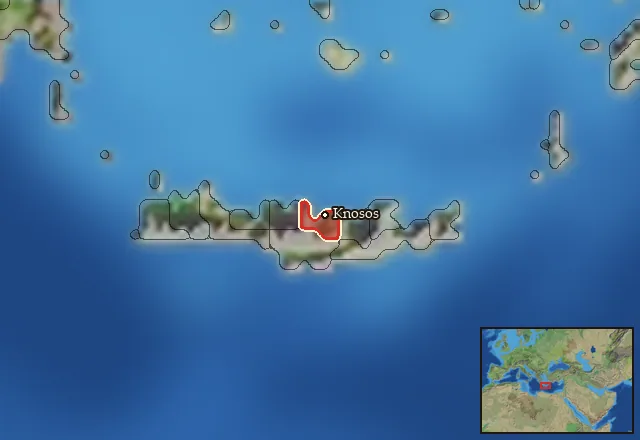
| Zone | Provinces | ||||||
|---|---|---|---|---|---|---|---|
| Knossian | 1 |