
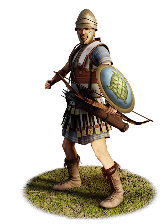
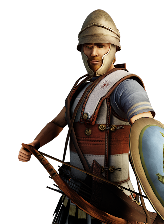
Description
"There is a land called Crete in the midst of the wine-dark sea,
a beautiful and fertile land, seagirt; in it are many
people, innumerable, and there are ninety cities.
Language with language is mingled together. There are Achaians,
there are great-hearted Eteokretans, there are Kydonians,
and Dorians in their three clans, and noble Pelasgians."
– Homer (The Odyssey, 19.172-177).
By far the most famous of Greek archers, the Cretan Archers are renowned as specialist mercenaries throughout Greece and the Eastern Mediterranean. The political instability and endemic warfare of Crete means that a steady supply of Cretans is available for mercenary service overseas. With their composite bows, they outrange most other archers, and due to their experience and skills learned from childhood they are some of the best bowmen of the ancient world. In the Hellenistic period, they are protected by light linothorakes with pteryges, bronze helmets or petasos hats, thick boots, and small, round pelte shields. Should they be forced into a melee, they can defend themselves with their curved machaira swords. The archers of Kydonia are some of the best among the Cretans, and they will fight proudly for the greatest city of western Crete.
Historical background
According to myths, Kydonia was founded by Minos and his son Kydon (Diod. 5.78.2; Paus. 8.53.4), while the Kydoniats themselves claimed that Kydon was a son of Hermes and Akakallis (Paus. 8.53.4), the daughter of Minos, and thus the grandson, and not the son of Minos – but also a demigod, not a quartergod. Archaeological excavations conducted by a team of Greek, Danish and Swedish experts have unearthed a Minoan town on the site of the modern Chania, thus proving that Kydonia, like all the other major cities on the island, had already been established in the Minoan period (Hallager and Tzedakis, Greek-Swedish excavations (1993); Andreadaki-Vlazaki, Hallager and Tzedakis, Greek–Swedish–Danish Excavations at Kastelli (2010)). Kydonia soon became the third largest city on Crete after Knossos and Gortyn (Strab. 10.4.7C476). As Homer implied, the Kydoniats long resisted Dorian colonisation (Hom. Od. 19.176-177) and were probably at least partly Eteokretan, that is, Minoan, and hence not Greek. This would only change in the 6th century BC: Polykrates, the famous tyrant of Samos, who remained invincible as long as he was wearing his signet ring (extensively told in book III of Herodotus’ Histories and later retold in Schiller’s Der Ring des Polykrates), was quelling a rebellion and banished his surviving enemies. These Samians, Dorians by origin, came to Crete in ca. 523 BC and took over the government of Kydonia (Hdt. 3.44.1). They were supported by a party from Aigina, which itself had a mixed Minoan-Ionian-Dorian population (Strab. 8.6.16C376). The Kydoniats were thus a blend of various ethnic groups who came together to form something new.
In 429 BC, during the early stages of the Peloponnesian War, a first war between Kydonia and Gortyn is attested. Gortyn was supporting Polichne, a neighbour of Kydonia, in a battle against the Kydoniats, but when the defenders prevailed, the Gortynians called on Athens for help. The combined fleet of Polichne, Gortyn, and Athens raided Kydonia’s territory and devastated many farms and harbours (Thuc. 2.85.5-6). The city’s high walls kept it safe, however, and since we do not hear about Polichne anymore afterwards, it is likely that the Kydoniats ultimately won the war. The polis is next mentioned in 342 BC, when Phalaikos the Phokian had brought a mercenary army to Crete to assist Knossos in destroying Lyttos. After initial successes, Spartan reinforcements for Lyttos forced Phalaikos to abandon his campaign against the Lyttians (Diod. 16.62.3-4). The restless commander now turned against Kydonia, for reasons we do not know: perhaps, the Knossians tried to destroy another rival, or maybe they only wanted to get rid of the dangerous Phalaikos and his army of thousands of mercenaries. In any case, Kydonia was encircled and besieged, and Phalaikos ordered the construction of the greatest siege engines of the day (Diod. 16.63.2-3). When his mighty towers were rolling against the city walls, a thunderstorm broke out, however; lighting struck the engines, and when the mercenaries and Phalaikos tried to save them, they perished in a great fire, a “divine fire”, as Diodorus put it (Diod. 16.63.3). The Sikeliote historian also provides the explanation that Phalaikos had offended one of his mercenaries and was subsequently struck down by him (Diod. 16.63.4). The rogue commander was dead, Kydonia saved.
In the 270s BC, on Spartan initiative, Kydonia forged an alliance with its eastern neighbour Aptera, while Polyrrhenia and Phalasarna, at the western end of the island, also entered into a symmachia. They were meant to support Sparta during the Chremonidean War against Macedon, just like Gortyn, Itanos, Olous, and Rithymna (Chaniotis, Die Verträge zwischen kretischen Poleis (1996), pp. 32-33). As Aptera was also an ally of Knossos (Polyb. 4.55.4), the latter was given to Knossos in RIS, while Polyrrhenia went to Kydonia. Kydonia’s actual participation in the Chremonidean War (267-261 BC) was minimal, but after the conflict, the city could not escape the bloc building on the island. First, Gortyn and Knossos created their own coalitions, but in the second half of the third century, they all joined one Cretan Koinon (Polyb. 4.53.4). The resistance of Lyttos alone led to the Lyttian War (221-215 BC): the Cretan League attacked Lyttos and the Knossians prevailed in destroying it, but the Lyttian citizens survived and many cities soon deserted the grand coalition (Polyb. 4.53.3-54.6). Polyrrhenia, Lappa and the younger citizens of Gortyn became Lyttos' strongest allies, and they strengthened their case by securing alliances with the Achaian League and Antigonid Macedon. After a small army from the Greek mainland, which included Illyrian mercenaries, arrived on the island, they marched towards Kydonia, which was still clinging to the Knossian case. Kydonia was quickly surrounded and besieged. At this point, the Kydoniats seemingly remembered past grievances with Knossos and agreed to change sides (Polyb. 4.55.1-4). After this, the war was virtually lost for Knossos, but it went on for several years until Philip V of Macedon declared Crete a protectorate of Macedon (Polyb. 7.14.4).
The Cretans did not accept this state of affairs for long, and in the so-called Cretan War (205-200 BC), Macedonian influence was eradicated from the island (Brulé, La Piraterie crétoise hellénistique (1978), pp. 29-55). Knossos and Gortyn renewed their war over the island and fought until the defeat of Antiochos III, the ally of Knossos, in 189/188 BC. At that point, Knossos gave in to rejoin the Cretan Koinon, and together, they turned on Kydonia, which had abstained from the coalition, like Lyttos three decades earlier (Liv. 37.60.3). Later that year, a Roman fleet under the praetor Quintus Fabius Laebo arrived and demanded from both sides to release slaves from Italy they had taken in the wars on the Peloponnese in the 190s BC. Kydonia simply ignored the request, and seeing the city’s strong forces and fortifications, Laebo decided to not risk an attack and sail away (Liv. 37.60.4-5). In the meantime, the Kydonians conquered Phalasarna in western Crete, but soon after, they lost a pitched battle against Gortyn and had to hand over hostages to prevent a siege of their own city (Polyb. 15.15.3). Upon this news, Knossos apparently abandoned the coalition with Gortyn once again, leaving the fate of Crete hanging in the air (Polyb. 15.15.1). In 184 BC, a Roman commission under Appius Claudius arrived on the island, presumably upon Kydonia’s request. They recommended restoring the status quo ante bellum: Kydonia had to give back Phalasarna in return for the hostages and all other conquests, too, were given back to their previous owners (Polyb. 15.15.3-6). In the next year, 183 BC, the reinvigorated Cretan League signed a treaty with Pergamon, which shows that most cities on the island were member states, but Kydonia was not (Syll. 627 = IC 4.179).
Kydonia seemingly became more and more isolated, with Apollonia its last attested ally. What happened next, in 170 BC, must have been the result of desperation, anger and ambition and shocked the Greek world:
"The people of Kydonia at this time committed a shocking act of treachery universally condemned. For although many such things have happened in Crete, what was done then was thought to surpass all other instances of their habitual ferocity. For while they were not only friends with the Apolloniats, but united with them in one community, and shared with them in general all the rights observed by men, there being a sworn treaty to this effect deposited in the temple of Idaian Zeus, they treacherously seized on the city, killing the men, laying violent hands on all property, and dividing among themselves and keeping the women and children, and the city with its territory."
– Polybios (Histories, 28.14.1-3)
Diodorus of Agyrion (1st century BC) would later call the act “monstrous and utterly foreign to Greek custom” (Diod. 30.13.1). Kydonia’s attempt at reclaiming glory and wealth met the fierce resistance of Gortyn and Knossos. The two big cities now turned against Kydonia, defeated its army in a major battle, and freed Apollonia. Nothokrates, the Gortynian general, then led his forces towards Kydonia and almost succeeded in breaching its walls (Polyb. 28.15.1, cf. Chaniotis, Die Verträge (1996), p. 45). The alarmed Kydoniats appealed to Eumenes II of Pergamon (r. 197-159 BC) for help, with whom they, too, seemingly had an alliance. Eumenes dispatched 300 elite soldiers under an officer called Leon to Crete who strengthened the Kydoniat garrison (Polyb. 28.15.2-3). This deterred the Gortynians from further attacks, and instead they spent the next two years (169-168 BC) fighting Knossos over the possession of Apollonia, until Ptolemy VI helped negotiated a new peace (Chaniotis, Das antike Kreta (2004), pp. 82-83).
After the Apollonian War, Kydonia had lost much credit. We do not hear about its participation in any of the further wars of the 2nd century BC, but the erection of a stela in Kydonia’s territory with the peace treaty that ended the long conflict between Lato and Olous at the end of the century may suggest that Kydonia had played a diplomatic role in this process (CI 3, 61). If this is true, Kydonia’s reputation may have been partly restored at this point. Later, it fought with the Cretan League to crush the first Roman invasion of Marcus Antonius Creticus (App. Sic. 6), but fell to the forces of Caecilius Metellus in 69 BC (Konstant. Porphyr. Emb. 8). Yet, its fierce resistance against Antonius was not forgotten, and in 30 BC, Augustus restored Kydonia’s freedom after his own victory over Antonius’ son (Cass. Dio 51.2.3) – a just reward for the brave knights of Kydonia!
Kydonia fought many wars in its long history, and the most important element of its army, like elsewhere on Crete, were always bowmen. On a Hellenistic grave relief from the White Mountains (today called Lefka Ori) south of Kydonia, Cretan archers are shown wearing white tunics (chiton) and headbands (cf. Sekunda, Army of Pyrrhus of Epirus (2019) for various depictions and mentions), but as mercenaries or professional soldiers they probably wore bronze pilos helmets and petasos hats on their heads as well as linothorakes over the clothes – as is depicted among the Greek bowmen on the 4th century Nereid Monument from Xanthos in Lycia which is now in the British Museum (surprise, surprise). Additional protection in skirmishing or melee was afforded by the peltai. These small round bronze or bronze covered shields were a distinctive feature of the Cretan archers (Xen. An. 5.2.29-30). They were strapped to the forearm so as to enable both arms to be free to work the bow. Cretans used the composite bow, a bow of a “Scythian” type, which enabled them to fire quickly and powerfully. Arrows were made of wood, and the arrowheads were large and heavy, with 4.25 inch bronze heads, often barbed or hooked (Du Plessis, Seleucid Army (2022), fig. 31). On their feet they wore either standard Greek military boots or the so-called Endromis shoes that were laced over a broad tongue at the front and can be seen on many contemporary vases. With this panoply, the archers of Kydonia were a force to be reckoned with and a major factor in defending the city’s freedom and assuring Kydonia was one of the three foremost cities on Crete throughout antiquity (Strab. 10.4.7C476). Today called Chania, it is still the second biggest city on Crete, and its archers are not forgotten, as a look in the Archaeological Museum of Chania or, of course, RIS, shows!
Stats
| Rank in roster | ||
|---|---|---|
| Men per unit | 40 | ███······· 30% |
| Attack | 11 | ███······· 34% |
| Charge bonus | 5 | ███······· 26% |
| Defence | 25 | ███······· 28% |
| · armour | 7 | ████······ 42% |
| · defence skill | 16 | ███······· 28% |
| · shield | 2 | ███······· 25% |
| Morale | 10 | ███······· 29% |
| Discipline | Normal | |
| Training | Trained | |
| Recruitment cost | 1,808 dn | ████······ 38% |
| Upkeep per turn | 662 dn | ██████···· 56% |
| Turns to recruit | 4 |
Weapons
| Primary | Secondary | Primary | Secondary | Primary | Secondary | Primary | Secondary | ||||
|---|---|---|---|---|---|---|---|---|---|---|---|
| Attack | 11 | 8 | Charge bonus | 5 | 7 | Type | missile · archery | melee · blade | Damage | piercing | slashing |
| Projectile | arrow | — | Range | 170 | — | Ammunition | 25 | — |
Defence
| Primary | Secondary | Primary | Secondary | Primary | Secondary | Primary | Secondary | ||||
|---|---|---|---|---|---|---|---|---|---|---|---|
| Total | 25 | — | Armour | 7 | — | Defence skill | 16 | — | Shield | 2 | — |
Condition and terrain
| Hit points | 1 | Ground: scrub / sand / forest / snow | 0 / 0 / 0 / 0 | Charge distance | 30 | Formations | Square |
Technical stats
| Time between blows (primary / secondary) | 2.5 s / 2.5 s | Extra fatigue in hot climates | 0 | Collision mass per man (1.0 is normal) | 0.96 | Spacing between men: close / loose | 1.1 × 2.6 m / 1.98 × 4.68 m |
| Default ranks | 5 |
In battle: Very good stamina
Who can recruit it
A core roster unit for one faction, which can raise it anywhere it holds the right building:
A further 1 faction can raise it in the provinces below.
Exactly what a settlement must have, route by route (3)
| Building | Also requires | Building | Also requires | Building | Also requires | ||
|---|---|---|---|---|---|---|---|
| Any settlement | Tier 3 Military Industrial Complex · Kydonian area of recruitment · Any Government (Dependency, Indirect Rule or Direct Rule) · Tier 2 Colony not built | Direct Rule | Tier 3 Military Industrial Complex · Tier 2 Colony | Homeland | Tier 2 Military Industrial Complex |
Areas of recruitment
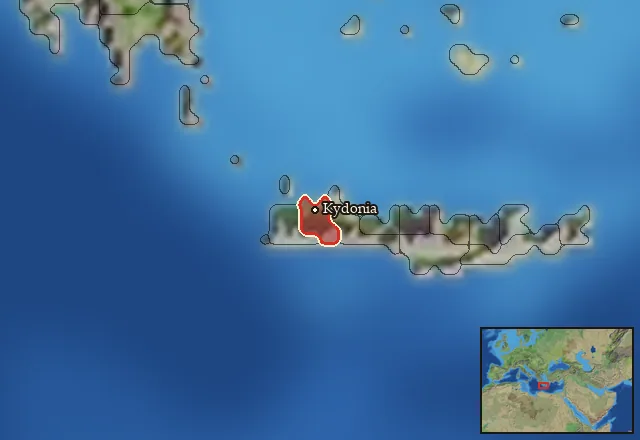
| Zone | Provinces | ||||||
|---|---|---|---|---|---|---|---|
| Kydonian | 1 |