
Liburnian Thureophoroi
Class: spearmen · Category: infantry · Men per unit: 40
Reforms: Unlocked by Second wave of military innovations have arrived!, Illyrian Thureophoroi Reform
Description
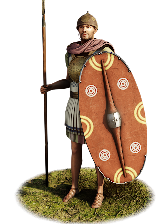
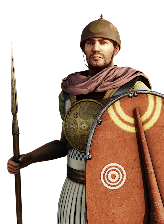
Liburnian Thureophoroi are fearsome Liburnian elite warriors, armed with sharp spears and wearing the finest linothorax armour, often supplemented by bronze chest guards. They further protect themselves by wearing bronze helms and are named after their use of tall, oval thureos shields, of Greek or Illyrian make. The Liburnian Thureophoroi are a force to be reckoned with, drawing from their experience as pirates, nobles and raiders, and should be able to face down most except for the most terrible of foes.
Historical background
The Liburnians have been the subject of much debate as to whether they were indeed Illyrians. Modern consensus is that they were a distinct ethnic group, sharing many characteristics with the Histri and Veneti (Boršić et al., Liburnians and Illyrian Lembs (2021), p. 11). They were renowned for many reasons, including unusual social arrangements, a penchant for piracy, and a strong military. The principal settlements of the Liburni were located in their southern territory, on the coastal plain around Idassa/Iader (Zadar), between the rivers Tedanius (Zrmanja) and Titus (Krka). The term Liburnian seems to have only been gradually applied to their smaller coastal settlements north of Istria after the fourth century BC (Wilkes (1996), p. 187). The Liburnians also controlled several islands such as Curictae (Krk), Arba (Rab), Apsyrtides (Cres-Losinj), Gissa (Pag), and the Kvarner region's Cres and Mali Losinj. As time went on, however, the pressure from their southern Illyrian neighbours saw the Liburnians losing territory to the Ardiaei and Delmatae. By the first century BC, they were much reduced and pushed further north – in stark contrast to their original territory that spanned from Corfu up to the Adriatic (Wilkes, The Illyrians (1996), p. 188).
Liburnian communities were distinct from other Illyrian groups, with clearer social complexity and long periods of intensive contacts with Magna Grecia and Italy. This meant they often influenced those nearby to them (Borsic et al., Liburnians and Illyrian Lembs (2021), pp. 12-13). Pseudo-Scylax (22.1) claims the Liburnians “were ruled by women”, which at least indicates that women played a much more prominent role in politics and public life compared to among their direct neighbours, the Greeks, or Italic peoples. They and the Veneti both shared certain characteristics in root names, such as starting names with Volt- or Vols-, or ending with -icus and -odus. This contrasts starkly with other Illyrian cultures on the Adriatic coast as the majority of Liburnian names are not found in their southern and eastern neighbours, excluding some border provinces (Wilkes (1996), p. 78), perhaps implying that these originally strong southern Liburnian provinces were gradually taken over and the Liburnian populace replaced as their power waned. The Liburnian league were slower to absorb Greek influence than their South Illyrian neighbours such as the ethnic Illyrians, the Autariatae, Dardani and Scordisci (Dzino, Deconstructing ‘Illyrians’ (2008), p. 49.) The economic and political influence of the Greeks in the centre and Adriatic areas of Illyria had a significant effect on the development of Illyrian identities. The first phrase of influence and expansion during the 5-6th century BC with the establishment of Corcyra (Corfu, an island near Epirus), this phase strengthened an oppositional Liburnian identity through conflict. The second phase was in the 3-4th century BC when the Greeks built more poleis that combined both Greek and local populaces (Dzino (2008), p. 49.) Several scholars such as Stipcevic, (Stipcevic, The Illyrians: History and Culture (1977), p. 110) Borsic, Dzino and Radic trace and highlight the varying degrees of Hellenisation between the coastal Iapodes and Liburni on the one side and the Delmatae of the hinterland on the other side (Borsic et al. (2021), p. 15).
The Liburnians commonly had hillforts, even some major settlements with stone walls such as Varvaria-Bribirska glavica, and within they had evidence of imported Apulian, south Italian, and Greek pottery, also suggesting that the Liburni later embraced a role of an intermediary importer of Hellenistic goods to the Adriatic hinterland and of Latic goods to their south (Terzan and Marinis, The Northern Adriatic (2018), p. 36). The Tilurium Tropaion (a Roman victory trophy made after war against the Delmatae) from the 2nd decade of the 1st century BC has a frieze of a depicting a captured barbarian soldier with a tall thureos shield and armour resembling a linothorax. Whilst the frieze is likely about a Delmatae warrior, this evidence is a compelling enough reason for us to give the Liburnians a Thureophoroi unit as they were in a right place and within the right sphere of influence to have adopted such a military unit perhaps even before their Delmatae neighbours.
Stats
| Rank in roster | ||
|---|---|---|
| Men per unit | 40 | ███······· 30% |
| Attack | 17 | █████████· 87% |
| Charge bonus | 14 | ██████···· 60% |
| Defence | 49 | █████████· 94% |
| · armour | 7 | ████······ 42% |
| · defence skill | 37 | ██████████ 99% |
| · shield | 5 | ██████···· 57% |
| Morale | 14 | ████████·· 79% |
| Discipline | Normal | |
| Training | Untrained | |
| Recruitment cost | 2,306 dn | ██████···· 61% |
| Upkeep per turn | 844 dn | ████████·· 81% |
| Turns to recruit | 4 |
Weapons
| Primary | Secondary | Primary | Secondary | Primary | Secondary | Primary | Secondary | ||||
|---|---|---|---|---|---|---|---|---|---|---|---|
| Attack | 17 | 13 | Charge bonus | 14 | 16 | Type | thrown · blade | melee · blade | Damage | piercing | piercing |
| Projectile | javelin | — | Range | 50 | — | Ammunition | 2 | — | Properties | Used just before charging into combat | Light spear (braced against cavalry charges from the front) · +8 attack against cavalry |
Defence
| Primary | Secondary | Primary | Secondary | Primary | Secondary | Primary | Secondary | ||||
|---|---|---|---|---|---|---|---|---|---|---|---|
| Total | 49 | — | Armour | 7 | — | Defence skill | 37 | — | Shield | 5 | — |
Condition and terrain
| Hit points | 1 | Ground: scrub / sand / forest / snow | 0 / -1 / -1 / -1 | Charge distance | 30 | Formations | Square |
Technical stats
| Time between blows (primary / secondary) | 2.5 s / 2.5 s | Extra fatigue in hot climates | 1 | Collision mass per man (1.0 is normal) | 1.09 | Spacing between men: close / loose | 1 × 1.2 m / 2 × 2.4 m |
| Default ranks | 5 |
In battle: Can hide in long grass · Can sap · Very good stamina
Who can recruit it
A core roster unit for one faction, which can raise it anywhere it holds the right building:
Any faction holding one of the provinces below can field it.
Exactly what a settlement must have, route by route (4)
| Building | Also requires | Building | Also requires | Building | Also requires | Building | Also requires |
|---|---|---|---|---|---|---|---|
| Any settlement | Tier 3 Military Industrial Complex · Second wave of military innovations have arrived! · Liburnian area of recruitment · Any Government (Dependency, Indirect Rule or Direct Rule) · Tier 2 Colony not built | Direct Rule | Tier 2 Military Industrial Complex · Illyrian Thureophoroi Reform · Tier 2 Colony | Homeland | Tier 2 Military Industrial Complex · Illyrian Thureophoroi Reform | Any settlement | Tier 2 Military Industrial Complex · Second wave of military innovations have arrived! · Liburnian area of recruitment · Dependency only · Tier 1 Colony not built |
Areas of recruitment
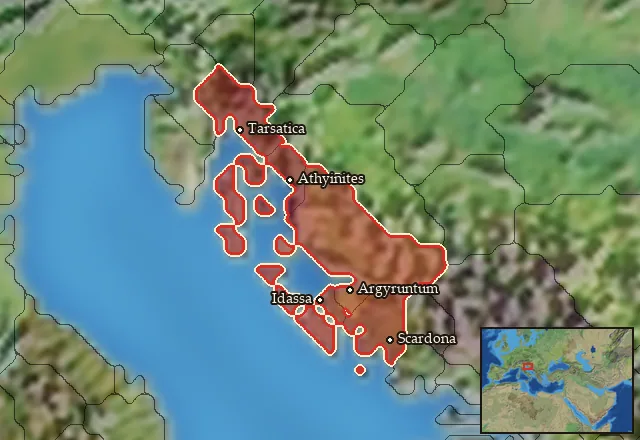
| Zone | Provinces | ||||||
|---|---|---|---|---|---|---|---|
| Liburnian | 5 |