
Description
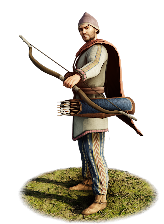
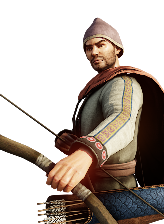
These Maiotian archers use Scythian composite bows to attack their enemies from great range. Hailing from the outskirts of Scythia, they are familiar with archery from childhood and always carry arrows with them in their gorytoi (bow cases and quivers in one). The traditional Scythian short sword, the akinakes, serves for melee, though some men now prefer Greek types such as the straight xiphos or the curved machaira. While clad in the same long-sleeved tunics, pointy caps, belts, and boots as their Sindian neighbours, the Maiotians more often possess armour and helmets. Konos, Pseudo-Illyrian domed, or Pseudo-Chalcidian domed helmets – all with cheek guards – have gained some popularity and are even imported all the way from the Aegean. Hellenic linothorakes are complemented by Scythian rawhide scale cuirasses, but the majority of these men are happy to stick with simple tunics and cloaks. Archers in the steppe eschew carrying shields in favour of mobility and should therefore be kept out of melee.
Historical background
“As long as the Persians were traversing the Scythian and Sauromatic territory there was nothing for them to harm, as the land was dry and barren. But when they entered the country of the Budinoi, they found themselves before the wooden-walled town; the Budinoi had abandoned it and left nothing in it, and the Persians burnt the town. [2] Then going forward still on the horsemen’s track, they passed through this country into desolation, which is inhabited by no one; it lies to the north of the Budinoi and its breadth is a seven days' march. [3] Beyond this desolation live the Thyssagetai; four great rivers flow from their country through the land of the Maiotians, and issue into the lake called the Maiotian; their names are Lykos, Oaros, Tanaïs, Syrgis.”
– Herodotus (Histories, 4.123)
The Maiotian Lake described here by Herodotus corresponds to the modern Sea of Azov, an inland shelf about double the size of the Peloponnese which is attached to the northeastern end of the Black Sea, beyond the Kimmerian Bosporos (Strait of Kerch). Lake Maiotis must have been known to Greeks since at least the Milesian colonisation of the Crimean coast in the late 6th century BC, but it is not mentioned in any source available to us before Herodotus and Aischylos (Prometheus Bound, l, 420), with both texts dating to the mid to late 5th century BC (Ruffell, Aeschylus: Prometheus Bound (2012), pp. 14-18). For Greek authors, both the tribes around Lake Maiotis and those further south, on the Taman Peninsula, were Maiotians (cf. Strab. 11.2.1) – this included the Sindians, the best-known ethnos of the region (see the Sindian unit descriptions for more info). Archaeological evidence, perhaps surprisingly, confirms the seemingly generalising statements of Hellenic observers, since burial and ritual cultures are indeed shared across the whole region (Chandrasekaran, Identifying the Tribes of the Eastern Black Sea Region [2013]).
With the foundation of the Bosporan Arche in 480/479 BC, contacts between Greeks and Maiotians grew closer. Around 400 BC, Satyros I of the Kimmerian Bosporos was the first to try and conquer the kingdom of the Sindians on the Taman peninsula (Polyain. 8.55). When he only managed to win over the Hellenised elites, his son Leukon I had to complete the job, and by the mid 4th century BC, he used the title basileus Sindon (“king of the Sindians”: Gallotta, The Bosporan Kingdom and indigenous Peoples (2014), p. 217). In the Bosporan-Sindian War, the Ixomatai, an eastern Maiotian people, had fought on the side of the Sindian queen Tigartao (Polyain. 8.55). Accordingly, Leukon set his sights on the remaining Maiotians. The Toretians, Psessians, and Dandarians, probably located around the borders of the Sindike towards the north, east, and south, were apparently conquered quickly, since only a few years later, Leukon becomes known as their Archon (Sokolova, New material from the excavation at Nymphaion (2000-2001), p. 86), and then, again only a few years later, king (CIRB 6a = IOSPE II 343). Leukon’s son Pairisades erected an inscription in 310 BC in which he styles himself “king of all Maiotians and Sindians” (CIRB 10). If this is not an exaggeration, the Ixomatai, too, as well as unknown Maiotians to the northeast of Lake Maiotis were subjugated – or decided to emigrate from the area.
The most impressive evidence for Maiotian warriors is a well-preserved limestone statue found in the Kuban in 1896. The man wears a Sindian cap and Sindian clothes with long sleeves and trousers (Medvedeva/Musin, The Imperial Archaeological Commission (1859–1917) (2019), p. 477). He is armed with a bow and a gorytos, and perhaps akinakes. His tunic could also be interpreted as a linothorax (as the wise Jorellaf suggested). Furthermore, there is an excavated settlement in Elizavetovskoe near Ouspe, the capital of the Siraces, which might actually be Maiotian or Sindian. The burials contain spears, swords, arrowheads, a muscle cuirass with a gorgon, scale armour, and a shield covered with iron stripes (Shilov, Novye dannye ob Elizavetinskom gorodiŝe po raskopkam [1952]; Anfimov, Meotskij mogilʹnik I–II vv. n. è. bliz stanicy Elizavetinskoj [1984]). Furthermore, dozens of swords have been found in the Sindike and were collectively published by Krushkol in 2010. Among these, figures 27.46 and 36.59 could be xiphoi, and figures 29.51 & 197.142.1 look like an akinakes (Krushkol, Description of burial associations [2010]). Both of the latter were unearthed in the Anapa region near the farmstead of Rassvet in 1958, which lies on ancient Sindian territory. Meanwhile, figure 74.108 is a beautifully preserved xiphos, figure 80.118 once used to be one, and the same is true for figures 100.148.6 and 203.149.3 (Novichikhin, Grave goods from the Rassvet necropolis [2010]). Archaeological excavations have also achieved much in the search for helmets in Maiotian lands. Among those found are otherwise little-known types termed as pseudo-Illyric and domed (Chalcidian?) helmets, but also konoi and piloi (Symonenko, Sarmatian age helmets (2015), p. 296).
Therefore, the Maiotian archers are very similar to the Sindian archers, but slightly more Sarmatian and less Greek in style. Scythian composite bows and gorytoi are their most important weapons, but akinakes and sometimes xiphoi or machairai are worn so that they can theoretically fight at close-range, too. Most Maiotian bowmen wear pointy Sindian caps with rims, but konos helmets, pseudo-Illyric domed helmets, and Pseudo-Chalcidian helmets – all with cheek guards – also appear commonly. They are all clad in the same style of clothes inspired by the Sindian warrior statue, with long sleeves, cloaks, simple belts, and trousers, and very few own either a linothorax or a scale cuirass made of rawhide as attested in nearby Scythia (Mielczarek (1999), p. 53, n. 204). Maiotians served in the Bosporan army from at least the mid 4th century BC (Mielczarek, Bosporan Army (1999), p. 40), but they are also available as AoR troops or mercenaries.
Stats
| Rank in roster | ||
|---|---|---|
| Men per unit | 40 | ███······· 30% |
| Attack | 10 | ██········ 19% |
| Charge bonus | 1 | █········· 4% |
| Defence | 16 | █········· 10% |
| · armour | 5 | ████······ 35% |
| · defence skill | 11 | █········· 6% |
| · shield | 0 | █········· 0% |
| Morale | 6 | █········· 6% |
| Discipline | Low | |
| Training | Untrained | |
| Recruitment cost | 1,443 dn | █········· 14% |
| Upkeep per turn | 502 dn | ██········ 20% |
| Turns to recruit | 2 |
Weapons
| Primary | Secondary | Primary | Secondary | Primary | Secondary | Primary | Secondary | ||||
|---|---|---|---|---|---|---|---|---|---|---|---|
| Attack | 10 | 4 | Charge bonus | 1 | 9 | Type | missile · archery | melee · blade | Damage | piercing | slashing |
| Projectile | arrow | — | Range | 170 | — | Ammunition | 30 | — | Properties | — | Armour-piercing (counts only half the target's armour) |
Defence
| Primary | Secondary | Primary | Secondary | Primary | Secondary | Primary | Secondary | ||||
|---|---|---|---|---|---|---|---|---|---|---|---|
| Total | 16 | — | Armour | 5 | — | Defence skill | 11 | — | Shield | 0 | — |
Condition and terrain
| Hit points | 1 | Ground: scrub / sand / forest / snow | 0 / 0 / 0 / 0 | Charge distance | 30 | Formations | Square |
Technical stats
| Time between blows (primary / secondary) | 2.5 s / 2.5 s | Extra fatigue in hot climates | 0 | Collision mass per man (1.0 is normal) | 0.88 | Spacing between men: close / loose | 1.1 × 2.6 m / 1.98 × 4.68 m |
| Default ranks | 5 |
In battle: Can hide in long grass · Very good stamina
Who can recruit it
A core roster unit for one faction, which can raise it anywhere it holds the right building:
Any faction holding one of the provinces below can field it.
Exactly what a settlement must have, route by route (5)
| Building | Also requires | Building | Also requires | Building | Also requires | Building | Also requires |
|---|---|---|---|---|---|---|---|
| Any settlement | Garrison Building or Tier 1 Military Industrial Complex · Maeotian area of recruitment · Any Government (Dependency, Indirect Rule or Direct Rule) · Tier 2 Colony not built | Indirect Rule | Tier 2 Military Industrial Complex · Tier 1 Colony | Direct Rule | Tier 2 Military Industrial Complex · Tier 1 Colony | Homeland | Tier 2 Military Industrial Complex |
| Any settlement | Garrison Building or Tier 1 Military Industrial Complex · Maeotian area of recruitment · Dependency or Indirect Rule · Tier 1 Colony not built |
Areas of recruitment
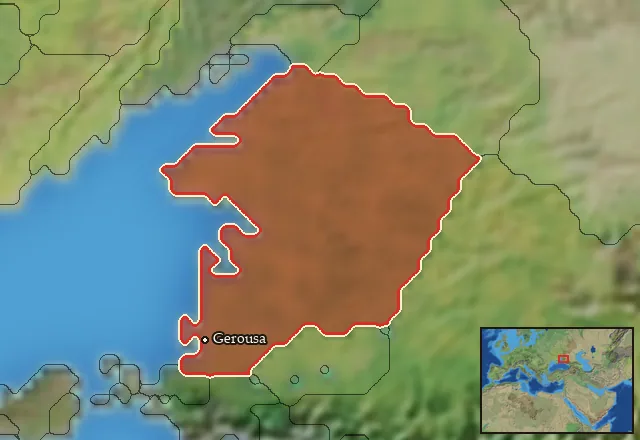
| Zone | Provinces | ||||||
|---|---|---|---|---|---|---|---|
| Maeotian | 1 |