

Description
“They are a very warlike race, and it is said that no triumph was ever awarded for a victory over them except for this single disaster. There had been up to this time a saying, ‘No triumph over Marsians or without Marsians’.” – Appian, The Civil Wars (App. B Civ. 1.46), recording a famous proverb about the Marsi’s military skills following a Roman victory against them during the Social War.
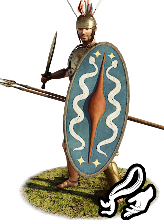
Drawn from the central Apennines surrounding Lake Fucinus, these Marsi Swordsmen serve as shock infantry as part of the allied contingents of Central Italy. Renowned for their warlike disposition and a lifestyle of austerity and physical hardship, these Marsian soldiers enter battle equipped with a straight, double-edged xiphos sword, throwing heavy javelins at their enemies. They are protected by a large oval thureos featuring local cultural motifs, including the snake, a reminder of their fame for putting snakes to sleep by the use of spells and then robbing the serpents’ teeth of venom. While most of the Marsi fight unarmoured, the wealthier warriors among them are protected by bronze pectorals, a greave on the left leg, as well as bronze Montefortino or Attic-Phrygian helmets, adorned with imposing horsehair crests or side feathers. Their high morale, disciplined formation, and skill in hand-to-hand combat allows them to break through opposing infantry lines and to hold their ground against more heavily armoured enemies.
Historical background
“Beyond the Picentine country are the Vestini, the Marsi, the Peligni, the Marrucini, and the Frentani (a Samnitic tribe); they occupy the mountain-country there, their territory touching upon the sea for only short stretches. These tribes are small, it is true, but they are very brave and oftentimes have exhibited this virtue to the Romans: first, when they went to war against them; a second time, when they took the field with them as allies; and a third time when, begging for freedom and political rights without getting them, they revolted and kindled what is called the Marsic War, for they proclaimed Corfinium (the metropolis of the Peligni) the common city for all the Italiotes, instead of Rome, making it their base of operations for the war and changing its name to Italica; and here it was that they mustered all their followers and elected consuls and praetors. And they persisted in the war for two years, until they achieved the partnership for which they went to war. The war was named "Marsic" after the people who began the revolt” – Strabo, Geography (5.3.11, 5.4.2).
The Marsi were an Oscan-Sabellian mountain people whose territory bordered the Paeligni, Marrucini, Vestini, and Frentani (Liv. 8.29.3–5). They were a small ethnic group related to the Samnites and had a reputation as hardy mountaineers and renowned warriors. They occupied the basin of the now drained Fucine Lake, the valley of the River Giovenco, and the upper River Liri valley, better known as Valle Roveto. The dominating presence of the lake always conditioned the people of this country: the scarcity of land in a mountainous environment and the inconstancy of the lake, lacking in natural emissaries, determined the economy, the social organization, the various types of settlement and culture of the inhabitants, giving rise to astonishing forms of continuity (Letta, 'The Marsi', in: Farney and Bradley (eds.), The Peoples of Ancient Italy (2017), p. 517).
The Marsi are first mentioned in the year 340 BC (Livy 8.6.8), when they allow a Roman army marching towards Capua to pass through their territory (Letta (2017), p. 512). During the Samnite Wars, the Marsi initially fought alongside the Samnites as allies, until 304 BC, when together with the Marrucini, Paeligni, and Frentani they ratified an alliance with Rome, which was renewed in 302 BC, after a short-lived attempt to rebel (Liv. 9.45.18, 10.3.5). Thereafter, they remained consistently on the Roman side during all the wars fought in the Italian peninsula as autonomous allies (socii), obligated to supply specified troop numbers for Roman campaigns, and contributed to many overseas campaigns, their exceptional valour being repeatedly noted by Roman historians. Following the Battle of Sentinum (295 BC), Marsic military units participated in Roman-led military campaigns far beyond the Marsica as early as 294 BC (Liv. 10.37.1–5; Letta (2017), p. 513). Inscriptions in the Latin alphabet utilizing Latin onomastic formulas and Roman military terminology indicate that the Marsic ruling class adopted many aspects of Roman culture at an early date (Letta (2017), p. 513).
As for their society, the unity and stability in Italy enforced by Rome created a safe environment for large-scale sheepherding, which generated immense wealth for a number of elite Marsic families, who later led the Italic insurgency (Letta (2017), p. 514). During the 2nd century BC, the influx of wealth and slaves from Roman Mediterranean expansion caused great socio-economic changes. Wealthy Marsic families began to engage in maritime trade across the Mediterranean as negotiators. M. Attius Peticius Marsus, for instance, operated merchant ships in the Aegean in the mid-1st century BC (Plut. Pomp. 73.4–9; Letta (2017), p. 514).
Regarding their culture, Boardman remarks that in general the inland Italics were less affected by Hellenism than those living in other parts of Italy. To them the Greek world was remote, and they rarely possessed the means to import much either from there or anywhere else. But they did not deliberately resist extraneous influences nor were their mountain habitats completely impenetrable (Salmon, ‘The Iron Age’, in: Boardman et al. (eds.), The Cambridge Ancient History 4 (2008), p. 704). Similar to the tribes of Samnium, the central Italic tribes of Marsi, Paeligni, Vestini, Marrucini, and Frentani were joined in a league (Salmon (2008), p. 714). Pliny the Elder (Natural History, 7.15) records that the Marsi possessed powers against poisonous creatures: "A similar race of Marsi also prevails in Italy, whom they say were born from the son of Circe, and therefore possess a natural power. And yet all men possess venom against snakes: they say that those bitten by their saliva flee as if from contact with boiling water; but if it penetrates the throat, they also die, and this especially in the case of a human mouth that is empty."
Throughout the Middle Republic, Marsic cohorts fought in several Roman military campaigns and battled across Italy and the Mediterranean (Liv. 28.45.12, 44.41). Marsic troops were mobilized as part of the Gallic emergency levy in 225 BC (Liv. 9.19.3–4), and seem to have served against Hannibal at the Battle of Cannae in 216 BC, as well as having volunteered for Scipio Africanus' invasion fleet in 205 BC (Liv. 28.45.12). Silius Italicus (Sil. Pun. 8.495–501) highlights their skills both in battle and as snake charmers, mentioning a curious tale of how the Marsi could enchant them: “They all knew how to wage war, yet the Marsi could not merely fight but also send snakes to sleep by the use of spells, and rob the serpent’s tooth of venom by means of herbs and charms”.
Later, the Marsi proved to be the "most resolute" among the rebelling Italian allies in the early phases of the Social War, acting as the leaders of the coalition (Letta (2017), p. 515). The Marsian leader Poppaedius Silo served as the main commander and leader of the Italian confederacy until he fell in battle in 88 BC after the Marsian forces were defeated by Roman commanders including Lucius Cinna and Caecilius Pius (Liv. Per. 76.e). Diodorus Siculus (Diod. Sic. 37.2) narrates the start of the war: “At this time Quintus Pompaedius Silo, a Marsian, (a person of the highest repute in his country), and Gaius Aponius Motylus, a Samnite, [...] were chosen consuls. […] Having put all things into this good order [...] they threw themselves more intently and earnestly into the prosecution of the war. […] And they were so successful, that they for the most part came off as victors, until Gnaeus Pompeius was made consul and commander in the war, who with Sulla, the general of Cato the other consul, often routed them, and reduced them to such straits, that at length their power was shattered to bits”.
Eventually, Roman military victories and the grant of citizenship broke the unity of the rebellious Italics, leading to peace. Following the conclusion of the Social War, the last remainders of Marsian cultural autonomy rapidly vanished, and, in the course of two generations, their local languages had disappeared (Letta (2017), p. 515). With direct intrusion of the Roman state, the middle-Apenninic peoples experienced a radical change in forms of settlement and administrative organization, and the Marsi experienced the Roman administrative reforms as especially invasive. The Roman urban model was superimposed on their old social structures, with five municipia being founded on top of the older network of pre-urban small oppida and rural settlements (Letta (2017), pp. 515–516).
The establishment of municipia initiated a period of rapid economic growth and an intense civic building competition among leading families, “eager both to gain prestige and gratitude in their communities through their contribution to the monumentalization of towns and sanctuaries, and to reaffirm their power through the magnificence of their houses” (Letta (2017), p. 516). By the period of the late Republic and early Principate, Marsic families had been effectively integrated into the Roman state, with severa; local families entering the Roman Senate (such as the Vettii Scatones, Octavii Balbi, and Octavii Laenates) and the equestrian order (such as Q. Fresidius Pedo in 23 AD) (Letta (2017), p. 516).
Stats
| Rank in roster | ||
|---|---|---|
| Men per unit | 40 | ███······· 30% |
| Attack | 17 | █████████· 87% |
| Charge bonus | 13 | █████····· 52% |
| Defence | 41 | ████████·· 76% |
| · armour | 6 | ████······ 38% |
| · defence skill | 30 | █████████· 93% |
| · shield | 5 | ██████···· 57% |
| Morale | 15 | █████████· 91% |
| Discipline | Normal | |
| Training | Highly trained | |
| Recruitment cost | 2,088 dn | █████····· 53% |
| Upkeep per turn | 764 dn | ███████··· 74% |
| Turns to recruit | 4 |
Weapons
| Primary | Secondary | Primary | Secondary | Primary | Secondary | Primary | Secondary | ||||
|---|---|---|---|---|---|---|---|---|---|---|---|
| Attack | 17 | 13 | Charge bonus | 13 | 14 | Type | thrown · blade | melee · blade | Damage | piercing | piercing |
| Projectile | javelin | — | Range | 50 | — | Ammunition | 2 | — | Properties | Used just before charging into combat | — |
Defence
| Primary | Secondary | Primary | Secondary | Primary | Secondary | Primary | Secondary | ||||
|---|---|---|---|---|---|---|---|---|---|---|---|
| Total | 41 | — | Armour | 6 | — | Defence skill | 30 | — | Shield | 5 | — |
Condition and terrain
| Hit points | 1 | Ground: scrub / sand / forest / snow | 0 / -1 / 0 / -1 | Charge distance | 30 | Formations | Square |
Technical stats
| Time between blows (primary / secondary) | 2.5 s / 2.5 s | Extra fatigue in hot climates | 1 | Collision mass per man (1.0 is normal) | 1.05 | Spacing between men: close / loose | 1 × 1.2 m / 2 × 2.4 m |
| Default ranks | 5 |
In battle: Can sap · Very good stamina
Who can recruit it
No faction has this on its core roster: it can be raised only in the provinces below.
Any faction holding one of the provinces below can field it.
Exactly what a settlement must have, route by route (1)
| Building | Also requires | ||||||
|---|---|---|---|---|---|---|---|
| Any settlement | Tier 2 Military Industrial Complex · Paelignian area of recruitment · Dependency or Indirect Rule · Tier 1 Colony not built |
Areas of recruitment
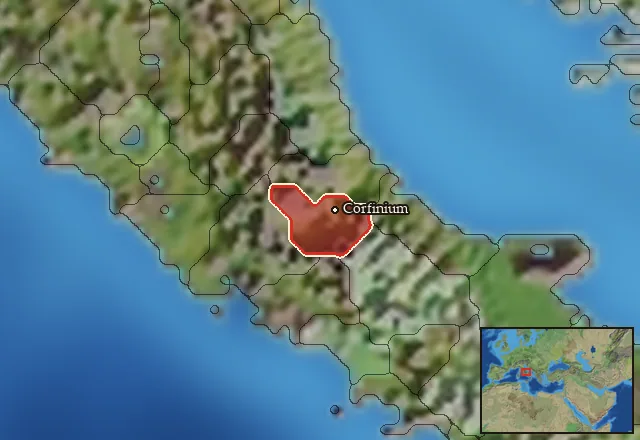
| Zone | Provinces | ||||||
|---|---|---|---|---|---|---|---|
| Paelignian | 1 |