
Mercenary Aitolian Slingers
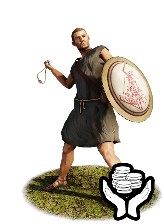

Mercenary. Hired from a regional pool, not recruited from a building.
Class: missile · Category: infantry · Men per unit: 40
Description
The sling is a very common sight on the battlefields of Ancient Greece. Being relatively easy to learn, its usage is often taught from early childhood in shepherding communities, who have to protect their herds from predators. This includes the mountainous regions of Akarnania and Achaia, home to the best-known slingers of the Greek world, and likely also Aitolia, which is better known for its peltasts, but likely had good slingers of its own. In battle these men wear simple tunics and Kausia hats, as worn by the goddess Aitolia on Aitolian coins (SNG Cop 10, Cop 13ff, etc.). They are protected by a pelte shield on their arm and use a dagger as a backup weapon, though it is for the best if they stay out of close combat. The Aitolian Slingers are available both as citizens and as mercenaries.
Historical background
Aitolia’s landscape is described by Strabo as "rough and wretched" (10, 2, 3), a mountainous terrain that likely affected Aitolia’s economic and military situation (Mackil, Common Polity (2013), p. 277). These circumstances encouraged pastoralist practices among most of the Aitolian peoples, who lived as livestock herders in decentralized and scattered open villages, protecting themselves with the arms they carried with them in the fields (Thuc. I, 5, 2f). The livestock and its produce were sold at the poleis in the valleys or near the Corinthian Gulf. This included, beside the Aitolian markets of Thermon or Naupaktos, the Achaian polis of Patrai, which was regularly frequented by Aitolians. Though the Achaians and Aitolians were enemies for most of the Hellenistic period, small time frames of alliances between them, as well as between the Aitolian League and Elis, resulted in continuous contact between Aitolia and the north-western Peloponnese, best known for its slingers (Liv. XXXVIII, 29, 4-7; Mackil, Common Polity (2013), p. 282). During the invasion of the Galatians in 280/279 BC and their incursion into Aitolia, Patrai was the only Achaian polis to militarily support them, although their contingent of hoplites was not able to rout the plundering Celts. In the end, it was the lightly armed Aitolian home levy that effectively dislodged the Celts from Aitolia. Their tactics are described in Pausanias’ description of Greece:
‘‘But the Aitolians, men and women, drawn up all along the road, kept shooting at the barbarians, and few shots failed to find a mark among the enemies protected by nothing but their national shields. Pursued by the Gauls they easily escaped, renewing their attack with vigour when their enemies returned from the pursuit.” (Paus. X, 22, 6)
This section, one of many, demonstrates how the Aitolians of the Classical and Hellenistic periods mainly fought in a manner that complemented the rugged terrain and the arms they would use in day-to-day life. Their weapons would have been simple and easy to learn from childhood, like the shepherd’s sling to scare away predators (Bardunias, Ray Jr., Hoplites at War (2016), p. 147), or the javelin for skirmishing or pirate raids against other tribes and settlements. The development of fortified centres of retreat and cooperation beyond these tribal structures did lead to a common identity and organizational efforts that allowed the Aitolians to defend their land against outside attacks (Mackil, Common Polity (2013), p. 56). During the Peloponnesian War, the Messenians in Naupaktos persuaded the Athenian general Demosthenes to attack the neighbouring Aitolians, who supposedly were easy to conquer due to their unwalled villages and their light armour (Thuc. III, 94, 3f). The incursion was met by Aitolian light troops, who fell back into the mountains and harassed the heavily armed hoplites from afar. At Aigition, Athens lost 120 hoplites, "the best men in the city of Athens" and had to retreat to Lokris (Thuk. III, 98, 4).
In another instance, the Aitolians participated in the Lamian War (323 – 322 BC) with 7,000 soldiers (Diod. XVIII, 9, 5) against Macedon but returned home earlier because of internal affairs (Diod. XVIII, 13, 4). After the Greeks were defeated, the Macedonian generals Antipater and Krateros marched into Aitolia, where the citizens had abandoned their cities and sought shelter in the mountains. Similar to the wars against Athens or the Gauls, pursuing the Aitolians in unfavourable terrain caused many casualties among the Macedonians and seeing a lack of success, they planned to starve them out during the winter. Urgent business in Asia, however, forced them to make a quick peace with the Aitolians and leave them unpunished (Diod. XVIII, 24-25).
This effectiveness of the Aitolians in ranged combat made them popular as mercenaries. They are attested in army of Demetrios Poliorketes (Polyain. IV, 9, 2), as pirates with Antigonos Gonatas and Philip V, and among the cavalry and infantry of Pyrrhos’ forces (Griffith, The Mercenaries of the Hellenistic World (1935), p. 245; Dion. Hal. XX, 1, 2).
Stats
| Rank in roster | ||
|---|---|---|
| Men per unit | 40 | ███······· 30% |
| Attack | 7 | █········· 6% |
| Charge bonus | 1 | █········· 4% |
| Defence | 12 | █········· 4% |
| · armour | 1 | █········· 0% |
| · defence skill | 9 | █········· 3% |
| · shield | 2 | ███······· 25% |
| Morale | 7 | █········· 10% |
| Discipline | Low | |
| Training | Untrained | |
| Upkeep per turn | 477 dn | ██········ 18% |
Weapons
| Primary | Secondary | Primary | Secondary | Primary | Secondary | Primary | Secondary | ||||
|---|---|---|---|---|---|---|---|---|---|---|---|
| Attack | 7 | 3 | Charge bonus | 1 | 1 | Type | missile · archery | melee · simple | Damage | blunt | piercing |
| Projectile | stone | — | Range | 150 | — | Ammunition | 35 | — |
Defence
| Primary | Secondary | Primary | Secondary | Primary | Secondary | Primary | Secondary | ||||
|---|---|---|---|---|---|---|---|---|---|---|---|
| Total | 12 | — | Armour | 1 | — | Defence skill | 9 | — | Shield | 2 | — |
Condition and terrain
| Hit points | 1 | Ground: scrub / sand / forest / snow | 0 / 0 / 0 / 0 | Charge distance | 30 | Formations | Square |
Technical stats
| Time between blows (primary / secondary) | 2.5 s / 2.5 s | Extra fatigue in hot climates | 0 | Collision mass per man (1.0 is normal) | 0.84 | Spacing between men: close / loose | 1.2 × 2.8 m / 2.16 × 5.04 m |
| Default ranks | 5 |
In battle: Very good stamina
Where to hire it
Mercenaries are hired from a regional pool, not recruited from a building. This unit is offered by 3 pools covering 9 regions, at 3,738–4,187 dn to hire and 0–1 experience.
Mercenary pools: Aitolia Akarnania · Knossos · Odysseus Islands
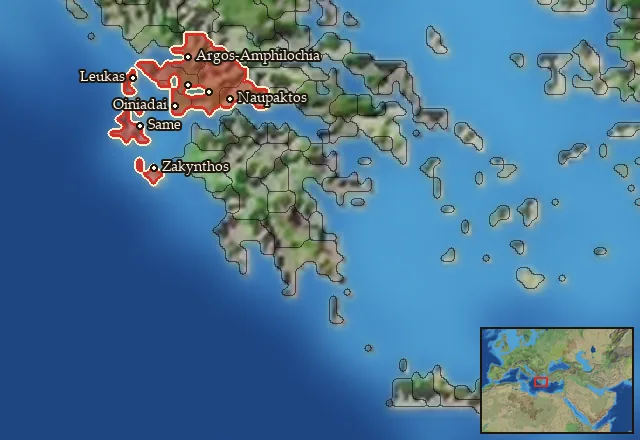
At least one of those pools sells to any faction that has an army in range, with no faction restriction.
Some pools additionally restrict it to Knossos.
The 9 regions where this unit appears in a mercenary pool
Acheloos · Aitolia · Akarnania · Amphilochia · Kephallenia · Leukas · Minoa · Ozolia Lokris · Zakynthos