
Mercenary Cappadocian Cavalry
Mercenary. Hired from a regional pool, not recruited from a building.
Class: heavy · Category: cavalry · Men per unit: 30
Description
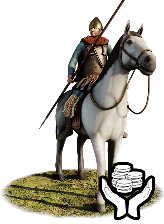
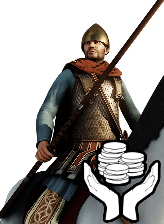
These cavalrymen are the backbone of the Cappadocian army. They are well-armed and well protected. While they are not as heavily armoured as cataphracts, they are faster and their charge is devastating, making them a true force on the battlefield if used wisely. Their main weapon is a long lance, as is the case with every proper heavy cavalry unit. For melee, they use Greek xiphos or kopis swords. Scale-lined linothorakes or leather cuirasses (some without the scales) are worn over long-sleeved tunics and trousers to protect the riders, while their horses are equipped with metal headgear. These cavalrymen wear a selection of conical helmets in the Armenian-Assyrian style made of thick bronze, or typical Hellenistic types. Paphlagonian shoes and colourful cloaks complete their equipment.
Historical background
Cappadocia was a vast region in Eastern Anatolia consisting of highlands, mountains, and valleys, often separated by rivers. Some of its districts were barren, others much more fertile and able to support larger populations as well as armies. Strabo of Amaseia (ca. 63BC-25 AD), the historian and geographer from Pontos, writes about Melitenê, an eastern strategia (province) of Cappadocia:
“[... it is] planted with fruit-trees, the only country in all Cappadocia of which this is true, so that it produces, not only the olive, but also the Monarite wine, which rivals the Greek wines. It is situated opposite to Sophenê; and the Euphrates River flows between it and Commagenê (...). On the far side of the river is a noteworthy fortress belonging to the Cappadocians, Tomisa by name.” (Strab. 12.2.1C535)
Meanwhile, Kataonia, situated to the southwest of Melitenê, “[...] is a broad hollow plain, and produces everything except evergreen-trees” (Strab. 12.2.2C535). And yet, “neither the plain of the Kataonians nor the country Melitenê has a city, but they have strongholds on the mountains, I mean Azamora and Dastarkon” (Strab. 12.26C537). Despite the lack of urbanisation – Strabo accepted only Tyana and Mazaka, the capital, as proper cities (Strab. 12.2.7C537) – the rulers of Cappadocia could raise sizable armies. Its plains and plateaus were ideal for the rearing of horses, and thus, when the diadoch Eumenes of Kardia arrived in the region in 321 BC, he was able to assemble an army of 6,300 horsemen through gifts and promises of tax exemptions (Plut. Eumenes 4.3-4). Dareios had regularly made use of Cappadocian cavalry in the war against Alexander (Arr. Anab. 3.8.5; 11.7; Curt. Ruf. 4.12.12), and Greek observers respected their skills (Anson, Eumenes (2015), p. 91). Ariarathes, the last Achaemenid satrap of Cappadocia, had commanded the grand number of 15,000 mounted soldiers (alongside 30,000 infantry) in 322 BC, proving both the quality of the land’s pastures and its people’s skill in horse riding (Diod. 18.16.2).
At the same time, the Greek authors tell us little about the exact equipment of Cappadocian cavalry. Luckily, the Cappadocian kings liked to portray themselves as horsemen on their coins, with the bronze issues of Ariaramnes and Ariarathes III (between ca. 280 and 220 BC) being especially useful for our purpose. On their reverses, we see riders with lances, pilos-like helmets, tunics with long sleeves, trousers, cloaks, scale armour cuirasses, and metal headgear for the horses (e.g., Simonetta 6; SNG von Aulock 6357; HGC 7, 795 or Simonetta 2a; HGC 7). Duncan Head reconstructed the details of the armour on this basis (Head, Armies (2015), p. 120 & Fig. 55 on p. 121). It fits late Achaemenid horsemen, who often wore scale cuirasses as well (Roy, Warfare in Pre-British India (2015), p. 30). Finally, a rider with lance and conical helmet similar to a pilos also appears on a frieze in the Yozgat Museum in modern Cappadocia (images by pickett.jordan can be found on Flickr: Yozgat Museum, Pontus | museum set in an old konak, includes… | Flickr).
The Cappadocian cavalry in RIS thus wears long-sleeved eastern Anatolian tunics, trousers, colourful cloaks, and Paphlagonian-style shoes which reach up to the knees (cf. Hdt. 7.72.1 for the similarities between Paphlagonian and Cappadocian clothing). Besides the scale-lined linothorakes, they also use scale-reinforced leather cuirasses in the style of Persian cavalry, as can be seen on the 4th century Çan Sarcophagus (Ma, Mysians on the Çan Sarcophagus? [2008]). Their conical helmets were used by the Achaemenids at least as far back as the Battle of Marathon in 490 BC, which we know because one of them survives in the museum of Olympia (Olympia, Archaeological Museum, B5100). A few soldiers wear other helmets typical for the Seleucid army, since Cappadocia had been a Seleucid protectorate until the mid-3rd century BC (Gabelko/Kuzmin, A case of Stratonices: Two Royal Women between Three Hellenistic Dynasties (2019), p. 221). These horsemen’s main weapon is a long lance, while they carry typical Hellenistic xiphos and kopis swords for melee. Their horses, meanwhile, wear frontlets of metal or rawhide frontlets, representing a first step in the development towards cataphracts.
Stats
| Rank in roster | ||
|---|---|---|
| Men per unit | 30 | █········· 8% |
| Attack | 10 | ██········ 19% |
| Charge bonus | 28 | █████████· 86% |
| Defence | 31 | █████····· 46% |
| · armour | 13 | ████████·· 75% |
| · defence skill | 18 | ████······ 38% |
| · shield | 0 | █········· 0% |
| Morale | 11 | ████······ 39% |
| Discipline | Normal | |
| Training | Highly trained | |
| Upkeep per turn | 784 dn | ████████·· 76% |
Weapons
Its secondary attack is the stronger one: 11 against 10.
| Primary | Secondary | Primary | Secondary | Primary | Secondary | Primary | Secondary | ||||
|---|---|---|---|---|---|---|---|---|---|---|---|
| Attack | 10 | 11 | Charge bonus | 28 | 23 | Type | melee · blade | melee · blade | Damage | piercing | slashing |
Defence
| Primary | Secondary | Primary | Secondary | Primary | Secondary | Primary | Secondary | ||||
|---|---|---|---|---|---|---|---|---|---|---|---|
| Total | 31 | — | Armour | 13 | — | Defence skill | 18 | — | Shield | 0 | — |
Condition and terrain
| Hit points | 1 | Mount | half armoured horse | Ground: scrub / sand / forest / snow | -4 / 0 / -8 / 0 | Charge distance | 40 |
| Formations | Square |
Technical stats
| Time between blows (primary / secondary) | 2.5 s / 2.5 s | Extra fatigue in hot climates | 2 | Spacing between men: close / loose | 2 × 4.8 m / 3 × 7.2 m | Default ranks | 5 |
In battle: Good stamina
Where to hire it
Mercenaries are hired from a regional pool, not recruited from a building. This unit is offered by 2 pools covering 11 regions, at 4,357–4,859 dn to hire and 2–3 experience.
Mercenary pools: Cappadocia · Sidon
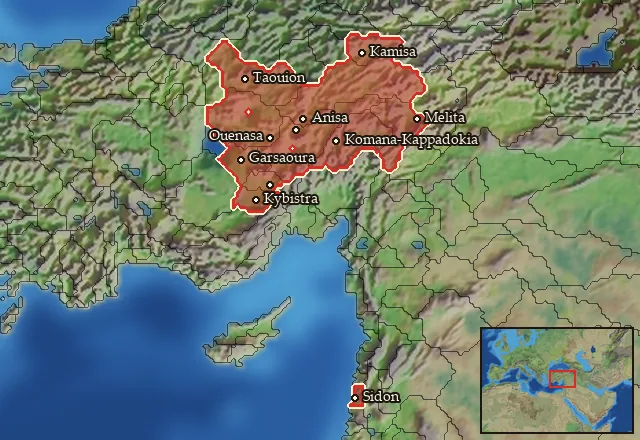
At least one of those pools sells to any faction that has an army in range, with no faction restriction.
Some pools additionally restrict it to Ptolemaic Empire · Ptolemaic Rebels.
The 11 regions where this unit appears in a mercenary pool
Garsaouritis · Kamisene · Kappadokia · Kappadokike Kilikia · Kappadoxia · Kataonia · Melitene · Morimene-Chammanene · Saraouene-Laouiniasene · Tyanitis · Zidun