
Description
"Oh Lord (Apollo), yours is Miletos, charming city by the sea."
– (Homeric Hymn to Apollo, 179)
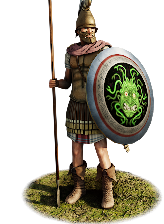
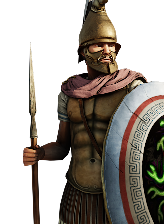
These men are the citizen infantry of wealthy Miletos, the self-proclaimed capital of Ionia. Miletos was once the largest and most important of all Greek cities, home of Hekataios, the first historian and geographer in human history, Thales, the first natural philosopher, and his pupils Anaximander, himself the teacher of the Samian Pythagoras, and Anaximenes. This Ionian Renaissance put the Greeks on the scene of world history, and now, three centuries later, Miletos is striving to reclaim its place under the sun. Though officially acknowledging Ptolemaic authority, it is still an impressive and thriving polis, and its enemies face an army of several thousand hoplites. They are equipped with finely made Ionian muscle cuirasses, reliable military boots, expensive cloaks, colourful Phrygian and crested Attic helmets made of shiny bronze, and bronze covered aspis shields. They fight with the dory, the traditional spear of the hoplite, but if forced into a melee in tight spaces, they can rely on xiphos or kopis swords. Their forefathers have made Miletos known all over the world, and these men will rise to the occasion and be worthy of their ancestors.
Historical background
Miletos, "Capital of Ionia" (Plin. nat. hist. 5.112), was founded in the 14th century BC and was known to the Hittites as Millawanda (for its history: Niemeier, Myceneans (1998)). Four generations after the fall of Troy – if we are to believe the Ionian Herodotus – Neileos, son of Kodros, from Athens founded Miletos anew, but now as an Ionian city (Hdt. 9.97). The existing population was apparently Carian, and after killing the male inhabitants, the Ionian men married the Carian women (Hdt. 1.146). The affluent city grew and expanded continuously, and during the Archaic period, it established more than 90 (!) apoikiai ('colonies'), more than any other ancient city (Plin. nat. hist. 5.112). Most of them surrounded the Black Sea or were dotted across western Asia Minor, demonstrating the power and ambitions of Miletos. To quote Strabo (14.1.6C635):
"Many are the achievements of this city, but the greatest is the number of its colonisations; for the Euxine Pontos has been colonised everywhere by these people, as also the Propontis and several other regions."
Yet, the world was changing, and the great city was not always safe. In the 670s BC, the marauding Cimmerians threatened Miletos, and around 600 BC, its tyrant Thrasyboulos repelled the Lydian king Alyattes (Hdt. 1.22). A few decades later, Miletos accepted the claims of Kroisos of Lydia and then Kyros the Great of Persia as rulers of Asia, but it retained a very privileged position (Hdt. 1.141; 143; 169). Other Ionian cities occasionally challenged Miletos, but were roundly defeated – Naxos in the 7th century BC (Andriskos, FGrHist 500 F1) and Priene in the early 6th (IPriene 37). At this time, Miletos was ruled by powerful tyrants like Thoas and Damasenor (Plut. qu. Hr. 32; Hdt. 5.28). Tyrants do not need to be equated with oppression and violence, however. In fact, Miletos was a place of free thought and thriving culture. In the 6th century BC, it was the home of Hekataios, the first historian and geographer in human history, Thales, the first natural philosopher, and his pupils Anaximander, himself the teacher of the Samian Pythagoras, and Anaximenes. While everyone will remember Thales from maths lessons at school, Hekataios divided the known world, the oikumene, into the three parts he called Europa, Asia, and Libya (Hdt. 4.36.-45). This Ionian Renaissance put the Greeks on the scene of world history, and brought Miletos eternal fame.
Miletos took centre stage in the Ionian Revolt from 499 to 494 BC. The tyrant Histiaios and his son-in-law Aristogoras conspired against Persian rule and, supported by the Ionian League, Athens, Eretria, and a majority of the Carians, they rose up in 499 BC (Ray, Land Battles (2011), pp. 28–30). Miletos at this time encompassed four Ionian and two Carian tribes, and each could muster around 500 hoplites. The Milesians alone thus made up almost half of the Greek hoplite force (Ray (2011), pp. 33–34). The Greeks initially surprised the Persians by marching on Sardeis and burning this capital of the Lydian satrapy, but despite this success and later victories by the Carians, the revolt was doomed. Samos soon abandoned the coalition, and the Hellenic fleet was destroyed in the battle of Lade in 494 BC. Miletos was besieged and fell to the Achaemenids. Great destruction followed, and many Milesians abandoned their city (Hdt. 5.28–6.42). All of the Greek world mourned. When the tragic poet Phrynichos (ca. 540-470 BC) published a play called "The Capture of Miletos by Dareios", the angry Athenians fined him one thousand drachmae (Kallisthenes apud Strab. 14.1.7C635). Yet, Miletos was repopulated soon after the catastrophe. The architect and mathematician Hippodamos of Miletos (ca. 480-408 BC) played a starring role in this enterprise: he studied how an ideal city could look like, and devised a plan for a city for 10,000 citizens and an overall population of 50,000 (Aristot. Pol. 2.8). Following his plan, Miletos was rebuilt with an orthogonal grid plan, which would later become the role model for the Piraeus (Demosth. Thm. 22) and, much later, the cities of the United States of America. In the centre of the new city, considerable open space was left for markets, temples, and political assembly halls, creating a beautiful and impressive settlement (Cf. Kleiner, Ruinen (1968)).
This process took time, however: during the Peloponnesian War, only 800 hoplites defended the city (Thuc. 8.25.2), though elsewhere (4.54.1), Thucydides reports it dispatched 2,000 hoplites against Skandeia on Kythera – unless they had suffered catastrophic losses on their expeditions, one of the numbers may well be wrong (cf. Figueira, Four Notes (1988), p. 531). Milesian Hoplites featured heavily in the armies of the Delian League, and thus destruction may not have been as great as is often thought (Mattingly, The Athenian Empire (1999), pp. 396, 482-483). In any case, in 412 BC, Miletos deserted the Athenian case and became the most important Aegean harbour for the Spartan fleet (Thuc. 8.17-19). Seven years later, the Lakedaimonian commander Lysander and his Persian allies helped the oligarchs to take over Miletos and abolished democracy (Diod. 13.104). This would only last for a mere three years, however, as Tissaphernes, the former satrap of Lydia, who was fighting the usurper Kyros the Younger to restore his own reputation, welcomed the Milesian democrats and helped them to regain their city in 402 BC (Xen. an. 1.1.7). In the following decades, Miletos attempted to strike the right balance between Athens, Sparta, and Persia. When the satrap of Caria, Mausolos, rose to prominence in the 370s and 360s BC, Miletos accepted his superior authority, symbolised by the abbreviation MA appearing on Milesian coins (Nudell, Classical Ionia (2023), pp. 122-123). After his death, the polis honoured his successors Idrieus and Ada by erecting statues for them at Delphi (Tod 2 161B = SIG³ 225).
In the summer of 334 BC, Miletos faced a new challenge: Alexander the Great. After the battle at Granikos in May, the Macedonian king advanced southwards. Hegisistratos, commander of the garrison of Greek mercenaries and Milesian citizens, heard that the Persian fleet was on its way to reinforce him and refused to submit to Alexander (Arr. Anab. 1.18). After prolonged fighting, Miletos' situation became desperate, especially because the Persian fleet did not venture to attack the Greco-Macedonian ships. When Alexander's artillery had opened breaches in the walls, the Macedonians stormed the city (Arr. Anab. 1.19, Diod. 17.22.3). In contrast to earlier practice, Alexander treated the losers kindly, and Miletos was not torn down a second time (Diod. 17.22.4). Miletos thus survived and entered the Hellenistic period intact and blossoming.
As we have seen, the largest part of Miletos’ military was long made up of hoplites. There is no direct evidence for their armament in the Hellenistic period, but the equipment of hoplites is well known: the dory (spear) for melee, xiphos or kopis sword (they have a mix) as backup weapon, and a big, round, wooden aspis shield with some bronze cover. Images known from Milesian coinage feature on these shields thanks to the industrious work of the RIS art department. Phrygian and crested Attic helmets are typical for hoplites, and since Phrygia is in Asia Minor, their inclusion in Miletos seemed reasonable enough. The military boots are Greek standard variants, and we picked them over greaves since older depictions of Milesian Hoplites (from Kazartepe, 6th century BC: most are now in the Altes Museum in Berlin) always have them wear boots, not greaves. Finally, the expensively looking chlamys (cloak) and the muscle cuirasses fit the image of a rich city with traditional values.
Stats
| Rank in roster | ||
|---|---|---|
| Men per unit | 40 | ███······· 30% |
| Attack | 10 | ██········ 19% |
| Charge bonus | 15 | ██████···· 64% |
| Defence | 46 | █████████· 89% |
| · armour | 12 | ███████··· 69% |
| · defence skill | 29 | █████████· 91% |
| · shield | 5 | ██████···· 57% |
| Morale | 11 | ████······ 39% |
| Discipline | Normal | |
| Training | Highly trained | |
| Recruitment cost | 1,896 dn | ████······ 44% |
| Upkeep per turn | 694 dn | ███████··· 65% |
| Turns to recruit | 2 |
Weapons
| Primary | Secondary | Primary | Secondary | Primary | Secondary | Primary | Secondary | ||||
|---|---|---|---|---|---|---|---|---|---|---|---|
| Attack | 10 | — | Charge bonus | 15 | — | Type | melee · blade | — | Damage | piercing | — |
| Properties | Light spear (braced against cavalry charges from the front) · +8 attack against cavalry | — |
Defence
| Primary | Secondary | Primary | Secondary | Primary | Secondary | Primary | Secondary | ||||
|---|---|---|---|---|---|---|---|---|---|---|---|
| Total | 46 | — | Armour | 12 | — | Defence skill | 29 | — | Shield | 5 | — |
Condition and terrain
| Hit points | 1 | Ground: scrub / sand / forest / snow | -1 / -2 / -4 / -2 | Charge distance | 30 | Formations | Square |
Technical stats
| Time between blows (primary / secondary) | 2.5 s / — | Extra fatigue in hot climates | 4 | Collision mass per man (1.0 is normal) | 1.32 | Spacing between men: close / loose | 1 × 1.05 m / 2 × 2.4 m |
| Default ranks | 5 |
In battle: Can sap · Very good stamina
Who can recruit it
A core roster unit for one faction, which can raise it anywhere it holds the right building:
Any faction holding one of the provinces below can field it.
Exactly what a settlement must have, route by route (5)
| Building | Also requires | Building | Also requires | Building | Also requires | Building | Also requires |
|---|---|---|---|---|---|---|---|
| Any settlement | Tier 2 Military Industrial Complex · Milesian area of recruitment · Any Government (Dependency, Indirect Rule or Direct Rule) · Tier 2 Colony not built | Indirect Rule | Tier 2 Military Industrial Complex · Tier 1 Colony | Direct Rule | Tier 2 Military Industrial Complex · Tier 1 Colony | Homeland | Tier 2 Military Industrial Complex |
| Any settlement | Tier 2 Military Industrial Complex · Milesian area of recruitment · Dependency or Indirect Rule · Tier 1 Colony not built |
Areas of recruitment
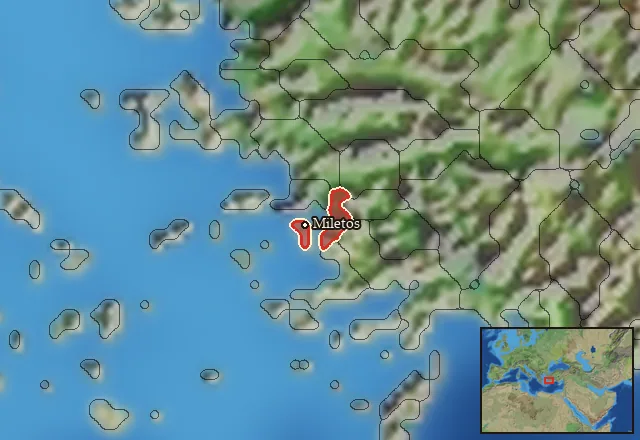
| Zone | Provinces | ||||||
|---|---|---|---|---|---|---|---|
| Milesian | 1 |