
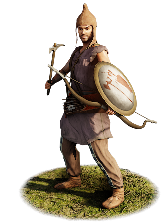
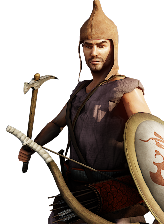
Description
Ahhh, Olbia, the happy city. Sitting on the crossroads of the Greek and Scythian worlds, between the wine-red sea and the wide, open steppe, it is easily accessible from the hot plains of Thrace and Asia Minor, and yet forms the gate to the endless lands of snow and ice. The fertility of its soil has given rise to creatures and peoples of all kinds, the finest Greeks as much as the most barbarian brutes. Those few who have ventured beyond the mighty Borysthenes river even bring us reports of monstrous beings that cannot easily be described with words. Is it any wonder, then, that Hellenes and barbarians have mixed to produce a new people here? They live on the farther stretches of Olbia's territory, tending their fields alongside the Borysthenes and defending them against Scythian incursions (or Greek tax collectors - hear! hear!). These ‘mixhellenes’ wear both Hellenic clothes – mostly the chiton, boots or sandals, and Chalcidian or Thracian helmets – and Scythian dress, consisting of trousers, woolen hats, belts with iron plaques, and scabbards for akinakes. As most inhabitants of the region, they usually fight as bowmen, sending Apollo’s best wishes straight from the heavens to their enemies. Should need arise, they can defend themselves in melee with pelte shields and war axes. Do the mixhellenes, then, represent the best possible blend of Hellenes and barbarians? Only you can judge that, brave strategos.
Historical background
"At the double junction of the Hypanis and Borysthenes rivers a city was founded, first called Olbia, afterwards, again by the Greeks, Borysthenes; this city the Milesians founded during Median rule. The upriver sail from the sea is two hundred and two score stades on the Borysthenes river. This [river] is the most useful of all, having many giant fish and bearing the fruit that grows and the flocks of the pasturages. They say it flows navigably for a 40-day sailing, but it cannot be sailed, nor is it passable to the upper places: for the way is barred by snow and ice."
– Pseudo-Skymnos (anonymous, possibly a Bithynian author, 804-819)
The early Hellenistic period was a golden age for Olbia. Having survived the siege by Alexander the Great’s general Zopyrion (Macr. Sat. 1.11.33), the polis gained prestige among both the Greek cities of the Black Sea as well as its Scythian and Getic neighbours. Impressive finds of gold and silver coins minted by Olbia as well as coins imported from northern Asia Minor attest economic growth and flourishing overseas trade during this period (Gilevich, Coins from Berezan Island (2021), p. 133; Abramzon/Kunetsov, A hoard of 4th to 1st centuries BC coins from Phanagoria (2014), p. 156). Furthermore, the massive import of tiles from Sinope (and amphorae from Herakleia Pontike) suggest great building activity and, perhaps, a significant increase in the size of the population (Krapivina, Ceramics from Sinope in Olbia Pontica (2010), p. 468). Either under continuous Athenian influence or out of resistance against the spread of Macedonian monarchy, Olbia also adopted a new constitution which introduced a more radical form of democracy (IOSPE 12 179). The “happy city” had become an Athens of the north.
Things began to change in the 270s BC, just before the start of the RIS main campaign. A serious crisis happened in Nikonion, the closest Greek city to the west. The settlement had been destroyed by Zopyrion before his attack on Olbia at the end of the 4th century BC (Sekerskaya, Nikonion (2021), p. 86). It was rebuilt soon after, perhaps with help from OIbia, or Chersonesos (cf. Sekerskaya (2021), p. 87). By the middle of the 3rd century BC, however, Nikonion and the neighbouring settlements had been completely annihilated. In Tyras, the nearest surviving Greek colony, a man called Autokles was honoured a few years later for seeking help from Istros in the south and seemingly evacuating the survivors from Nikonion (Sekerskaya (2021), p. 87). Who had attacked and torched the town? This was, apparently, a mystery to the Greeks as much as to us today. A mysterious new power had appeared, and it would soon turn against Olbia.
Around 215-210 BC (Nikolaev, One More Step to the Completion of the Discussion on the Chronology of the Decree in Honour of Protogenes [2021]), one of the most extraordinary sources preserved from antiquity was created: The Protogenes decree (IOSPE 12, 32; Syll. ³ 495; SEG. 49.1041). With an astonishing length of 193 lines, it is the second longest inscription known from the ancient world after the Res Gestae (report of the deeds) of emperor Augustus (281 lines). The stele was erected by the council and the people of Olbia to thank Protogenes, one of the city’s citizens, for his contributions to Olbian affairs. For instance, Protogenes gave 100 gold pieces to pay off a public debt to a Greek merchant (?) called Polycharmos (IOSPE 12, 32, ll. 15-20) and 300 gold pieces to pay an outstanding bill for wine (l. 20-22), while he eventually decided to abate the city's debt of an incredible 6,000 gold pieces owed to himself and his father (ll. 178-184). Most fascinating are the comments on Olbia’s foreign affairs, including the mysterious threat that disturbed all of Scythia and the northern Black Sea coast. First of all, we learn that the mightiest Scythian king in the area, like the royal Scythians in days long past, tried to assert sovereignty over the wealthy Olbia:
"When King Saitaphernes arrived at Kankytos and demanded the gifts due for his passage, and the public treasury was exhausted, Protogenes was called upon by the people and gave 400 gold pieces (...) (Later), when the Saioi came by to receive their gifts (...) (Protogenes) came forward and promised 400 gold pieces." – (ll. 11-14, 34-38)
The Saioi, conceivably under Saitaphernes’ rule, had apparently become the strongest people in Scythia at this point (possibly they were Sarmatians, the words might be related: Kothe, Die königlichen Skythen (1969), p. 106) and thus demanded tribute from Olbia. But Protogenes was a clever man, and did not only pay the king, but also the ‘sceptre bearers’ who acted as royal governors (IOSPE 12, 32, ll. 40-41). Thus, he and the Olbiopolites also meddled in Saian affairs to influence them to their own advantage (Thonemann, The Hellenistic Age (2018), pp. 85-86). Sataiphernes was a crafty ruler as well, and soon suspected that the Olbiopolites were manipulating his subjects and/or giving him less money than his subalterns. Thus, at his next meeting with Protogenes and the Olbian ambassadors, the king lost his temper and insulted the Greeks (ll. 84-97). The situation got even worse soon after, for a greater threat appeared. To quote the inscription (ll. 103-112):
"Deserters were reporting that the Galatians and the Sciri had formed an alliance, that a large force had been collected and would be coming during the winter, and in addition that the Thisarnatai, Scythians, and Saudaratai were anxious to seize the fort, as they themselves were equally terrified of the cruelty of the Galatians. Because of this many were in despair and prepared to abandon the city."
What a wondrous statement this is – Galatians on the steppe!? A Völkerwanderung in the Hellenistic period! Who are the Thisarnate and Saudaratai? And why is there no mention of Saitaphernes and his Saioi? It is possible that ‘Scythians’ is used for them, but it could also be that the king died and his confederation dissolved into the three peoples mentioned together here (cf. Braund, Steppe and Sea (2002), p. 204). The Galatians may have been Galatians proper, perhaps coming from Tylis in Thrace to the north (Braund (2002), p. 204), or they might have been the Germanic Bastarnae who moved from what is now Poland towards the western coast of the Black Sea (Karyshkovskii/Kleiman, The City of Tyras (1996), p. 158). The Sciri, finally, might be the same wandering people as those known from Late Antiquity (Goffart, Barbarian Tides (2006), p. 205), or another Scythian group. In any case, it is at this point that we finally get to meet our Mixhellenes:
"In addition many other losses had been suffered in the countryside, in that all the slaves and the half-Greeks (Mixhellenes) who live in the plain along the river bank had been lost to us, no fewer than 1,500 in number, who had fought on our side in the city in the previous war (...)" – (ll. 112-119).
Apparently, the Mixhellenes are only loosely part of Olbia’s sphere and do not live on the polis’ chora (territory). Instead, they were probably the offspring of Greco-Scythian marriages and did not possess citizen rights in Olbia (Thonemann (2018), p. 87). Their equipment has recently been reconstructed by the Ukrainian archaeologist Andriy Liashenko, based on archaeological finds in the area beyond Olbia: a chiton with a Scythian belt with iron plaques, Iranian trousers, some with boots, others with sandals, and Scythian bows, carried in a gorytos (Liashenko, The weapons of the warriors of Olbia - The protection of the happy city (2023), pp. 48-49). Scythian axes (sagaris type) are used for melee as depicted on the reverse of some coins from the early 3rd century BC (SNG BM Black Sea 46, GCS 3.2, 1887), while the akinakes dagger is worn in a scabbard. A small Greek pelte shield serves for protection. Phrygian hats, as well as Chalcidian and Thracian helmets complete their panoply (Liashenko (2023), pp. 48-49).
A big part of Olbia, especially along the Borysthenes river and the fish market, was unfortified when the Galatians and Sciri arrived (ll. 98-101). Having lost the Mixhellenes, the Olbiopolites resolved to build a wall as soon as possible and to repair all gates and towers – this was financed by Protogenes, of course (ll. 125-161). The inscription does not mention how the fights ended, but presumably there would not have been a decree if Olbia had lost (cf. Thonemann (2018), p. 87). It is likely that the surviving Mixhellenes were subsequently put under the polis’ rule again and fought as bowmen in later wars.
Stats
| Rank in roster | ||
|---|---|---|
| Men per unit | 40 | ███······· 30% |
| Attack | 10 | ██········ 19% |
| Charge bonus | 1 | █········· 4% |
| Defence | 16 | █········· 10% |
| · armour | 2 | █········· 13% |
| · defence skill | 12 | █········· 9% |
| · shield | 2 | ███······· 25% |
| Morale | 6 | █········· 6% |
| Discipline | Low | |
| Training | Untrained | |
| Recruitment cost | 1,436 dn | █········· 14% |
| Upkeep per turn | 526 dn | ██········ 24% |
| Turns to recruit | 2 |
Weapons
| Primary | Secondary | Primary | Secondary | Primary | Secondary | Primary | Secondary | ||||
|---|---|---|---|---|---|---|---|---|---|---|---|
| Attack | 10 | 4 | Charge bonus | 1 | 10 | Type | missile · archery | melee · blade | Damage | piercing | slashing |
| Projectile | arrow | — | Range | 170 | — | Ammunition | 30 | — | Properties | — | Armour-piercing (counts only half the target's armour) |
Defence
| Primary | Secondary | Primary | Secondary | Primary | Secondary | Primary | Secondary | ||||
|---|---|---|---|---|---|---|---|---|---|---|---|
| Total | 16 | — | Armour | 2 | — | Defence skill | 12 | — | Shield | 2 | — |
Condition and terrain
| Hit points | 1 | Ground: scrub / sand / forest / snow | 0 / 0 / 0 / 0 | Charge distance | 30 | Formations | Square |
Technical stats
| Time between blows (primary / secondary) | 2.5 s / 2.5 s | Extra fatigue in hot climates | 0 | Collision mass per man (1.0 is normal) | 0.85 | Spacing between men: close / loose | 1.1 × 2.6 m / 1.98 × 4.68 m |
| Default ranks | 5 |
In battle: Can hide in long grass · Very good stamina
Who can recruit it
A core roster unit for one faction, which can raise it anywhere it holds the right building:
Any faction holding one of the provinces below can field it.
Exactly what a settlement must have, route by route (4)
| Building | Also requires | Building | Also requires | Building | Also requires | Building | Also requires |
|---|---|---|---|---|---|---|---|
| Any settlement | Garrison Building or Tier 1 Military Industrial Complex · in a Olbian region · Any Government (Dependency, Indirect Rule or Direct Rule) · Tier 2 Colony not built | Indirect Rule | Garrison Building or Tier 1 Military Industrial Complex · Tier 1 Colony | Direct Rule | Garrison Building or Tier 1 Military Industrial Complex · Tier 1 Colony | Homeland | Garrison Building or Tier 1 Military Industrial Complex |
Areas of recruitment
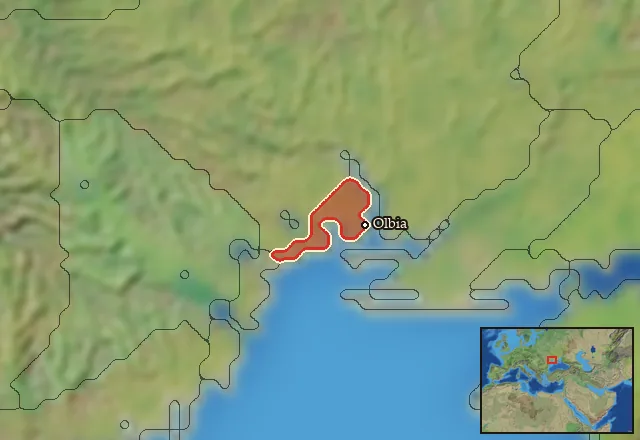
| Zone | Provinces | ||||||
|---|---|---|---|---|---|---|---|
| Olbian homeland | 1 |