
Northern Illyrian Levy
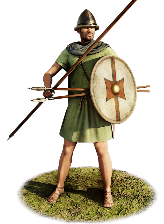
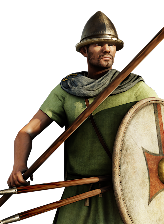
Class: spearmen · Category: infantry · Men per unit: 60
Description
Round up the men, we have fighting to do! Northern Illyrian Levy follow their local leaders into battle armed with the basic weapons most free Illyrians would have had access to. They use spears, javelins, and Pecine knives to try and break the formations of the enemy, but mainly thrive when attacking disordered troops. These men are generally less wealthy than other warriors of their tribes, which results in their defensive equipment being limited to a small wooden shield, a tunic, and a hat, with the occasional Negau helmet being the fancier exception.
Historical background
Although in RIS we use the catch-all term of ‘Northern Illyrians’ to group certain tribes or peoples such as the Daesitiates, Liburni, and Iapodes, it is worth bearing in mind that they were still independent groups with some similarities but many differences. By the timeframe of RIS, some areas of Northern Illyria were starting to develop beyond a simple dependence on raising livestock, with the Iapodes (and to some extent their neighbours, the Daesitiates) becoming a more agriculturally and economically advanced society. They reaped rich material bounties derived from the wealth of their fertile plains, a stark contrast to those scraping a meagre living in the hills or without access to the sea (Adzanela, Cultural Treasure of Bosnia and Herzegovina (2004), p. 6). The Liburnians, too, had started to express their own material culture, which featured Greek and Italic influences. They created trade networks and were even showing signs of nascent urbanisation by founding several towns and hillforts, distinguishing them from their less developed neighbours in Dalmatia (Borsic, Dzino, and Radic Rossi, Liburnians and Illyrian Lembs (2021), pp. 12-3). The Northern Illyrians were distinct in others ways, too, as some of them could be identified by their habit of tattooing their bodies, which led to the Iapodes famously being misidentified as Celts for doing so, despite it being their own native tradition (Dzino, ‘The people who are Illyrians and Celts’ (2008), p. 420). Burial rights also varied, as Liburnians still often followed a common European tradition of burying corpses in a crouched position, although cremations became increasingly common in Northern Illyria during the Roman era (Wilkes, The Illyrians (1996), p. 242), which probably has an indeterminable impact on the number of burial sites and archaeological findings there.
This Northern Illyrian Levy unit represents a warband of clan fighters who are called to battle by their local leaders or strongmen, whether for defence or to sally forth and raid someone else. They wield the Sibyna, a long heavy spear described by the Roman poet Ennius (Annals 5.540) as a symbolically Illyrian weapon, alongside javelins and a round wooden shield, with a Pecine knife as a sidearm (although this is purely decorative and remains unused in game). To represent the defensive equipment they likely would have had access to by 270 BC, this unit uses a variety of hats for the poorer warriors, while the more affluent have some bronze Vace-type Negau helmets from the 4th century BC coupled with the Idrija Negau variant from the 4th to the 1st century BC (Stephan et. al., Die Negauer Helme aus Ženjak (Schöniagg) in den Slovenske Gorice (2019), pp. 322-3). Most Illyrian warriors tended to avoid wearing armour, whether for financial, tactical, or operational reasons, and are often noted for doing so. Polybius makes it very clear that Illyrians fought without armour during the Battle of Mantinea in 207 BC, where Philopoemen had hired Illyrian mercenaries. He provides several separate references to these mercenaries when discussing the army’s composition, such as “the Illyrians and the men with body armour”, and when Philopoemen “sent his light-armed men forward to occupy the hill, which rises to a considerable height above the road called Xenis and the above-mentioned temple: he stationed the men with body armour next, resting on this hill to the south; next to them the Illyrians” (Plb. 11.11.4). However, the battle turned for the worse, and Philopoemen had to cover his retreat and “collect such of the Illyrians and body armour men and mercenaries as remained behind” to form a rearguard (Plb. 11.15). In each case, Illyrians and soldiers with armour are clearly separated, to highlight this disparity in equipment. Like many tribal fighters, these levied men are best suited to irregular warfare, but still have some limited skills in more organised styles of combat.
Stats
| Rank in roster | ||
|---|---|---|
| Men per unit | 60 | █████████· 87% |
| Attack | 7 | █········· 6% |
| Charge bonus | 3 | ██········ 16% |
| Defence | 30 | ████······ 42% |
| · armour | 2 | █········· 13% |
| · defence skill | 25 | ███████··· 74% |
| · shield | 3 | ████······ 37% |
| Morale | 7 | █········· 10% |
| Discipline | Low | |
| Training | Untrained | |
| Recruitment cost | 1,554 dn | ██········ 21% |
| Upkeep per turn | 569 dn | ███······· 34% |
| Turns to recruit | 2 |
Weapons
| Primary | Secondary | Primary | Secondary | Primary | Secondary | Primary | Secondary | ||||
|---|---|---|---|---|---|---|---|---|---|---|---|
| Attack | 7 | 6 | Charge bonus | 3 | 5 | Type | thrown · blade | melee · blade | Damage | piercing | piercing |
| Projectile | javelin | — | Range | 60 | — | Ammunition | 5 | — | Properties | Used just before charging into combat · thrown | Light spear (braced against cavalry charges from the front) · +8 attack against cavalry |
Defence
| Primary | Secondary | Primary | Secondary | Primary | Secondary | Primary | Secondary | ||||
|---|---|---|---|---|---|---|---|---|---|---|---|
| Total | 30 | — | Armour | 2 | — | Defence skill | 25 | — | Shield | 3 | — |
Condition and terrain
| Hit points | 1 | Ground: scrub / sand / forest / snow | -1 / 0 / -2 / 0 | Charge distance | 30 | Formations | Square |
Technical stats
| Time between blows (primary / secondary) | 2.5 s / 2.5 s | Extra fatigue in hot climates | 0 | Collision mass per man (1.0 is normal) | 0.87 | Spacing between men: close / loose | 1 × 1.2 m / 2 × 2.4 m |
| Default ranks | 5 |
In battle: Can hide in long grass · Can sap · Very good stamina
Who can recruit it
A core roster unit for 3 factions, each able to raise it anywhere they hold the right building:
Daesitiates · Histri · Iapodes
Any faction holding one of the provinces below can field it.
Exactly what a settlement must have, route by route (4)
| Building | Also requires | Building | Also requires | Building | Also requires | Building | Also requires |
|---|---|---|---|---|---|---|---|
| Any settlement | Garrison Building or Tier 1 Military Industrial Complex · Northern Illyrian area of recruitment · not Dardanian area of recruitment · Any Government (Dependency, Indirect Rule or Direct Rule) · Tier 2 Colony not built | Indirect Rule | Garrison Building or Tier 1 Military Industrial Complex · Tier 1 Colony | Direct Rule | Garrison Building or Tier 1 Military Industrial Complex · Tier 1 Colony | Homeland | Garrison Building or Tier 1 Military Industrial Complex |
Areas of recruitment
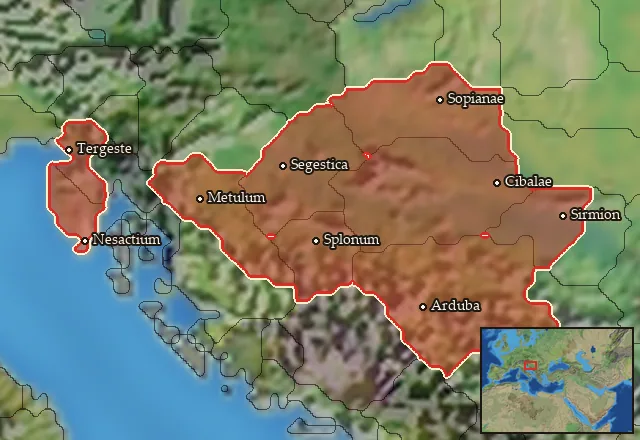
| Zone | Provinces | ||||||
|---|---|---|---|---|---|---|---|
| Northern illyrian | 9 |