
Northern Illyrian Skirmishers
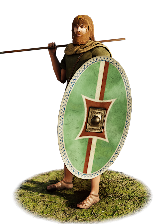
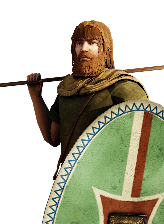
Class: missile · Category: infantry · Men per unit: 40
Description
“They have no regular order that they should be ashamed of deserting their positions when hard pressed; flight and attack are with them equally honourable” – Thucydides (4.126)
Northern Illyrian Skirmishers represent the lowest ‘classes’ of Illyrian society capable of joining the battlefield. These men are simple shepherds, herders, and farmers, who fight for their clans and the armies of Illyrian chieftains and kings. They lack any noteworthy armour, trusting entirely on their mobility and their round, leather bound shields for protection. Their clothing is what they would be wearing in daily life: short tunics and cloaks to keep cool or warm where appropriate, and straw hats to keep the rain and sun off their heads. These men are capable javelin throwers and can use their short curved pecine knives up close with some skill, however, it is still best to use them to flank rather than to confront the enemy head on.
Historical background
Northern Illyrian Skirmishers were generally called into war by their local leaders and did the most menial work on campaign as camp followers, porters, and labourers. While little is truly known about Illyrian society in general, some things can be inferred using pattern recognition. Whilst initial Illyrian society may have been primarily pastoral and based on following strong men, over time this hierarchy evolved from clan groupings to tribes, then federations of tribes with their own aristocracy (Hammond, Illyrians And North-West Greeks (1994), p. 428). Their communities were based on families concentrated around the few fertile plains of the Dinaric karst or within river valleys. They maintained trade and communications through mountain passes, founding small settlements and hillforts at strategic or economically vital points. Their world was often fragmented, held together by blood ties, perhaps with a level of tribal loyalty, too (Dzino, Contesting Identities of pre-Roman Illyricum (2012), pp. 73-4).
Northern Illyrians lived close to Italy and some of the further reaching Greek colonies, which certainly shaped their cultural and material evolution to some degree, but perhaps not as much as you might think. This distance from the Greeks meant that Southern Illyrian states like the ethnic Illyrians, the Autariatae, Dardani, and Scordisci were the first to feel the effects of ‘globalisation’, with an increase in trade with Greek or Hellenic states to their south. The Liburnian League and later the Histrian Kingdom on the Adriatic coast were slower to absorb this Greek influence, but eventually it also ended up being transmitted to the Cisalpine and Transalpine Iapodes and finally to the Delmatae in the Illyrian hinterland. The economic and political influence of the Greeks in the central and Adriatic areas of Illyria had a significant effect on the development of Illyrian identities. The first phase was during the 6th and 5th centuries BC with the establishment of Korkyra (Corfu – an island near Epirus), this phase strengthened the Liburnian identity as one of opposition to the Greeks, especially through conflict. The second phase was in the 4th and 3rd centuries BC, when the Greeks built more poleis that encompassed Greek as well as local populaces. This period was also notable for the movement of La Tene cultural communities through the Balkans, creating multiple pressure points upon native Illyrian societies (Dzino, Deconstructing ‘Illyrians’ (2008), p. 49).
Some Northern Illyrians felt the effects of La Tene more strongly, for the Iapodes were often mistaken for Celts. Strabo (Strab 7.5.10), for instance, stated that the Iapodes were “a mixed Celtic and Illyrian tribe”. This is at odds with the archaeological evidence, which contains rather minimal Celtic cultural findings and seems to show that much like the Liburni, the Iapodes maintained a fairly autarkic and autonomous culture that lived on until their eventual defeat and subjugation by Rome in 33 BC (Biba and De Marinis, Northern Adriatic (2018), p. 35). It is quite likely that the use of Celtic weaponry by many different Illyrians including the Iapodes was a matter of finding and applying better technology when appropriate, rather than a complete capitulation to La Tene culture (Dzino (2012), p. 81). Thus, it seems that the Northern Illyrians were capable of doing things their own way and supplementing their society and technology on their own terms, despite much influence from Greece and Italy, as well as migrating Celts.
When it comes to the equipment of the Northern Illyrian Skirmishers, they are pretty similar to other units of this general type. Their clothes are shortened tunics with capes and pins to hold everything together, as depicted in situla art of Illyrian warriors, along with them using iron knives and whetstones (Drnic, Segestica and Siscia (2020), p. 97). Their curved 30cm knives and round shields are common for most Illyrian warriors, being regularly found in graves, with the shields showing evidence of hide or leatherbound covers and bronze or iron bosses (Wilkes, The Illyrians (1996), p. 239). Spears and javelins also commonly show up in grave findings throughout the southeastern Alpine to the southern Pannonian regions, showing that the Illyrian reputation for skirmishing has a solid foundation in reality (Drnic and Dizdar, Segestan Warriors (2018), p. 78). This means that this unit is a good representation of one of the most common types of warriors available to the Northern Illyrians.
Stats
| Rank in roster | ||
|---|---|---|
| Men per unit | 40 | ███······· 30% |
| Attack | 12 | █████····· 48% |
| Charge bonus | 3 | ██········ 16% |
| Defence | 18 | ██········ 16% |
| · armour | 1 | █········· 0% |
| · defence skill | 13 | █········· 13% |
| · shield | 4 | █████····· 48% |
| Morale | 6 | █········· 6% |
| Discipline | Low | |
| Training | Untrained | |
| Recruitment cost | 1,025 dn | █········· 5% |
| Upkeep per turn | 375 dn | █········· 12% |
| Turns to recruit | 2 |
Weapons
| Primary | Secondary | Primary | Secondary | Primary | Secondary | Primary | Secondary | ||||
|---|---|---|---|---|---|---|---|---|---|---|---|
| Attack | 12 | 4 | Charge bonus | 3 | 5 | Type | thrown · archery | melee · blade | Damage | piercing | slashing |
| Projectile | javelin | — | Range | 50 | — | Ammunition | 6 | — | Properties | Thrown | Armour-piercing (counts only half the target's armour) |
Defence
| Primary | Secondary | Primary | Secondary | Primary | Secondary | Primary | Secondary | ||||
|---|---|---|---|---|---|---|---|---|---|---|---|
| Total | 18 | — | Armour | 1 | — | Defence skill | 13 | — | Shield | 4 | — |
Condition and terrain
| Hit points | 1 | Ground: scrub / sand / forest / snow | 8 / 0 / 8 / 0 | Charge distance | 30 | Formations | Square |
Technical stats
| Time between blows (primary / secondary) | 2.5 s / 2.5 s | Extra fatigue in hot climates | 0 | Collision mass per man (1.0 is normal) | 0.9 | Spacing between men: close / loose | 1.2 × 2.8 m / 2.16 × 5.04 m |
| Default ranks | 5 |
In battle: Can hide in long grass · Very good stamina
Who can recruit it
A core roster unit for 3 factions, each able to raise it anywhere they hold the right building:
Daesitiates · Histri · Iapodes
Any faction holding one of the provinces below can field it.
Exactly what a settlement must have, route by route (4)
| Building | Also requires | Building | Also requires | Building | Also requires | Building | Also requires |
|---|---|---|---|---|---|---|---|
| Any settlement | Garrison Building or Tier 1 Military Industrial Complex · Northern Illyrian area of recruitment · Any Government (Dependency, Indirect Rule or Direct Rule) · Tier 2 Colony not built | Indirect Rule | Garrison Building or Tier 1 Military Industrial Complex · Tier 1 Colony | Direct Rule | Garrison Building or Tier 1 Military Industrial Complex · Tier 1 Colony | Homeland | Garrison Building or Tier 1 Military Industrial Complex |
Areas of recruitment
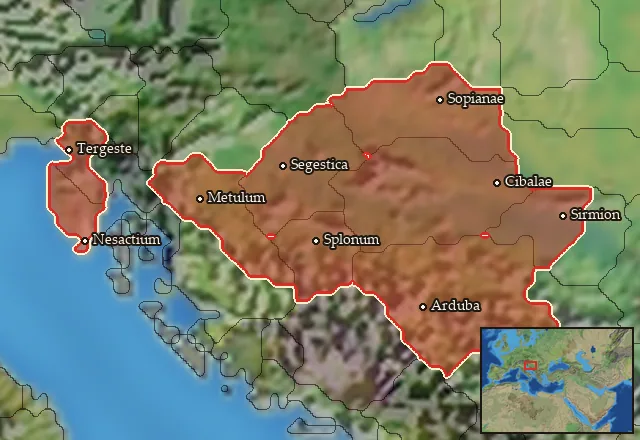
| Zone | Provinces | ||||||
|---|---|---|---|---|---|---|---|
| Northern illyrian | 9 |