
Pisidian Thureophoroi
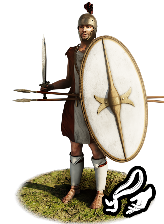
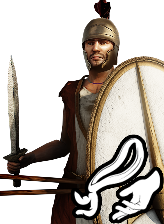
Class: light · Category: infantry · Men per unit: 40
Reforms: Unlocked by Military innovations have arrived!, Adoption of the Thureos
Description
This infantry unit is made up of brave Pisidians with large, oval thureos shields. They wear Greek-style tunics and Pisidian leg wraps, as well as boots with white felt socks and reddish-brown straps. Being a mix of south Anatolian tradition and Hellenic influence, they go into battle with straight xiphos swords and javelins, wearing either plumed Attico-Boiotian or Thraco-Attic helmets. Pisidian Thureophoroi fight for their local communities, of which the most famous and flourishing is Selge, for the powerful Ptolemaic dynasty, or whoever else pays for their service.
Historical background
Pisidia was a mountainous and cold region in southern Anatolia, mostly rocky and barren, aside from the bountiful plateau of Selge (see description: Selgian Slingers). Accordingly, its inhabitants usually fought as skirmishers, such as javelinmen or slingers (see: Pisidian Javelinmen). However, Pisidia, too, was not immune to outside influences. Selge had long been a partly Greek city and Hellenic authors speculated that it may have been founded by Lakedaimon, for its constitution seemed balanced and fair to them (Strab. 12.7.3C570). By the early 3rd century BC, Pisidia found itself on the fringes of the grand Seleucid and Ptolemaic empires. Already in 281 BC, the city of Termessos in the southwest of Pisidia dated its years by the reign of Ptolemy II (BE_1967.601), and in the same year, Sagalassos in the northwest had fallen under Seleucid control (Pobolome/Waelkens, Sagalassos III. Report on the Fourth Excavation Campaign of 1993 (1995), p. 302). Soon after, Pisidian soldiers in typically Hellenistic gear of the mid to late 3rd century BC appear: the stelae of two men called Saettas and Dioskourides, respectively, who served in the Ptolemaic garrison of Sidon in Phoenicia just before 200 BC (Couilloud-Le Dinahet, Les Rituels Funéraires en Asie Mineure et en Syrie (2015), p. 75), show warriors with swords, helmets, and - most importantly - the large, oval thureos (or thyreos) shields that had been adopted after the Celtic role model all across the Hellenistic world (Du Plessis, Light Infantry of the Greek and Roman World (2024), pp. 102-106).
The two colourful stelae, both of which are now in the Archaeological Museum in Istanbul, reveal more important details: the two men wear impressive metallic helmets of the Attico-Boiotian and Thraco-Attic type, respectively, but no body armour, which is also confirmed as typically Pisidian by the imperial-era commander Arrian from Bithynia, when describing the battles between Alexander the Great and his Pisidian foes (Anab. 1.28). Therefore, our Pisidian Thureophoroi are only clad in tunics. On their legs and feet, Saettas and in particular Dioskurides can be seen to wear Pisidian leg wraps and boots with white felt socks and reddish-brown straps. Saettas is readying himself to throw a javelin, while Dioskourides wields a short, straight xiphos sword. Their equipment thus very much corresponds to that of other thureophoroi in the Greek world.
Saettas, as his gravestone informs us, was the son of a Trokondos, who had belonged to a settlement from Termessos near Oinoanda in Lykia. In Oinoanda, he had grown up in the Pisidian Neighbourhood (“Little Pisidia/Termessia”) and thus, after his death, the community erected the beautifully painted stela for him (AGRW 273 = Mendel, Musées impériaux (1914), 103 = AGRW ID# 1891). Meanwhile, Dioskourides was the son of an Exaboas from Balboura in Pisidia. He had served as the standard bearer (semeophoros) of an “allied unit” - surely a Pisidian contingent - in the Ptolemaic army. His brother Keraias had served with him and praises him as an excellent man before bidding him farewell on the stela (Macridy-Bey, À travers les Nécropoles sidoniennes (1904), 547-572 = Mendel (1914), 102 = Sekunda, Hellenistic infantry (2006), pp. 146-148). Both men are thus typical examples of Pisidian soldiers in the Hellenistic period, who often served and fought abroad. In Athens, a marble monument on the southern slope of the Acropolis, erected a few decades before the two stelae in Sidon, was dedicated to the memory of a [Ξ]ένων (Πισίδης), a Pisidian mercenary (IG II² 1957, l. 17; Traill, Persons of ancient Athens (2011), p. 294, no. 095550). In neighbouring Boiotia, too, Pisidian mercenaries are attested: Xanthippos, son of Kendebas, became proxenos (“guest friend”) in Tanagra around the same time the monument in Athens was constructed (IG VII 508). Pisidian proxenoi in the Aegean are only recorded in Boiotia, and there are Pamphylian xenoi, especially from Aspendos, too. Thus, a connection with mercenary activities seems plausible and Hadrien Bru (The Pisidians between Seleukids and Ptolemies (2024), pp. 185-190) plausibly argues they had been sent by their Ptolemaic overlords to recruit mercenaries in Greece. In return, they may well have supplied the Boiotian League with some Pisidian mercenaries, and hence they were honoured for both of their services.
Aside from the stelae of Saettas and Dioskourides, the soldier list from Ras Habni near Laodikeia (Rey-Coquais, Inscription grecque découverte à Ras Ibn Hani (1976), pp. 51–61; ibid. (1978), pp. 313–325), the grave stela of Bianor, son of Konon, from Adada, in the Sidon garrison - Pisidians from allied Adada - the painted monument of Salmas, son of Moles (Sekunda (2006), pp. 68-71) and the funerary sandstone stela from Amathous on Cyprus (Limassol Archaeological Museum inv. no. 562/1 (LM 562) with SEG XXVI 1 1462) all attest to Pisidians in Ptolemaic service in the 3rd and 2nd centuries BC. That so many Pisidians went abroad to become mercenaries was a product of the scarcity and barren soils of much of their region: thus, risking one's life in war was an attractive alternative (Bru (2024), p. 180). Based on the review of the sources, Pisidian Thureophoroi are both available as a reform unit for Selge, RIS’ dedicated Pisidian faction, and as factional mercenaries for the Ptolemies, Athens, and the Boiotian League. Anyone who conquers Pisidia will unlock their recruitment after the reform. They are fast and flexible infantry, who can add to a battle line both in attack and defence with their all-round skillset, and a capable commander will make good use of the Pisidian fighting spirit.
Stats
| Rank in roster | ||
|---|---|---|
| Men per unit | 40 | ███······· 30% |
| Attack | 15 | ███████··· 72% |
| Charge bonus | 10 | ████······ 35% |
| Defence | 27 | ████······ 35% |
| · armour | 3 | ██········ 21% |
| · defence skill | 19 | ████······ 44% |
| · shield | 5 | ██████···· 57% |
| Morale | 11 | ████······ 39% |
| Discipline | Normal | |
| Training | Trained | |
| Recruitment cost | 1,608 dn | ██········ 24% |
| Upkeep per turn | 589 dn | ████······ 38% |
| Turns to recruit | 2 |
Weapons
| Primary | Secondary | Primary | Secondary | Primary | Secondary | Primary | Secondary | ||||
|---|---|---|---|---|---|---|---|---|---|---|---|
| Attack | 15 | 9 | Charge bonus | 10 | 11 | Type | thrown · blade | melee · blade | Damage | piercing | piercing |
| Projectile | javelin | — | Range | 50 | — | Ammunition | 2 | — | Properties | Used just before charging into combat | — |
Defence
| Primary | Secondary | Primary | Secondary | Primary | Secondary | Primary | Secondary | ||||
|---|---|---|---|---|---|---|---|---|---|---|---|
| Total | 27 | — | Armour | 3 | — | Defence skill | 19 | — | Shield | 5 | — |
Condition and terrain
| Hit points | 1 | Ground: scrub / sand / forest / snow | 0 / 0 / 0 / 0 | Charge distance | 30 | Formations | Square |
Technical stats
| Time between blows (primary / secondary) | 2.5 s / 2.5 s | Extra fatigue in hot climates | 0 | Collision mass per man (1.0 is normal) | 0.95 | Spacing between men: close / loose | 1 × 1.2 m / 2 × 2.4 m |
| Default ranks | 5 |
In battle: Can sap · Very good stamina
Who can recruit it
A core roster unit for one faction, which can raise it anywhere it holds the right building:
Any faction holding one of the provinces below can field it.
Exactly what a settlement must have, route by route (4)
| Building | Also requires | Building | Also requires | Building | Also requires | Building | Also requires |
|---|---|---|---|---|---|---|---|
| Any settlement | Garrison Building or Tier 1 Military Industrial Complex · Military innovations have arrived! · Pisidian area of recruitment · Any Government (Dependency, Indirect Rule or Direct Rule) · Tier 2 Colony not built | Indirect Rule | Garrison Building or Tier 1 Military Industrial Complex · Adoption of the Thureos · Tier 1 Colony | Direct Rule | Garrison Building or Tier 1 Military Industrial Complex · Adoption of the Thureos · Tier 1 Colony | Homeland | Garrison Building or Tier 1 Military Industrial Complex · Adoption of the Thureos |
Areas of recruitment
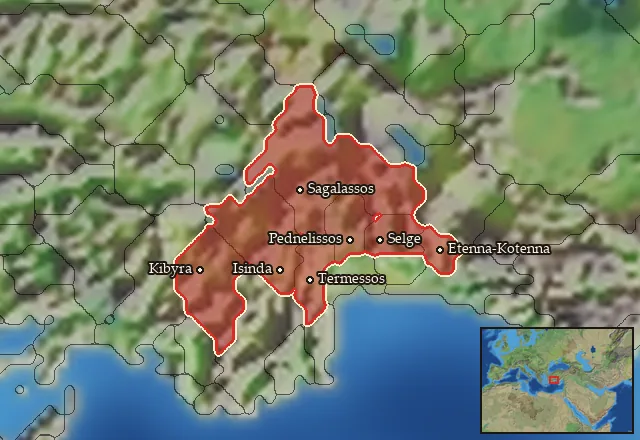
| Zone | Provinces | ||||||
|---|---|---|---|---|---|---|---|
| Pisidian | 7 |