
Ptolemaic General's Bodyguard
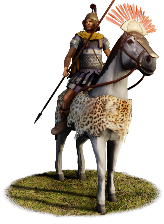
Class: heavy · Category: cavalry · Men per unit: 6
Reforms: No longer recruitable after Ptolemaic Military Reforms · Becomes a newer unit with Ptolemaic Military Reforms
Description
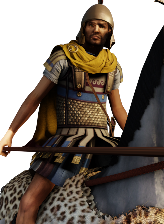
The Therapeia cavalry represents the mounted household guard of the Ptolemaic kings. Their appearance betrays their role: the saffron-yellow chlamys (cloak) with purple borders, white chiton, brown boots and golden headgear for the horses is as costly as magnificent. They are protected by plumed Boiotian helmets and composite cuirasses, while they will charge with a deadly xyston. A sword on a baldric is available for prolonged melee. These picked men will defend the lives of their king and his relatives as if it were their own!
Historical background
The Therapeia were the Household troops of the Ptolemaic Empire, forming a guard that protected the Pharaoh-King in Alexandria and, if needed, on campaign. Papyri describe regiments "at the court" (περὶ τὴν αὐλὴν), which might have included bodyguards and ceremonial troops (Fischer-Bovet, Army and Society (2014), p. 150). The Hellenistic historian Polybios of Megalopolis (ca. 200-118 BC) mentions the θεραπεία and the troops περὶ τὴν αὐλὴν ("around the court") together (Polyb. XV, 25a, 17), and they are thus represented by a single unit. The household regiments seem to have consisted of both infantry and cavalry, forming a reliable elite force. They were arguably not as battle-hardened as the Basilikon Agema or, respectively, the Agema of the Hippeis, but still equipped with the best weapons and armour available, and trained under the supervision of the king himself. At the Battle of Raphia in 217 BC, the Therapeia cavalry numbered 700 men, and was under the command of Polykrates of Argos (Polyb. V, 65, 5), who had only recently arrived from Greece and may have been responsible for reforming the regiment (Polyb. V, 64, 4) – a reform you will be able to unlock in the campaign.
The equipment of the Therapeia resembles that of the Hetairoi of Alexander the Great, as is attested by several stelae. The so-called Funerary Stela of a Soldier on Horseback (Alexandria, Graeco-Roman Museum Inv. 10228, ca. 300 BC) shows a man in a white chiton, wearing brown boots, a saffron-yellow chlamys with purple borders, composite cuirass, plumed Boiotian helmet, sword on a baldric and Xyston. Some of the stelae of Ptolemaic Hippeis fitted as Xystophoroi show them with blue Linothorakes and belted tunics (Funerary Stela of a Man on Horseback, Alexandria, Graeco-Roman Museum, Inv. 22116, 3rd century BC), as represented in this unit. Finally, Fischer-Bovet (2014, pp. 148-150) has suggested, apparently following one of the speculative theories of Nick Sekunda, that the Therapeia cavalry was equipped with Aspis shields. There is, however, no evidence on this. Neither shielded (Graeco-Macedonian) cavalry nor shielded cavalry with the two-handed Xyston appears in the sources, and indeed Fischer-Bovet says as much herself (2014, p. 131). Therefore, the idea can be safely dismissed.
Stats
| Rank in roster | ||
|---|---|---|
| Men per unit | 6 | █········· 0% |
| Attack | 13 | ██████···· 57% |
| Charge bonus | 33 | ██████████ 95% |
| Defence | 37 | ██████···· 64% |
| · armour | 16 | █████████· 90% |
| · defence skill | 21 | █████····· 54% |
| · shield | 0 | █········· 0% |
| Morale | 16 | ██████████ 98% |
| Discipline | Normal | |
| Training | Highly trained | |
| Recruitment cost | 5,018 dn | ██████████ 97% |
| Upkeep per turn | 76 dn | █········· 4% |
| Turns to recruit | 4 |
Weapons
Its secondary attack is the stronger one: 14 against 13.
| Primary | Secondary | Primary | Secondary | Primary | Secondary | Primary | Secondary | ||||
|---|---|---|---|---|---|---|---|---|---|---|---|
| Attack | 13 | 14 | Charge bonus | 33 | 28 | Type | melee · blade | melee · blade | Damage | piercing | slashing |
Defence
| Primary | Secondary | Primary | Secondary | Primary | Secondary | Primary | Secondary | ||||
|---|---|---|---|---|---|---|---|---|---|---|---|
| Total | 37 | — | Armour | 16 | — | Defence skill | 21 | — | Shield | 0 | — |
Condition and terrain
| Hit points | 1 | Mount | hetairoi horse | Ground: scrub / sand / forest / snow | -6 / -1 / -8 / -1 | Charge distance | 40 |
| Formations | Square · Wedge |
Technical stats
| Time between blows (primary / secondary) | 2.5 s / 2.5 s | Extra fatigue in hot climates | 0 | Spacing between men: close / loose | 2 × 4.8 m / 3 × 7.2 m | Default ranks | 5 |
In battle: A unit suitable for a general · Powerful charge
Who can recruit it
A core roster unit for 2 factions, each able to raise it anywhere they hold the right building:
Ptolemaic Empire · Ptolemaic Rebels
Exactly what a settlement must have, route by route (2)
| Building | Also requires | Building | Also requires | ||||
|---|---|---|---|---|---|---|---|
| Direct Rule | Tier 3 Military Industrial Complex · not Ptolemaic Military Reforms · Tier 2 Colony | Homeland | Tier 2 Military Industrial Complex · not Ptolemaic Military Reforms |