
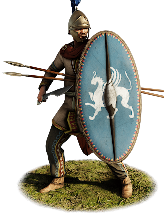
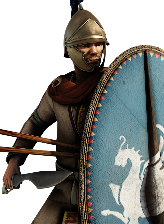
Description
The Sindians are a people related to the Scythians who live in the western parts of the Maiotis (Taman peninsula), the peninsula across from the Taurike (Crimea). In the first half of the 4th century BC, Leukon I of the Kimmerian Bosporos conquered their lands and integrated the Sindians into his realm. Now, they fight in the Bosporan army, mostly as light infantry. Their primary weapons are javelins, but they also carry curved machaira swords for melee. Thanks to the introduction of the Celtic thureos shield, these Sindian warriors are now much better protected, and while some only wear their traditional caps, others sport Pseudo-Illyrian, Pseudo-Chalcidian or Konos helmets – all of them with cheek guards. Their tunics with long sleeves, cloaks, belts, trousers, and boots all show little influence of Hellenic styles and easily distinguish them from the Greek soldiers in the royal army. A few Sindian infantrymen have, however, bought themselves the useful linen cuirasses popular in the Aegean known as linothorakes. All in all, then, these Sindians can perform a dual-purpose role on the battlefield, being able to act both as skirmishers and as light swordsmen.
Historical background
The best source for the history of an independent kingdom in the Sindike is found in the Strategemata by the 2nd century AD advocate and rhetorician Polyainos from Macedonia, who based himself on an older source. He tells the story of a war in the Sindian realm, in which Satyros I, ruler of the Kimmerian Bosporos from 433/432-389 BC, intervened:
“Tirgatao of Maiotis married Hekataios, king of the Sindi, a people who live a little above the Bosporos. Hekataios was expelled from his kingdom, but was reinstated in his throne by Satyros, tyrant of Bosporos. Satyros gave him his daughter in marriage, and urged him to kill his former wife. As Hekataios passionately loved the Maiotian, he could not think of killing her, but confined her to a strong castle; however, she found a way of making her escape from there. Fearing lest she should excite the Maiotians to war, Hekataios and Satyros made a strict search for her, which she skilfully eluded, travelling through lonely and deserted ways, hiding herself in the woods in the day, and continuing her journey in the night. At last she reached the country of the Ixomatai, where her own family possessed the throne. Her father was dead, and she afterwards married his successor in the kingdom. Then she roused the Ixomatai to war, and engaged many warlike nations around the Maiotis to join the alliance. The confederates first invaded the country of Hekataios, and afterwards ravaged the dominions of Satyros. Harassed by a war, in which they found themselves inferior to the enemy, they sent an embassy to sue for peace, accompanied by Metrodoros the son of Satyros, who was offered as a hostage. She granted them peace, on stipulated terms, which they bound themselves by oath to observe.” – (Polyain. 8.55)
The text illustrates the challenges of Bosporan attempts to control the northern Pontos region. Satyros probably intervened not least because Hekataios, with his Ionian name, may have been more open towards Greek influences and a Hellenisation of the Sindian kingdom (Gardiner-Garden, Maiotian Ethnography (1986), p. 200). Satyros must also have seen this as an opportunity to extend his sphere of influence. However, things went horribly wrong when Tirgatao mobilised the Ixomatai, an eastern Maiotian people somewhere in the Kuban, and probably her supporters among the Sindians, to overpower the Bosporans and Hekataios. Affairs in the steppes must have been difficult to understand and manoeuvre around for the Greeks, but the story does not end here:
“But no sooner had they made the oath, than they planned schemes to break it. Satyros prevailed on two of his friends, to revolt to her, and put themselves under her protection; so as the more easily to find an opportunity to assassinate her. On their revolt, Satyros wrote a letter, to ask for them to be handed over; which she answered, by alleging that the law of nations justified her in protecting those, who had placed themselves under her protection. The two men, who had revolted, one day requested an audience of her. While one distracted her with a pretended matter of importance, the other levelled a blow at her with a drawn sword, which fell upon her girdle; and the guards immediately seized and imprisoned them. They were afterwards examined by torture, and confessed the whole plot; upon which, Tirgatao ordered the hostage to be executed, and laid waste the territories of Satyros with fire and sword (...).’’ – (Polyain. 8.55)
The story ends with the death of Satyros, and thus apparently a clear failure for the Greeks, but there are doubts as to the veracity of this conclusion, for Satyros’ son Leukon I calls himself basileus Sindon (“king of the Sindians”) in official inscriptions (Gallotta, The Bosporan Kingdom and Indigenous Peoples (2014), p. 217). In fact, the source of Polyainos may have been a historian from Herakleia Pontike who was biased against the Bosporans, for his own city was also warring with them at the time (Gallotta (2014), pp. 216-217; Polyain. 5.23, 6.9.3 & 4; Ps.-Aristot. 2.2.8.). Leukon in fact inherited the kingdom after the death of Tigartao and Hekataios, suggesting either a Bosporan victory or a peaceful compromise (Gallotta (2014), p. 218). Instead of ruling the Sindike himself, he gave it to his brother Gorgippos, perhaps to appease the local population (Ustinova, K voprosu o prisooedinenii sindiki k bosporskomu gosudarstvu [1966]). Since his sister had been married to Hekataios, she, too, may have played a role in the new regime alongside Gorgippos, while we do not know what happened to their other (half?-) brother Metrodoros. In any case, Oktamasades, the son of the former royal couple, did not accept this arrangement, and rebelled. In reaction, Leukon sent Gorgippos reinforcements. Together, they defeated the Sindians and annexed their land to the Bosporan Kingdom (SEG XLVIII, 1027; cf. Gallotta (2014), p. 217). After their victory, they dedicated a gift to Apollo in the town of Labrys, near modern Semibratnee, 30 km from Gorgippia, the capital of Sindike (SEG XLVIII, 1027; Graham, Thasos and the Bosporan Kingdom [2002]).
On public monuments erected in the following years, Leukon is first called Archon of the Sindians, Toretians, Psessians, and Dandarians (Sokolova, New material from the excavation at Nymphaion (2000-2001), p. 86), and then king of these same peoples (CIRB 6a = IOSPE II 343). His son Pairisades I would later be known as “king of all Maiotians and Sindians” (CIRB 10). It is apparent, then, that Gorgippos ruled the Sindike until his death – renaming or founding its capital, Gorgippia – upon which his older brother Leukon first took the title of archon over the Sindians and their neighbours and then that of king, before his son Pairisades conquered the other Maiotians in the inland.
The thureos shield first appears in the Sindike in the 3rd century BC. A coffin from Gorgippia dated to this time is decorated with various finely made figures, two of which wear oval shields with spinae (Mielczarek, Bosporan Army (1999), pl. IVc & p. 54). The most common weapons from the Hellenistic period which were found in the Sindike are the curved machaira swords, ever so popular in all areas around the northern Black Sea (Krushkol, Description of burial associations (2010), fig. 5.1, 23.41). Pieces of konos, domed Pseudo-Chalcidian and pseudo-Illyric helmets have also been unearthed, along with a nondescript ‘conical’ helmet (Symonenko, Sarmatian age helmets (2015), p. 296). The most impressive evidence is a limestone statue of a Sindian warrior, found in the area in 1896. The man wears a Sindian cap and Sindian clothes with long sleeves and trousers (Medvedeva/Musin, The Imperial Archaeological Commission (1859–1917) (2019), p. 477). Javelins complete the armament as they fit the apparently light nature of Sindian infantry, while some variants of the unit wear linothorakes to reflect Bosporan Greek influences.
Stats
| Rank in roster | ||
|---|---|---|
| Men per unit | 60 | █████████· 87% |
| Attack | 12 | █████····· 48% |
| Charge bonus | 2 | █········· 11% |
| Defence | 25 | ███······· 28% |
| · armour | 6 | ████······ 38% |
| · defence skill | 14 | ██········ 18% |
| · shield | 5 | ██████···· 57% |
| Morale | 7 | █········· 10% |
| Discipline | Low | |
| Training | Untrained | |
| Recruitment cost | 1,564 dn | ██········ 21% |
| Upkeep per turn | 544 dn | ███······· 27% |
| Turns to recruit | 2 |
Weapons
| Primary | Secondary | Primary | Secondary | Primary | Secondary | Primary | Secondary | ||||
|---|---|---|---|---|---|---|---|---|---|---|---|
| Attack | 12 | 6 | Charge bonus | 2 | 5 | Type | thrown · blade | melee · blade | Damage | piercing | slashing |
| Projectile | javelin | — | Range | 50 | — | Ammunition | 2 | — | Properties | Used just before charging into combat | — |
Defence
| Primary | Secondary | Primary | Secondary | Primary | Secondary | Primary | Secondary | ||||
|---|---|---|---|---|---|---|---|---|---|---|---|
| Total | 25 | — | Armour | 6 | — | Defence skill | 14 | — | Shield | 5 | — |
Condition and terrain
| Hit points | 1 | Ground: scrub / sand / forest / snow | 0 / -1 / 0 / -1 | Charge distance | 30 | Formations | Square |
Technical stats
| Time between blows (primary / secondary) | 2.5 s / 2.5 s | Extra fatigue in hot climates | 0 | Collision mass per man (1.0 is normal) | 1.03 | Spacing between men: close / loose | 1 × 1.2 m / 2 × 2.4 m |
| Default ranks | 5 |
In battle: Can hide in long grass · Can sap · Very good stamina
Who can recruit it
A core roster unit for one faction, which can raise it anywhere it holds the right building:
Any faction holding one of the provinces below can field it.
Exactly what a settlement must have, route by route (5)
| Building | Also requires | Building | Also requires | Building | Also requires | Building | Also requires |
|---|---|---|---|---|---|---|---|
| Any settlement | Tier 2 Military Industrial Complex · Sindian area of recruitment · Any Government (Dependency, Indirect Rule or Direct Rule) · Tier 2 Colony not built | Indirect Rule | Tier 2 Military Industrial Complex · Tier 1 Colony | Direct Rule | Tier 2 Military Industrial Complex · Tier 1 Colony | Homeland | Tier 2 Military Industrial Complex |
| Any settlement | Tier 2 Military Industrial Complex · Sindian area of recruitment · Dependency or Indirect Rule · Tier 1 Colony not built |
Areas of recruitment
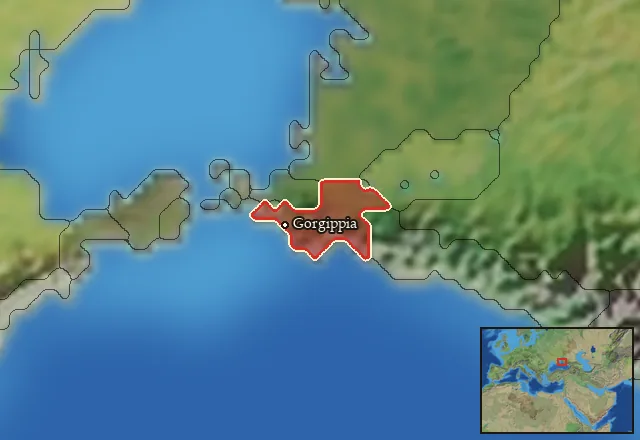
| Zone | Provinces | ||||||
|---|---|---|---|---|---|---|---|
| Sindian | 1 |