
Southern Illyrian Levy
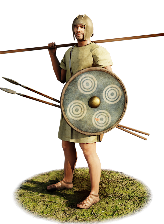
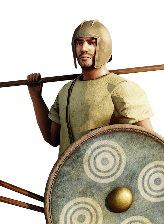
Class: spearmen · Category: infantry · Men per unit: 60
Description
Southern Illyrian Levy are basic troops, primarily armed with spears and javelins. They often protect their heads with Illyrian helms or even simple hats, while wearing tunics and a round wooden shield for defence. These men represent versatile light infantry that can skirmish as well as engage enemy cavalry or disorganised infantry, but should generally stick to broken ground and raiding due to its light equipment.
Historical background
The Southern Illyrians are partially characterised by their deeper and more common interactions with Greek and Hellenic culture in all forms. This influence was highly varied amongst the many peoples that composed the “Illyrians”. For example, the Daorsi drew comment for being able to mint their own money, the Delmatae for demanding tribute in grain and livestock from their neighbours, the Dardanians showed signs of what Greeks would consider education by playing music and founding cities – yet vigorously rejected many other keystones of Greek culture. The Southern Illyrians were people defined by contrasts. Some lived in areas in which one could grow the grape and olive, yet in other more interior regions one had to make do with other, lesser crops like barley or millet. This might have been the reason why it appears hard for Strabo to define exactly to what extent the Southern Illyrians were barbarian or civilised (Sasel Kos, Peoples on the Northern Fringes of the Greek World (2008), pp. 623-6).
Southern Illyrians experienced contact with the Greek world from early on, starting in the Archaic era, with some regions seeing influence take form in princely tombs around 700 BC, although these fell out of style by around 350 BC. Material influences were varied but included burial styles, and even religious cults like that of Diomedes, which spread throughout the eastern Adriatic. The discovery of the Nakovana cave revealed a combination of indigenous rituals involving a large phallic stalagmite, combined with offerings of Greek pottery, which in turn showed records of individuals with Greek names, who had participated throughout the 4th to the 1st centuries BC (Dzino, Contesting Identities of Pre-Roman Illyricum (2012), pp. 74-5). The Southern Illyrians may have accepted some elements of Greek culture but resisted others, with the Delmatae apparently refusing to drink wine, despite having access to it (Dzino (2012), p. 77). Archaeological findings of Hellenistic material goods are decreasingly common from the fourth to second centuries BC, with most found in areas bordering Macedonia such as Dardania, and almost none found further north. This also possibly indicates a loss of Athenian influence or commercial power, or a redirection of Greek interest to Southern Italy and the Adriatic in this period (Wilkes, The Illyrians (1996), p. 107). The use of Greek goods could also indicate much about regional relationships, with their adoption perhaps showing an alignment with nearby Greek colonists or a desire to climb the local hierarchy, whereas rejection could show opposition to migrating Greeks (Dzino (2012), p. 78). The Southern Illyrians were a disparate set of peoples with varying languages, customs, and rites even within one ethnic group, but in many cases still maintained a conscious sense of shared identity (Barnett, Rethinking Identity, Ethnicity, and ‘Hellenization’ (2017), p. 69).
By the timeframe of RIS, several Southern Illyrian groups were considered strong regional powers. The Ardiaei were renowned seafarers and a menace of the Adriatic coast, raiding even Rome and the western coast of Greece, sometimes reaching waters as far as the Aegean Sea. Theopompus (FGrH 115 F40) acclaimed them to have possessed more than 300,000 serfs at the height of their power. That said, this power was subsequently reduced heavily by the Autariatae and Macedonians, and then later the Romans from 229 BC. Furthermore, the Dardanians threw their weight around constantly, often within Illyria itself, as they vied for influence with the Ardiaei among the Illyrian tribes, and outwardly to the detriment of the Macedonians – so much so that Philip V had to utterly devastate their invasion route to stop them from foraging and supplying on the way to attack him (Hammond, The Kingdoms in Illyria circa 400 - 167 BC (1966), p. 249).
These Southern Illyrian Levy have a light assortment of equipment, mostly of Illyrian origin, as these men were not elites, so were unable to afford imported Greek or Celtic goods. They represent tribal or even more localised clan warriors who serve their community or alliance, and reflect the rather complex nature of social structures found in Southern Illyria (Mihajlovic, Tracing ethnicity backwards the case of the “Central Balkan Tribes” (2014) p. 99). They wield equipment most commonly associated with Illyrians: the Sibyna spear, javelins, as well as small, round shields made with hide or leather with a bronze boss (Wilkes (1996), p. 239). Some of them, exceptionally, wear the Illyrian helmet, to allow for this unit to represent slightly wealthier tribal levies too – not to mention the expectation that these men should be able to fight on the frontline on occasion if need arises!
Stats
| Rank in roster | ||
|---|---|---|
| Men per unit | 60 | █████████· 87% |
| Attack | 7 | █········· 6% |
| Charge bonus | 3 | ██········ 16% |
| Defence | 30 | ████······ 43% |
| · armour | 2 | █········· 13% |
| · defence skill | 25 | ███████··· 74% |
| · shield | 3 | ████······ 37% |
| Morale | 7 | █········· 10% |
| Discipline | Low | |
| Training | Untrained | |
| Recruitment cost | 1,554 dn | ██········ 21% |
| Upkeep per turn | 569 dn | ███······· 34% |
| Turns to recruit | 2 |
Weapons
| Primary | Secondary | Primary | Secondary | Primary | Secondary | Primary | Secondary | ||||
|---|---|---|---|---|---|---|---|---|---|---|---|
| Attack | 7 | 6 | Charge bonus | 3 | 5 | Type | thrown · blade | melee · blade | Damage | piercing | piercing |
| Projectile | javelin | — | Range | 60 | — | Ammunition | 5 | — | Properties | Used just before charging into combat · thrown | Light spear (braced against cavalry charges from the front) · +8 attack against cavalry |
Defence
| Primary | Secondary | Primary | Secondary | Primary | Secondary | Primary | Secondary | ||||
|---|---|---|---|---|---|---|---|---|---|---|---|
| Total | 30 | — | Armour | 2 | — | Defence skill | 25 | — | Shield | 3 | — |
Condition and terrain
| Hit points | 1 | Ground: scrub / sand / forest / snow | 0 / 0 / 0 / 0 | Charge distance | 30 | Formations | Square |
Technical stats
| Time between blows (primary / secondary) | 2.5 s / 2.5 s | Extra fatigue in hot climates | 0 | Collision mass per man (1.0 is normal) | 0.88 | Spacing between men: close / loose | 1 × 1.2 m / 2 × 2.4 m |
| Default ranks | 5 |
In battle: Can hide in long grass · Can sap · Very good stamina
Who can recruit it
A core roster unit for 5 factions, each able to raise it anywhere they hold the right building:
Ardiaei · Delmatae · Illyrian Kingdom · Labeatae · Liburni
Any faction holding one of the provinces below can field it.
Exactly what a settlement must have, route by route (4)
| Building | Also requires | Building | Also requires | Building | Also requires | Building | Also requires |
|---|---|---|---|---|---|---|---|
| Any settlement | Garrison Building or Tier 1 Military Industrial Complex · Southern Illyrian area of recruitment · Any Government (Dependency, Indirect Rule or Direct Rule) · Tier 2 Colony not built | Indirect Rule | Garrison Building or Tier 1 Military Industrial Complex · Tier 1 Colony | Direct Rule | Garrison Building or Tier 1 Military Industrial Complex · Tier 1 Colony | Homeland | Garrison Building or Tier 1 Military Industrial Complex |
Areas of recruitment
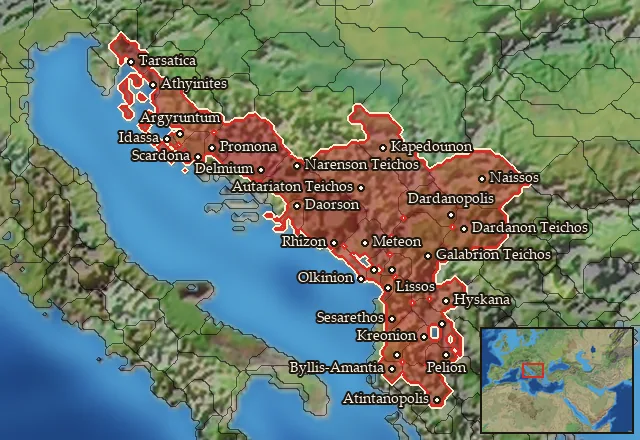
| Zone | Provinces | ||||||
|---|---|---|---|---|---|---|---|
| Southern illyrian | 29 |