
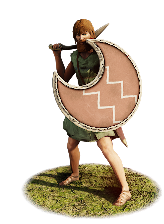
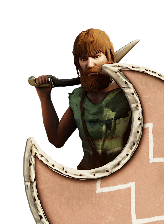
Description
These warriors come from the hills, forests, and tops of the Rhodope Mountains. They are simple shepherds, hunters, woodworkers, and peasants, voluntarily joining larger armies to profit from opportune raiding and pillaging on campaign, just for the chance to earn more from their service abroad than they might gain from their work at home. They are lightly armed, only clothed in their native tunics and boots, armed with iconic Thracian machairas, and only protected by plain wooden and leather shields. The Thracian Hillmen are not a reliable frontline unit, though they can be surprisingly fierce in their attack. Their meek protection makes them vulnerable to any professional unit, missile attacks, or cavalry charges. A war cry might heighten their spirits, but they will not hold their own in a prolonged melee.
Historical background
The Northern Aegean is a land rich in fertile soil, dense woods, and mountains filled with copper, silver, and gold. The old Strymon river that springs from deep within the Haemus Mountain Range has long ago cut a great path through the Rhodope Mountains - only second in height to the Haemus - flowing past the Pangaion, home to countless mines, and pouring into the Aegean. These mountains have been inhabited by Thracian peoples as long as the Greeks have put their myths into writing. Seeking to trick her husband into forgetting about the Siege of Troy, “Ox-eyed Hera […] darted from the summit of Olympos, to Pieria and lovely Emathia, skimming the snowy hills of the Thracian horsemen, not touching the slopes with her feet” (Hom. Il. XIV.225-228). Rhesos, the legendary king of the Thracian Edones hailed from these lands, his father being Eioneos, the eponym of the Thracian town of Eion on the Strymon, or even the Strymon itself (Eur. Rh. 279). Herodotus, in his commentary on the tribes and traditions of the Thracians, mentions the Satrians in the Rhodopes, a tribe that “never yet became obedient to any man”, remaining “up to [his] time still free, alone of all the Thracians” (VII.110-111). There, this warlike tribe is described as living in lofty mountains, covered with all kinds of forests and snow, their “prophets”, the Bessoi, protecting the Oracle of Dionysos. Over 400 years later, in 10 BC, the Bessoi still united behind the Dionysian priest Vologaisos, to revolt against the Romans and the pro-Roman Thracian kingdom of the Sapaians, killing King Rhaskyporis and stripping his uncle Rhoimetalkes of his power (Dio Cass. LIV.34.5). In the year 20 AD, the other infamous mountain tribe of the Dioi, already known to Thukydides as an independent tribe of swordsmen (Thuk. II.96), took up arms against the Romans, crossing the Haemus mountains to “raise the remote clans”, while the Odrysai and Koileletai besieged Philippopolis (Tac. Ann. III.38).
The tribes most feared in the Hellenistic period, however, were the Maidoi and Dentheletai, inhabiting the mountains and riverbanks of the upper Strymon (Strab. VII.5.12; Plin. NH. IV.1.3; IV.18.1). Neighbouring the Macedonian Kingdom downstream, they often had an easy inroad into Macedonian territory, while at the same time regularly suffering punitive or preventive expeditions by the Antigonid kings. On his way to Philippopolis, Philip V attacked the Dentheletai (along with the Odrysai and Bessoi) in 184/183 BC (Pol. XXIII-8.1-7; Liv. XXXIX.53.12-14), and once more when raiding them for supplies before a campaign against the Maidoi (Liv. XL.21-22). Incursions by the Maidoi continued (Liv. XXVIII.5; Pol. X.41.3), even after Macedonia fell under Roman control (App. Ill. 1.5, Obseq. 53), and despite resisting several attempts to subjugate them (Obseq. 48; Plut. Sul. XXIII.5; Eutrop. 5.7; Obseq. 59), they were finally subdued in 29 BC (Dio Cass. LI.25.3). Throughout the Macedonian Wars and thereafter, the Dentheletai were on good terms or allied to the Romans (Cic. In Pis. 84; Delev (2015), p. 70), an alliance that even held firm during the Mithridatic Wars that saw most of Thrace and Dardania pitted against the Romans (Lozanov, Roman Thrace (2015), p. 77). Around the 30s BC, the Dentheletai were overrun by the Bastarnai, the old allies of the Antigonids, who had carved out a permanent home for themselves in Getic lands, from whence they conducted expeditions against the new Roman hegemon in Macedonia. At this time, the Romans under Marcus Licinius Crassus defended the Dentheletai and their blind king Sitos (Dio Cass. LI.23.2, 25.3), but only 15 years later, this tribe fell back into its old habits and carried out raids into (Roman) Macedonia along with the Skordiskoi (LIV.20.1). Unfortunately, the context of this change of mind remains unexplained. The Dentheletai were permanently subdued and their territory incorporated into the Roman Empire, while their Romanized town of Pautalia eventually grew into an influential city in Late Antiquity (Dumanov, Thrace in Late Antiquity (2015), p. 99).
Thus, these Thracian Hillmen can be recruited by both the Maidoi and the Dentheletai. They are based on coins issued by the latter, dated roughly to the third quarter of the 4th century BC (Stoyas, Two Peculiar Thracian Coin Issus (2012), p. 157). On the reverse a warrior standing right in fighting stance is displayed, holding an iconic Thracian curved sword called machaira, and carrying a light shield called pelte, flanked by the description: l: ΔΑΝΤΗΛ, r: ΗΤΩΝ (DANTEL-ETON; Stoyas (2012), p. 144). Instead of a hat, he is wearing his hair in the style called ἀκρόκομοι (topknot: Stoyas (2012), p. 147; Hom. Il IV. 532). On the obverse we find the ivy-wreathed head of Dionysos, displaying their loyalty to the most popular Thracian God.
Stats
| Rank in roster | ||
|---|---|---|
| Men per unit | 60 | █████████· 87% |
| Attack | 6 | █········· 3% |
| Charge bonus | 5 | ███······· 26% |
| Defence | 18 | ██········ 16% |
| · armour | 1 | █········· 0% |
| · defence skill | 14 | ██········ 18% |
| · shield | 3 | ████······ 37% |
| Morale | 7 | █········· 10% |
| Discipline | Impetuous (may charge without orders) | |
| Training | Untrained | |
| Recruitment cost | 1,466 dn | ██········ 15% |
| Upkeep per turn | 537 dn | ███······· 25% |
| Turns to recruit | 2 |
Weapons
| Primary | Secondary | Primary | Secondary | Primary | Secondary | Primary | Secondary | ||||
|---|---|---|---|---|---|---|---|---|---|---|---|
| Attack | 6 | — | Charge bonus | 5 | — | Type | melee · blade | — | Damage | slashing | — |
Defence
| Primary | Secondary | Primary | Secondary | Primary | Secondary | Primary | Secondary | ||||
|---|---|---|---|---|---|---|---|---|---|---|---|
| Total | 18 | — | Armour | 1 | — | Defence skill | 14 | — | Shield | 3 | — |
Condition and terrain
| Hit points | 1 | Ground: scrub / sand / forest / snow | 0 / 0 / 0 / 0 | Charge distance | 30 | Formations | Square |
Technical stats
| Time between blows (primary / secondary) | 2.5 s / — | Extra fatigue in hot climates | 0 | Collision mass per man (1.0 is normal) | 0.85 | Spacing between men: close / loose | 1 × 1.2 m / 2 × 2.4 m |
| Default ranks | 5 |
In battle: Can hide in long grass · Can sap · Very good stamina
Who can recruit it
A core roster unit for 3 factions, each able to raise it anywhere they hold the right building:
Bessi · Dentheletae · Maedi
Any faction holding one of the provinces below can field it.
Exactly what a settlement must have, route by route (4)
| Building | Also requires | Building | Also requires | Building | Also requires | Building | Also requires |
|---|---|---|---|---|---|---|---|
| Any settlement | Garrison Building or Tier 1 Military Industrial Complex · Thracian Hillmen area of recruitment · Any Government (Dependency, Indirect Rule or Direct Rule) · Tier 2 Colony not built | Indirect Rule | Garrison Building or Tier 1 Military Industrial Complex · Tier 1 Colony | Direct Rule | Garrison Building or Tier 1 Military Industrial Complex · Tier 1 Colony | Homeland | Garrison Building or Tier 1 Military Industrial Complex |
Areas of recruitment
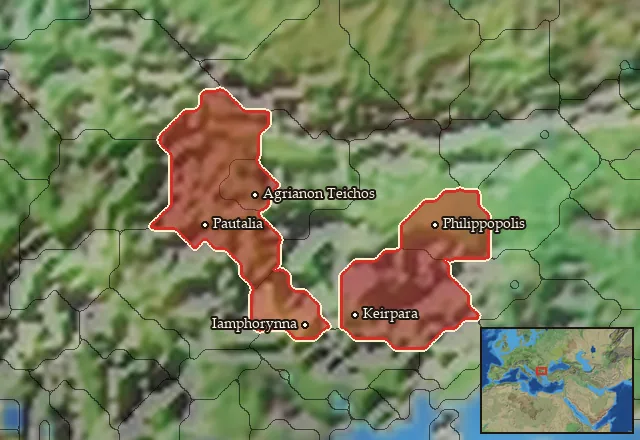
| Zone | Provinces | ||||||
|---|---|---|---|---|---|---|---|
| Thracian hillmen | 5 |