
Thracian Hippakontistai
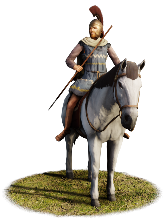
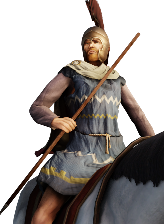
Class: missile · Category: cavalry · Men per unit: 30
Description
‘[Zeus] turned away his bright eyes, and looked afar, upon the land of the Thracian horsemen and of the Mysians that fight in close combat, and of the lordly Hippemolgoi that drink the milk of mares, and of the Abioi, the most righteous of men.’ – Hom. Il. 13.1-5
The Thracians are excellent and famed cavalrymen. Homer, as cited above, calls their land the "land of the Thracian horsemen" and makes repeated allusions to their associations with horses. Most of Thrace is great for horse-breeding and horses are highly regarded in Thracian culture (Stoyanov, Warfare (2015), p. 426). For the majority of their pre-Roman history, Thracian cavalrymen will have fought as hippakontistai, mounted skirmishers, whose speed and fighting style allows them to harass enemy infantry without getting caught in melee. Thus, they are armed with javelins for skirmishing and spears for close-quarter engagements, though it better not come to that. For some, their only protection comes from a Chalcidian-style helmet, whereas the others are only wearing leather and felt caps in the Phrygian-Thracian style. The riders are dressed in their distinctive Thracian patterned dress and cavalry boots, which have also been adopted by Greek cavalrymen. The light equipment of the hippakontistai makes them useful for both skirmishing and hunting down routing enemies, but they should stay out of melee combat against heavy infantry or cavalry.
Historical background
The ancient Thracians developed a society based around aristocrats presiding over the countryside that they controlled and defended from their hillforts. Light cavalry made up a significant part of their personal retinue, which helped them intercept hostile raiders or go on raids themselves. This resulted in a style of warfare characterized by skirmishing (Webber, Gods of Battle (2011), ch. Light Cavalry). From early on, they were well-known for their horse breeding skills and fine quality horses. Homer calls the horses of the Thracian king Rhesos the "fairest horses" to be seen, "the greatest, whiter than snow, and in speed like the winds" (Hom. Ill. 10.430). Several more times he connects the Thracians to their powerful cavalry and swift horses (Il. 10.463-475) and he calls Thrace the land of the horsemen (13.1-5; 14.225-230). Despite not necessarily being much bigger than Greek horses, studies on Thracian horses show that they were of good quality as well as of high importance to the Thracian nobility. Many horses with well-decorated horse trappings and bits were found in plenty of Thracian warrior graves (Webber, The Thracians (2001), p. 36). At Tazha, a fragmentary funerary epigram from the 2nd century BC was found concerning a certain Spartokos and his "beautiful horses" (ευιππον) (Dana, Inscriptions (2015), p. 248). Self-depictions as riders and hunters on horseback, as well as mounted warriors, became increasingly popular in Thrace and can be seen on the Thracian tomb wall paintings at Alexandrovo, Bulgaria (4th century BC) and Kazanlak dated to the end of the 4th or the beginning of the 3rd century BC (Danov, Altthrakien (1976), pp. 477-481).
The iconography of the Thracian rider had spread beyond Thrace itself, so that the image of the so called "Hero Rider" (Heros equitans) was widely adopted in Thrace, Moesia, and Macedonia, where it became a popular motif in funerary contexts. It usually shows an unarmoured and unhelmeted rider, riding from left to right and preparing a javelin in one hand to strike it at an animal beneath his horse. Several hero depictions are known from Hellenistic Thrace (3rd century BC relief in the Teteven museum, the Lukovit treasure, and many others), though the imagery of the Thracian rider and heros was also adopted by the Greeks and Romans. Athenian aristocrats styled themselves as Thracian horsemen in distinctively Thracian patterned clothing on many vases and even the Parthenon frieze (Matthew Sears, Athens (2015), p. 315). Even though the equipment of the Thracian cavalry eventually shifted towards heavy shielded cavalry (Webber (2001), p. 37), the imagery of the rearing horse over a "hunted victim" survived well into the Roman period and was adopted by Roman cavalrymen, probably thanks to Thracian inspiration (Gawronowksi, Roman horsemen against Germanic tribes (2018): Abdera horseman: p. 51; Flavius Bassus tombstone, Thracian horseman striking down barbarian: p. 141; Rufus Sita tombstone, Thracian horseman striking down barbarian: p. 159).
The aforementioned fighting style depicted by a plethora of Thracian and non-Thracian iconography was that of the mounted javelinman. The Greek term "hippakontistai" is a compound of hippos (horse) and akontistai (javelinmen) and describes a type of cavalry that had little defensive armour, but bore several javelins made of cornel wood (Webber 2003, p. 549) as well as a long, wooden lance. Initially, the term only referred to the skirmisher cavalry of Asia, which was first recruited by Alexander the Great when he invaded Central Asia (Arr. An. III.24.1). Aelian defines them as a sub-category of "Tarantine cavalry”, the hippakontistai being the ones who use javelins from afar, and the elaphoroi those who cast a javelin as a precursor before their charge (Ael. Tact. II). Most Thracian cavalry would have fought as hippakontistai for the majority of their pre-Roman history. Their armament was relatively light, apart from the aforementioned javelins and spears, they did not wear armour, but only their iconic Thracian tunics, boots, caps, and cloaks. As such they were often depicted on Attic red-figure pottery (Stoyanov (2015), p. 428; Attic Red Figure Cups: Museo Archaeologico Etrusco, Florence, 75770 (Beazly’s Archive, Nr. 211339); Musée du Louvre, G108 (Beazly’s Archive: 211333); Musée du Louvre, CP10896 (Beazly's Archive Nr. 200419)).
Even though heavy cavalry was already widely used by Thessalians and Macedonians in the Classical Era, the javelin-based fighting style was far safer and more popular. In his handbook for cavalry commanders, Xenophon recommends that riders should train their javelin-throwing skills from horseback (Cav. 22). The kind of training he mentions was still conducted by Roman cavalrymen as a sport in the 1st and 2nd centuries AD, as described by Arrian in his work on military tactics (Arr. Tact. 37-43). Thus, Thracian cavalry, who excelled at this kind of fighting-style, were highly sought after as allies or mercenaries, and could be found in the armies of the Triballoi (Nikolais of Damaskos: Mor. Mirab. F 115), Alexander (Diod. Sic. 17.17.4; 17.65.1), Aitolia (Liv. 37.48.4), Rome (Memnon, F.H.G. III. p. 556; Dio. Cass. 50.13.8), and Pontos (Dio. Cass. 36.9.3; Plut. Lucull. 28.3). The sheer number of Thracian cavalry that could be recruited must have been staggering to the Greeks. Herodotus says that the Thracians were the most numerous people in the world after the Indians, only weakened by their inability to unite (Hdt. 5.3). When Athens called the Odrysian king Sitalkes for help, he appeared with 150,000 men, a third of which made up of cavalry (compared to the usual 10:1 ratio of infantry to cavalry in Greek armies (Thuk. 2.98; Konijnendijk, Cavalry and the Character of Classical Warfare (2021), p. 190). When king Seuthes took the field against Lysimachos, he fielded 20,000 infantry and 8,000 cavalry, a ratio of 5:2. Though the use of Thracian mercenaries lessened during the Hellenistic period, Thracians still continued to provide cavalry to the Diadochoi and eventually Romans, where they often found themselves on both sides of the conflict (App. BC 4.11.88, 4.14.108).
Stats
| Rank in roster | ||
|---|---|---|
| Men per unit | 30 | █········· 8% |
| Attack | 10 | ██········ 19% |
| Charge bonus | 15 | ██████···· 64% |
| Defence | 16 | █········· 10% |
| · armour | 4 | ███······· 33% |
| · defence skill | 12 | █········· 9% |
| · shield | 0 | █········· 0% |
| Morale | 8 | ██········ 19% |
| Discipline | Normal | |
| Training | Untrained | |
| Recruitment cost | 1,352 dn | █········· 11% |
| Upkeep per turn | 544 dn | ███······· 27% |
| Turns to recruit | 2 |
Weapons
| Primary | Secondary | Primary | Secondary | Primary | Secondary | Primary | Secondary | ||||
|---|---|---|---|---|---|---|---|---|---|---|---|
| Attack | 10 | 7 | Charge bonus | 15 | 15 | Type | thrown · archery | melee · blade | Damage | piercing | piercing |
| Projectile | javelin | — | Range | 60 | — | Ammunition | 7 | — | Properties | Thrown | — |
Defence
| Primary | Secondary | Primary | Secondary | Primary | Secondary | Primary | Secondary | ||||
|---|---|---|---|---|---|---|---|---|---|---|---|
| Total | 16 | — | Armour | 4 | — | Defence skill | 12 | — | Shield | 0 | — |
Condition and terrain
| Hit points | 1 | Mount | light horse | Ground: scrub / sand / forest / snow | 0 / 0 / -3 / 0 | Charge distance | 40 |
| Formations | Square |
Technical stats
| Time between blows (primary / secondary) | 2.5 s / 2.5 s | Extra fatigue in hot climates | 0 | Spacing between men: close / loose | 2.2 × 5.2 m / 3.96 × 7.28 m | Default ranks | 5 |
In battle: Can form Cantabrian circle · Very good stamina
Who can recruit it
A core roster unit for 7 factions, each able to raise it anywhere they hold the right building:
Asti · Bessi · Cabyle · Dentheletae · Maedi · Paeonia · Triballi
Any faction holding one of the provinces below can field it.
Exactly what a settlement must have, route by route (4)
| Building | Also requires | Building | Also requires | Building | Also requires | Building | Also requires |
|---|---|---|---|---|---|---|---|
| Any settlement | Garrison Building or Tier 1 Military Industrial Complex · Thracian area of recruitment · Any Government (Dependency, Indirect Rule or Direct Rule) · Tier 2 Colony not built | Indirect Rule | Garrison Building or Tier 1 Military Industrial Complex · Tier 1 Colony | Direct Rule | Garrison Building or Tier 1 Military Industrial Complex · Tier 1 Colony | Homeland | Garrison Building or Tier 1 Military Industrial Complex |
Areas of recruitment
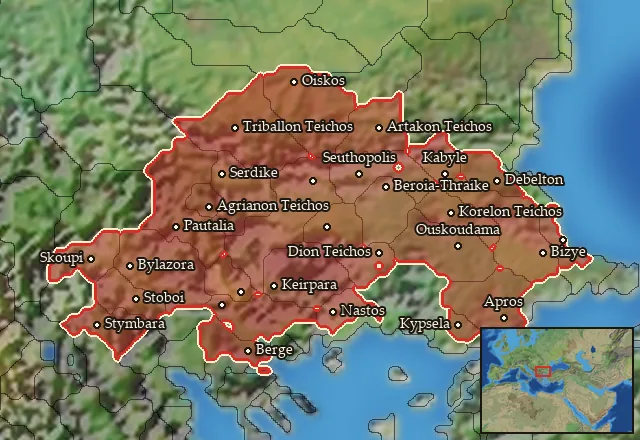
| Zone | Provinces | ||||||
|---|---|---|---|---|---|---|---|
| Thracian | 28 |