
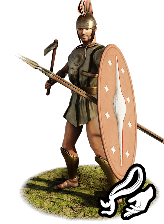
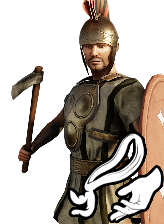
Description
"There too were those serried ranks of the Vestini, inferior to none in battle, toughened by hunting wild-beasts, while their flocks graze on Mount Fiscellus, over green Pinna, and the meadows of Aveia, which are quick to renew their growth again." – Silius Italicus (Punica 8.515–518)
Drawn from an Oscan-speaking Sabellian tribe on the eastern slopes of the central Apennines, these Vestini Axemen serve as shock infantry. Positioned north of the Paeligni and south of the Picentes, the Vestini inhabit a mountainous territory. Being accustomed to cattle husbandry, hunting wild animals, as well as a life of austerity and physical hardship, they are hardy warriors! These men are organized in cohort formations, and enter combat armed with single-handed axes, heavy throwing javelins, as well as a thureos shield. Protected by Italic triple-disc-cuirasses, greaves, and bronze Montefortino or Italic helmets, these mountain warriors attack the enemy battleline with javelins before making a devastating charge with their axes.
Historical background
The Vestini occupied the mountains surrounding the Gran Sasso, geographically divided into the Transmontani to the east (around Aveia, Peltuinum, and Aufinum) and the Cismontani to the west (around Pinna and Angulum) (Strab. 5.2.1, 5.4.2). Their primary urban and regional centres included Pinna, Aveia, Aternum, Peltuinum, Cutina, and Cingilia (Liv. 8.29.12). The roots of this warrior culture are exemplified by the famous 6th-century BC Capestrano Warrior statue, which depicts a local king equipped with a battleaxe, sword, two kardiophylakes, and spears (Menozzi, 'The Vestini’, in: Farney and Bradley (eds.), The Peoples of Ancient Italy (2017), pp. 519–538). By the 4th century BC, the Vestinian dialect had become closely aligned with the Oscan speech of their neighbours, the Marsi, Marrucini, and Paeligni (Menozzi (2017), p. 521). In civic and spiritual life, the Vestini maintained local cults dedicated to Silvanus, Jupiter, Hercules, Venus, and the Di Ancites (Buonocore, s.v. ‘Vestini’ (2006), in: DNP online).
Considered by Roman historians to be "quite as warlike as the Samnites" (Liv. 8.29.4), the Vestini first appeared in the historical record in 326 BC by allying with the Samnites at the start of the Second Samnite War (Liv. 8.29.1–14; Buonocore [2006]). Fearing the opening of a new eastern front, Rome attacked the Vestini in 325 BC. The consul Junius Brutus "carried on an active campaign amongst the Vestini without meeting with a single reverse", he then forced them to battle, where “he inflicted such a defeat on the Vestini, though with heavy loss on his own side also, that they fled to their camp, but not feeling sufficiently protected by fosse and rampart they dispersed in scattered parties to their towns, trusting to their strong positions and stone walls for their defence” (Liv. 8.29.9–12). In 302 BC, on the initiative of the Vestini themselves, a formal alliance (foedus) was established with Rome (Liv. 10.3.1; Menozzi (2017), p. 521). The Cismontane Vestini were incorporated into Roman territory in the early 3rd century BC, and their inter-valley trails were later monumentalized into the Via Claudia Valeria and Via Claudia Nova (Menozzi (2017), pp. 521, 537). During the 3rd century BC, the Vestini issued cast bronze coinage bearing the ethnic legend VES on the Italic-Adriatic weight system, likely used to pay allied troops (Menozzi (2017), pp. 521, 537; Buonocore [2006]).
Integrated as autonomous allies (socii) under the formula togatorum (a list maintained by the Romans for the purpose of determining the annual military contributions of the Italian allies – Baronowski, 'The "Formula Togatorum"', in: Historia 33-2 [1984]), Vestinian contingents subsequently served across major Roman campaigns all over the Mediterranean (Polyb. 2.24.12; Farney and Bradley (2017), pp. 113, 264–266; Menozzi (2017), p. 521). They were mobilized during the wars against the Boii, with their levy potential being counted (along with the Cenomani) at 20,000 soldiers, while only a smaller number ended up being stationed on the frontier of Gaul, to invade the territory of the Boii and divert them back from their expedition. They also participated in battle against the Transalpine Celts at Telamon in 225 BC, where 20,000 foot and 4,000 horse were fielded alongside the Marsi, Marrucini, and Frentani (Polyb. 2.24.12; Enn. Ann. 229; Menozzi (2017), p. 521), served against Hannibal at Cannae in 216 BC (Sil. Pun. 8.515–518), and fought in the advance guard against the Macedonian phalanx at Pydna in 168 BC (Liv. 44.40.5–7).
Despite extensive military service, the Vestini suffered military subordination, abuses of power, longer deployments, and political exclusion from Rome (Patrick Alan Kent in Farney and Bradley (2017), Kent, 'The Italians in Roman Armies’, in: Farney and Bradley (eds.), The Peoples of Ancient Italy (2017), pp. 264–266). Thus, joined by the Marsi, Paeligni, Marrucini, Picentes, and Samnites, the Vestini revolted in the Social War (91–89 BC) (Liv. Per. 72.e; App. B Civ. 1.39.175). In July 90 BC, Vestinian forces defeated and killed the Roman legate Q. Servilius Caepio (Oros. 5.18.14), before being defeated in turn by the consul Cn. Pompeius Strabo in 89 BC and capitulating in 88 BC (Liv. Per. 75, 76.e; App. B Civ. 1.52.227). Following the war, five Roman municipia (Peltuinum, Aveia, Pinna, Angulum, and Aufinum) were established over the older Vestini ocrei network (hillforts/fortified hilltop centres), starting a period of extensive civic rebuilding in their lands. This ended with the eventual integration of the principal Vestinian families into the Roman Senate and equestrian order (Menozzi (2017), pp. 537–538).
Stats
| Rank in roster | ||
|---|---|---|
| Men per unit | 40 | ███······· 30% |
| Attack | 16 | ████████·· 80% |
| Charge bonus | 11 | ████······ 38% |
| Defence | 32 | █████····· 49% |
| · armour | 5 | ████······ 35% |
| · defence skill | 23 | ███████··· 65% |
| · shield | 4 | █████····· 48% |
| Morale | 12 | ██████···· 57% |
| Discipline | Normal | |
| Training | Highly trained | |
| Recruitment cost | 1,661 dn | ███······· 28% |
| Upkeep per turn | 608 dn | ████······ 44% |
| Turns to recruit | 2 |
Weapons
| Primary | Secondary | Primary | Secondary | Primary | Secondary | Primary | Secondary | ||||
|---|---|---|---|---|---|---|---|---|---|---|---|
| Attack | 16 | 10 | Charge bonus | 11 | 20 | Type | thrown · blade | melee · blade | Damage | piercing | slashing |
| Projectile | javelin | — | Range | 50 | — | Ammunition | 2 | — | Properties | Used just before charging into combat | Armour-piercing (counts only half the target's armour) |
Defence
| Primary | Secondary | Primary | Secondary | Primary | Secondary | Primary | Secondary | ||||
|---|---|---|---|---|---|---|---|---|---|---|---|
| Total | 32 | — | Armour | 5 | — | Defence skill | 23 | — | Shield | 4 | — |
Condition and terrain
| Hit points | 1 | Ground: scrub / sand / forest / snow | 0 / -1 / 0 / -1 | Charge distance | 30 | Formations | Square |
Technical stats
| Time between blows (primary / secondary) | 2.5 s / 2.5 s | Extra fatigue in hot climates | 1 | Collision mass per man (1.0 is normal) | 1.02 | Spacing between men: close / loose | 1 × 1.2 m / 2 × 2.4 m |
| Default ranks | 5 |
In battle: Can sap · Very good stamina
Who can recruit it
No faction has this on its core roster: it can be raised only in the provinces below.
Any faction holding one of the provinces below can field it.
Exactly what a settlement must have, route by route (1)
| Building | Also requires | ||||||
|---|---|---|---|---|---|---|---|
| Any settlement | Tier 2 Military Industrial Complex · Marrucinian area of recruitment · Dependency only · Tier 1 Colony not built |
Areas of recruitment
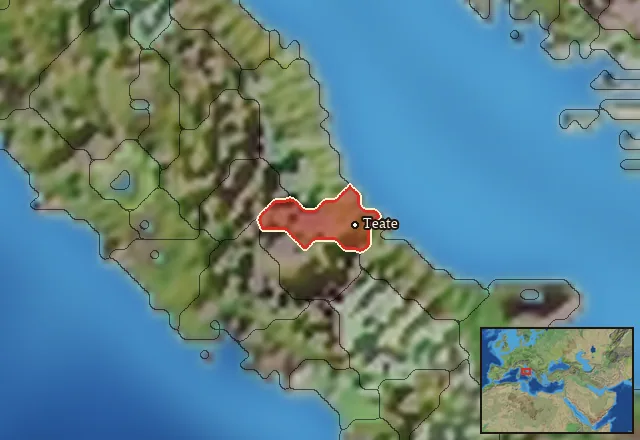
| Zone | Provinces | ||||||
|---|---|---|---|---|---|---|---|
| Marrucinian | 1 |