
Leves
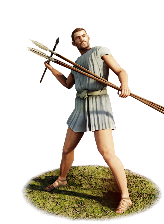
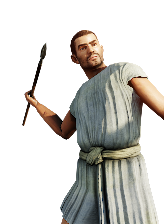
Class: missile · Category: infantry · Men per unit: 40
Reforms: No longer recruitable after A New Man: Gaius Marius (switched off), Polybian Reform · Becomes a newer unit with Polybian Reform
Description
The leves serve as the basic light infantry of the Roman army. Comprising the second-poorest citizens recruited from the 4th class of the Servian centuriate system, they are equipped solely with spears and javelins. Lacking armour or secondary weapons, their primary roles are scouting, foraging, and initiating the skirmish phase of a battle before retreating behind the heavier infantry lines. Consequently, they are highly vulnerable to melee combat, concentrated missile fire, and direct charges.
Historical background
Leves are mentioned as the light infantry of the Roman legion in Livy’s famous description of the manipular army in his book VIII. Twenty leves were attached to each maniple of heavy infantry, and contrary to these “scutati”, the leves are only armed with spears and javelins (“hastam tanum gaesaque gererent”, Liv. VIII.8.5). In most other passages, leves appear as “levis armaturae”, a broad Latin term referring to light infantry in general, comparable to the Greek “psiloi”. They fulfil the functions generally expected of light-armed infantry: skirmishing, fighting against elephants, and covering heavy infantry deployments (Anders, Roman Light Infantry and The Art of Combat (2011), p. 55). Though they are sometimes equated to the velites, whose existence is in turn dated back to the early Mid-Republic (Anders (2011), p. 55; Gauthier, Did Velites Disappear? (2021), p. 73), according to Livy’s narrative, the (shielded) velites are “invented” during the siege of Capua in 211 BC, as a picked group of skirmishers that works in tandem with the cavalry (Liv. XXVI.4.4-10). This passage is sometimes doubted, especially since Livy somewhat inconsistently mentions velites in earlier passages (XXI.55; XXIII.29; XXIV.34; and one time as “grosphomachoi” by Polybios in I.33.9; Anders (2011), p. 67), and by the time of Polybios’ writing, ca. 160-150 BC, the velites make up the entirety of the Roman light infantry.
However, Polybios, in most of his pre-book-VI narrative, besides the aforementioned single reference connected to the battle of Tunis (I.33.9, which could be an anachronism), consistently refers to the Roman light infantry as “(pez)akontistai” (i.e. (foot-)javelinmen: II.30; III.65; III.69; III.72-73; III.110). He explains the velites (= “grosphomachoi”) in his digression on the Roman army of his time in book VI (VI.21-22), and then starts reliably mentioning their presence in the Roman army from the siege of Carthago Nova in 209 BC onwards (X.15.10) – conveniently after 211 BC. It is thus not entirely unlikely that the leves (in the sense of simple “javelinmen”) indeed made up most of the Roman light infantry until the 2nd Punic War.
The armament of the leves consists of spears and javelins (Liv. XIII.8.5). They may have been levied from the 4th class of the Servian centuriata system, the part of the population whose worth was estimated to be around 25,000 aera (Roman bronze coins) and who were said to own nothing but spears and javelins (Liv. I.43.6: “nihil praeter hastam et verutum datum”).
Stats
| Rank in roster | ||
|---|---|---|
| Men per unit | 40 | ███······· 30% |
| Attack | 10 | ██········ 19% |
| Charge bonus | 1 | █········· 4% |
| Defence | 16 | █········· 10% |
| · armour | 1 | █········· 0% |
| · defence skill | 15 | ██········ 24% |
| · shield | 0 | █········· 0% |
| Morale | 4 | █········· 0% |
| Discipline | Low | |
| Training | Untrained | |
| Recruitment cost | 636 dn | █········· 0% |
| Upkeep per turn | 233 dn | █········· 6% |
| Turns to recruit | 2 |
Weapons
| Primary | Secondary | Primary | Secondary | Primary | Secondary | Primary | Secondary | ||||
|---|---|---|---|---|---|---|---|---|---|---|---|
| Attack | 10 | 4 | Charge bonus | 1 | 1 | Type | thrown · archery | melee · blade | Damage | piercing | piercing |
| Projectile | javelin | — | Range | 60 | — | Ammunition | 7 | — | Properties | Thrown | — |
Defence
| Primary | Secondary | Primary | Secondary | Primary | Secondary | Primary | Secondary | ||||
|---|---|---|---|---|---|---|---|---|---|---|---|
| Total | 16 | — | Armour | 1 | — | Defence skill | 15 | — | Shield | 0 | — |
Condition and terrain
| Hit points | 1 | Modifier against mounts | horse +1 · chariot +1 · camel +1 | Ground: scrub / sand / forest / snow | 8 / 0 / 8 / 0 | Charge distance | 30 |
| Formations | Square |
Technical stats
| Time between blows (primary / secondary) | 2.5 s / 2.5 s | Extra fatigue in hot climates | 0 | Collision mass per man (1.0 is normal) | 0.81 | Spacing between men: close / loose | 1.1 × 2.6 m / 1.98 × 4.68 m |
| Default ranks | 5 |
In battle: Very good stamina
Who can recruit it
A core roster unit for 4 factions, each able to raise it anywhere they hold the right building:
Any faction holding one of the provinces below can field it.
Exactly what a settlement must have, route by route (4)
| Building | Also requires | Building | Also requires | Building | Also requires | Building | Also requires |
|---|---|---|---|---|---|---|---|
| Indirect Rule | Garrison Building or Tier 1 Military Industrial Complex · Tier 1 Colony · not Polybian Reform | Direct Rule | Garrison Building or Tier 1 Military Industrial Complex · Tier 1 Colony · not Polybian Reform | Homeland | Garrison Building or Tier 1 Military Industrial Complex · not Polybian Reform | Any settlement | Garrison Building or Tier 1 Military Industrial Complex · Latin area of recruitment · Any Government except Homeland (Dependency, Indirect Rule or Direct Rule) · not Tier 2 Colony |
Areas of recruitment
| Zone | Provinces | ||||||
|---|---|---|---|---|---|---|---|
| Latin | 0 |