
Rorarii
Class: missile · Category: infantry · Men per unit: 40
Reforms: No longer recruitable after A New Man: Gaius Marius (switched off), Polybian Reform · Becomes a newer unit with Polybian Reform
Description
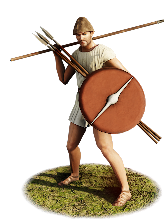
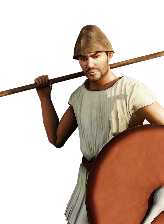
The rorarii are Roman skirmishers, superior to the leves. This unit is made up of the younger and less distinguished men of the Roman citizenry. Together with the triarii, they are recruited into the third line of the manipular legion, though their task is still to skirmish with javelins in front of the army and then retreat into safety, once the heavy infantry lines have clashed. Armed with several javelins and a light shield, they are better protected than the leves, though they should not actively seek close combat.
Historical background
As part of the famous army description of his book VIII, Titus Livius (ca. 59 BC – 17 AD) puts the rorarii, younger men who are less distinguished, under their own flag (vexillum) in the last line, together with the triarii and accensi (Liv. VIII.8.8: “secundum rorarios, minus roboris ae tate factisque”). This army description is a slight digression in his narrative on the Latin War (340-338 BC), preceding the Battle of Mount Vesuvius against the Latins in 340 BC (VIII.9.13-14). Here, the rorarii, presumably after initiating the battle, reinforce the losing hastati and principes. Beyond this, not much is known about them, especially compared to the other types of Roman soldiers from this era.
Marcus Terentius Varro (116-27 BC), who is still aware of the term in the 1st century BC, gives the following origin of the name rorarii: “Rorarii were those who started the battle, named from the 'dew-drop' (ros) because it ‘sprinkles' (rorat) before it really rains.” (Varr. Ling. Lat. VII.58). Though the etymology is commonly doubted by historians (Fiebiger, Rorarii, in: RE I A, 1 (1914), p. 1110-1111), it still shows how their role was understood. Another etymology was given by Gaius Lucilius (ca. 180 BC-103 BC), who writes that rorarii are “the soldiers who, before the battle lines had come together, would begin the fight with a few javelins at first; the name drawn from the fact that before the heaviest rains the sky begins to drizzle [rorare]. […] five spears, a rorarius veles with a golden belt.” (Non. 552/Lucil. VII.323). Confirming their position outside of the skirmishing phase, he goes on to write: “Behind those in soldier’s cloaks was standing the swift rorarius” (X.391).
The rorarii’s exact role on the battlefield has since long been hotly debated. Mommsen (Römische Geschichte 1 (1854), p. 430), taking their Varronian etymology literally as “sprinklers”, interpreted them as slingers. Delbrück (Das Altertum (1900), p. 320), who understands the invention of the velites from their initial role as “hamippoi” (a Greek term for lightly armed soldiers who fight in tandem with the cavalry), sees them as soldiers picked from the rorarii, now named after the weapon they carry (hasta velitaris – velites), a logic that came to extend to all rorarii and leves. His doubts about the rorarii and accensi having their own flags (vexilla) and thus maniples have been dismissed by Kromayer and Veith (Heerwesen und Kriegsführung der Griechen und Römer (1923), p. 268), and Fiebiger (RE: rorarii (1914), p. 1111). Kromayer/Veith rightly note that rorarii could have relieved the heavy infantry in a dire situation, as well (Liv. VIII.9.13-14). In that sense, it is quite strange to assume, as they do some pages later, that the rorarii would have been useless in combat after having spent all of their missiles (Kromayer; Veith (1924), p. 279).
The most convincing interpretation of the sources is that the rorarii were attached to the vexilla of the triarii in a similar manner as the leves were to the manipuli of hastati (and principes). Later, all these skirmishers came to be named after the light equipment they carried (Greek in Polybios: grosphomachoi – “light javelin fighters”; Latin: veles – perhaps derived from velum – “cloth, covering, veil”, as opposed to the armour of the heavy infantry [Lammert, Veles, in: RE VIII A, 1, p. 624]). This makes sense in the context of the 2nd century BC Polybian version of the manipular order, where every “speira” (maniple/vexillum) had 40 velites attached to it (Pol. VI.24.4).
There have also been attempts to connect the infantry types of the manipular battle order to the centuriate system established by Servius Tullius in the 6th century BC. Though there may be a partial overlap, especially due to the armament described for each class, the centuriate system essentially does not describes a military order, but rather a voting system for the citizenry (the comitia centuriata), divided on the basis of individual wealth (Cornell, The Beginnings of Rome (1995), p. 180). The rorarii may nonetheless have been picked from members of the 4th or 5th class (armed with javelins, spears, or slings, cf. Keppie, The Making of the Roman Army (1984), p. 8). Accordingly, they are armed with javelins and a small round shield, somewhat smaller than the one carried by the velites (Pol. VI.22.2; Liv. 38.21) as depicted on a bronze figurine from Rome (Museo Nazionale di Villa Giulia, inv. no. 24497, in: Taylor, Etruscan Identity and Service in the Roman Army (2017), p. 287). This gives them a small chance to hold their own in close combat.
Stats
| Rank in roster | ||
|---|---|---|
| Men per unit | 40 | ███······· 30% |
| Attack | 11 | ███······· 34% |
| Charge bonus | 3 | ██········ 16% |
| Defence | 20 | ██········ 19% |
| · armour | 1 | █········· 0% |
| · defence skill | 17 | ████······ 35% |
| · shield | 2 | ███······· 25% |
| Morale | 6 | █········· 6% |
| Discipline | Low | |
| Training | Untrained | |
| Recruitment cost | 809 dn | █········· 1% |
| Upkeep per turn | 296 dn | █········· 8% |
| Turns to recruit | 2 |
Weapons
| Primary | Secondary | Primary | Secondary | Primary | Secondary | Primary | Secondary | ||||
|---|---|---|---|---|---|---|---|---|---|---|---|
| Attack | 11 | 5 | Charge bonus | 3 | 3 | Type | thrown · archery | melee · blade | Damage | piercing | piercing |
| Projectile | javelin | — | Range | 60 | — | Ammunition | 7 | — | Properties | Thrown | — |
Defence
| Primary | Secondary | Primary | Secondary | Primary | Secondary | Primary | Secondary | ||||
|---|---|---|---|---|---|---|---|---|---|---|---|
| Total | 20 | — | Armour | 1 | — | Defence skill | 17 | — | Shield | 2 | — |
Condition and terrain
| Hit points | 1 | Modifier against mounts | horse +1 · chariot +1 · camel +1 | Ground: scrub / sand / forest / snow | 8 / 0 / 8 / 0 | Charge distance | 30 |
| Formations | Square |
Technical stats
| Time between blows (primary / secondary) | 2.5 s / 2.5 s | Extra fatigue in hot climates | 0 | Collision mass per man (1.0 is normal) | 0.84 | Spacing between men: close / loose | 1 × 2.4 m / 1.8 × 4.32 m |
| Default ranks | 5 |
In battle: Very good stamina
Who can recruit it
A core roster unit for 4 factions, each able to raise it anywhere they hold the right building:
Any faction holding one of the provinces below can field it.
Exactly what a settlement must have, route by route (3)
| Building | Also requires | Building | Also requires | Building | Also requires | ||
|---|---|---|---|---|---|---|---|
| Direct Rule | Garrison Building or Tier 1 Military Industrial Complex · Tier 1 Colony · not Polybian Reform | Homeland | Garrison Building or Tier 1 Military Industrial Complex · not Polybian Reform | Any settlement | Garrison Building or Tier 1 Military Industrial Complex · Latin area of recruitment · Any Government except Homeland (Dependency, Indirect Rule or Direct Rule) · not Tier 2 Colony |
Areas of recruitment
| Zone | Provinces | ||||||
|---|---|---|---|---|---|---|---|
| Latin | 0 |