
Triarii (Early)
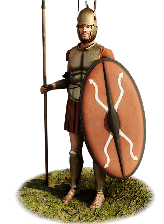
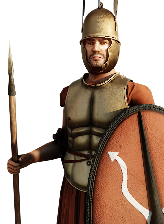
Class: spearmen · Category: infantry · Men per unit: 40
Reforms: No longer recruitable after A New Man: Gaius Marius (switched off), Polybian Reform · Becomes a newer unit with Polybian Reform
Description
The early triarii are the veterans of the Roman army, positioned in the third and final line of the legion. Armed with spears (hastae), oblong shields (scuta), and equipped with heavy armour, they act as reserves in case the hastati and principes are routed. The triarii will cover these younger men’s retreat or provide them with a position to rally behind. As the oldest and most experienced soldiers in the Roman army, these men are highly respected and can be relied upon, even if most of the time they will no longer see active combat.
Historical background
The triarii made up the third and last line (acies) of the Roman legion. Formally, they were not organised in maniples but in vexilla (“flags”/ “ensigns”), even though the distinction is minor. Similar to the other “ordines” (companies), their vexilla were made up of 60 men, commanded by two centurions and one standard bearer. On an organizational level, the triarii shared the third line with the rorarii and accensi. The latter apparently also formed vexilla of similar strengths, which would have resulted in combined companies of 186 men, but this is probably a confusion on Livy’s part. The common academic interpretation, based on other sources, is that the accensi were not proper soldiers but something akin to attendants, attached to the triarii outside of a battlefield situation. The rorarii were light infantry, probably attached to the vexilla like the leves were to the manipuli of hastiti and principes (on the accensi: Rawlings, Army and Battle During the Conquest of Italy (2007), p. 57; Anders, Roman Light Infantry and the Art of Combat (2011), p. 8-13. See also the description: rorarii).
The triarii were also called “pilani”, making the formations of hastati and principes the “antepilani” (“[those] in front of the pilani” Liv. VIII.8.7-8). The triarii’s task was to kneel on their right legs, waiting for their turn in battle, their spears put into the earth as if they formed a palisade (“haud secus quam vallo saepta inhorreret” Liv. VIII.8.10). If both the lines of hastati and principes had been routed, it “came to the triarii”, which was a proverb for an ensuing crisis (Liv. VIII.8.11: “inde rem ad triarios redisse”). After letting the retreating hastati and principes pass between the vexilla’s spaces, the triarii would close their ranks and throw themselves at the enemy as fresh reserves. Varro, however, has the following to say about them: ‘The pilani are called also triarii, 'third-line-men', because in the battle arrangement they were set in the rear, in the third line, as reserves […] Plautus says: ‘Come now, everyone sit on the periphery, just like triarii’” (Frivolaria frg. 5 Ritschl. = Varro Ling. Lat. V.89). This jab demonstrates that, even though everyone could expect the triarii to save the day in a crisis situation, in most battles they did not have much to do, other than sitting around.
The triarii are the only type of Roman heavy infantry that is already mentioned before the manipular reforms of the 4th century BC, though in their old role they seem to have functioned as camp guards. In 507 BC, shortly after the eviction of the Tarquinii from Rome, it came to a battle with the royal family and their Etruscan allies in Veii. The sons of the former king Lucius Tarquinius Superbus (r. 534-509 BC), Titus and Sextus, routed the Roman left flank and pursued the army to its camp, which was being guarded by the triarii (Dion. Hal. V.15.4). In 482 BC, a Volscian army, intoxicated by a preceding victory, attacked the Roman survivors of that battle in their camp, which was successfully defended by dismounted cavalrymen and the triarii, who had remained behind as guards (Dion. Hal. VIII.86.4). Other examples of triarii guarding the Roman camp include a battle against Veii in 480 BC (Liv. II.47.5-8), and a battle against the alliance of the Veian king Lars Tolumnius (d. 437 BC) (Liv. IV.19.8). As part of the manipular reforms, somewhere in the 4th century BC, the triarii were probably transferred out of the camp onto the battlefield as last line reserves, even if in 350 BC, we still see them tasked with the construction of fortifications (Liv. VII.23; manipular reforms dated to the siege of Veii 405-395 BC, according to Livy VIII.8.3-4, or during the Samnite wars according to others: FGrH 839 fr. 1; Ath. Diep. 6.273; Sall. Catil. 51.37).
In their new role, the triarii likely gained the respect they were later famed for. Their authority was demonstrated in 358 BC, when the seven-time primus pilus (the centurion of the first vexillum of triarii), Sextus Tullius, criticised dictator C. Sulpicius on behalf of the army (Liv. VII.13). In 325 BC, when the magister equitum (the attendant to the dictator elect), Q. Fabius, won a battle on his own against the orders of dictator L. Papirius, the latter wanted to punish and execute Fabius. During the army council, after Fabius had already been stripped by the lictors in preparation of his beheading, he was able to save himself among the triarii, who had started shouting and protesting, causing a riot which spread over the entire army and nearly led to a mutiny (Liv. VIII.32.11).
Since the triarii are the only battleline that kept its spears (hastae), they are often connected to Rome’s first class in the Servian centuriate system (mid-6th century BC), whose members were armed in hoplite-like gear, including heavy armour, round aspis shields, and spears (Liv. I.43.2-3; Dion. Hal. IV.16.1). While this interpretation seems plausible, it is also too simple. When Rome’s army developed the manipular system, it is likely that the old armament requirements of the classes disappeared – if they ever existed at all (Cornell, The Beginnings of Rome (1995), p. 180-186). The heavy infantry was likely levied from the first three classes as a whole, the light infantry from the lower two. The triarii’s early appearances demonstrate that they acted as reserves outside of the battle and were used as camp guards. In a society like ancient Rome’s, which fought yearly wars, their older age automatically made them into experienced veterans. The triarii were clearly respected for their seniority, but on the battlefield, the hastati and principes were the primary fighters. Concerning their equipment, they also ditched the aspis shield for the scutum (oblong oval shield) behind which they knelt (Liv. VIII.8.10: “Triarii […] scuta innixa umeris). Their helmets, besides the popular Montefortino type, are a bit old-fashioned and more individualistic, reminiscent of Etruscan, Latin, and Campanian findings and depictions of Italo-Phrygian and Italo-Chalcidian helmets (mirror from Praeneste, Royal Ontario Museum, Inv. 928.48.3; Tomba 1, Nola-Casamarciano; Amazonomachy sarcophagus of Ramtha Huzcnai of Tarquinia, Firenze, Museo Archaeologico Nazionale 5811). They wear excellent heavy armour, including muscle cuirasses and Etrusco-Latin style scale cuirasses, as well as greaves for additional protection.
Stats
| Rank in roster | ||
|---|---|---|
| Men per unit | 40 | ███······· 30% |
| Attack | 15 | ███████··· 72% |
| Charge bonus | 18 | ███████··· 72% |
| Defence | 46 | █████████· 89% |
| · armour | 10 | █████····· 54% |
| · defence skill | 31 | ██████████ 95% |
| · shield | 5 | ██████···· 57% |
| Morale | 14 | ████████·· 79% |
| Discipline | Normal | |
| Training | Highly trained | |
| Recruitment cost | 1,778 dn | ████······ 35% |
| Upkeep per turn | 651 dn | █████····· 53% |
| Turns to recruit | 4 |
Weapons
| Primary | Secondary | Primary | Secondary | Primary | Secondary | Primary | Secondary | ||||
|---|---|---|---|---|---|---|---|---|---|---|---|
| Attack | 15 | — | Charge bonus | 18 | — | Type | melee · blade | — | Damage | piercing | — |
| Properties | Light spear (braced against cavalry charges from the front) · +8 attack against cavalry | — |
Defence
| Primary | Secondary | Primary | Secondary | Primary | Secondary | Primary | Secondary | ||||
|---|---|---|---|---|---|---|---|---|---|---|---|
| Total | 46 | — | Armour | 10 | — | Defence skill | 31 | — | Shield | 5 | — |
Condition and terrain
| Hit points | 1 | Ground: scrub / sand / forest / snow | -1 / -1 / -4 / -1 | Charge distance | 30 | Formations | Square |
Technical stats
| Time between blows (primary / secondary) | 2.5 s / — | Extra fatigue in hot climates | 3 | Collision mass per man (1.0 is normal) | 1.27 | Spacing between men: close / loose | 1 × 1.2 m / 2 × 2.4 m |
| Default ranks | 5 |
In battle: Can sap · Good stamina
Who can recruit it
A core roster unit for 4 factions, each able to raise it anywhere they hold the right building:
Exactly what a settlement must have, route by route (2)
| Building | Also requires | Building | Also requires | ||||
|---|---|---|---|---|---|---|---|
| Direct Rule | Tier 3 Military Industrial Complex · Tier 2 Colony · not Polybian Reform | Homeland | Tier 2 Military Industrial Complex · not Polybian Reform |