
Arcadian Peltasts
Class: missile · Category: infantry · Men per unit: 40
Description
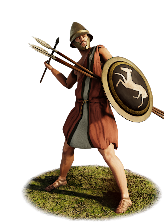
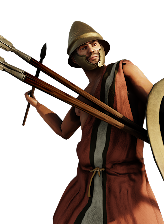
These men fight as classical Peltasts, javelinmen with a decent training, but only light equipment. Aside from their javelins, they are carrying a small, round Pelte shield on the arm and Konos or Pilos helmets for protection, while they can use their Machaira swords to defend themselves in melee. As they are recruited from the poorer classes of the Achaian and Arcadian poleis, their panoply is not as rich as that of, for instance, the Thureophoroi; but they fear no one and excel at skirmishing.
Historical background
Before the Hellenistic period, the Achaian League had never been a major player in Greek politics. Though the confederation was already established by the middle of the 5th century, the poleis of Achaia were small and insignificant. Its function was thus mainly ritual and it regulated the religious cults of the region. The main deity of this part of the Northern Peloponnese was Zeus Homarios, whose temple in Aigion served as the central meeting place for the members of the confederation. During the Peloponnesian War, some of them were forced to support the Lakedaimonians and the Peloponnesian League, but they never played a very active role. In 371 BC, a massive earthquake shocked the region and caused a tsunami which rolled over Helike, at that moment the leading city-state of Achaia. Its complete destruction further diminished the League’s political and military significance.
When Philip II reached for hegemony over Greece, the Achaians nevertheless supported Athens and the Boiotian League in their resistance (Dem. On the Crown, XVIII, 237). After the alliance was defeated at Chaironeia in 338 BC, Philip did not dissolve the League (as is popularly claimed) since we know from Hypereides I, 18 that it was still in existence in 324 BC. However, after the death of Alexander, one of the diadochi did indeed dissolve it as Polybios, who was later cavalry commander (Hipparchos) of the League, attests (Polyb. II, 40, 5). The end of the confederation brought conflict to this region of Greece, as its cities could now fight against each other. It therefore only took the Achaians a few decades to re-establish their organisation: After all, thanks to the small size of the poleis and their democratic constitutions, Achaia had always been one of the most peaceful areas in the Hellenic world.
In 281/280 BC, the western Achaian poleis Tritaia, Dyme, Pharai and Patrai (which took the leading position) set up a new Achaian League (Polyb. II, 41). In the 270s, they managed to either convince or force the pro-Macedonian tyrants of Aigion, Bura, Karyneia, Lention, Aigeira and Pellene to abdicate. In supporting Pyrrhos of Epeiros and subsequently joining Athens, Sparta and the Ptolemaic Empire in the Chremonidean War (267-261 BC) against Antigonid Macedon, they soon became a bigger player on the international stage than they had ever been before.
The new situation meant an increased need for soldiers. Though the Achaians would soon adopt contemporary equipment such as the Thureos shield and later on the Sarissa, its army originally still fought in the traditional ways. Achaia had traditionally been Hoplite country, just like the adjacent region of Arcadia in the South, and the Hoplites of both regions continued to be hired as mercenaries in the Hellenistic period (Trundle, Mercenaries 2004, p. 75/76). Yet, from the late 5th century on, they also produced excellent Peltasts. Aside from thousands of Achaian and Arcadian Hoplites, Xenophon also mentions Peltasts from the regions in his Anabasis (e.g. Xen. An. IV, 3, 22; 8, 18).
In the course of the 3rd century BC, most of the Arcadian cities joined the Achaian League. The historian Polybios himself hailed from Arcadia’s largest city, fittingly called Megalopolis by the Thebans who sponsored its anti-Spartan foundation in 368/367 BC (Diod. XV, 72, 4), and completely identified himself as an Achaian (e.g. Polyb. II, 38, 5-9). In fact, his father, Lykortas of Megalopolis, had been Strategos of the confederation (e.g. Polyb. XXIII,16, 1) and his older brother, Thearidas of Megalopolis, was appointed governor of Messene in 182 BC (IvOL 46,6) before later serving as the Achaian ambassador to Rome (e.g. Polyb. XXXII, 7, 1). The Arcadians thus came to be called Achaians as well (Polyb. II, 38) and would have fought together with Achaian Peltasts. At the Battle of Magnesia in 190 BC, Eumenes of Pergamon, the most important ally of Rome, was supported by Achaian Peltasts (together with "auxiliaries”, they counted 3,000 men: Liv. XXXVII, 39, 9.). These have often taken to be Phalangites (Sekunda, Military Forces 2007, p. 343) as Polybios commonly used the word Peltastai or Peltophoroi for Macedonian style pikemen (e.g. probably in XXIII, 16, 10 on Achaian troops). However, in Livy’s text we find the word caetrati, which Roman authors usually use to describe the light armed troops of the Iberians, who Strabo calls peltasts in the classical meaning (Strab. III, 4, 15, C163). It is thus likely that these men, who contributed to the decisive victory of the Romano-Attalid army, were javelinmen. Lucian of Samosata (ca. 120-180 AD) still mentions Arcadian Peltasts in general and those from Mantineia in particular (Dialogues of the Dead XIV), so their reputation lived on even in imperial times.
Stats
| Rank in roster | ||
|---|---|---|
| Men per unit | 40 | ███······· 30% |
| Attack | 11 | ███······· 34% |
| Charge bonus | 2 | █········· 11% |
| Defence | 21 | ██········ 21% |
| · armour | 5 | ████······ 35% |
| · defence skill | 14 | ██········ 18% |
| · shield | 2 | ███······· 25% |
| Morale | 6 | █········· 6% |
| Discipline | Low | |
| Training | Untrained | |
| Recruitment cost | 1,062 dn | █········· 5% |
| Upkeep per turn | 389 dn | █········· 14% |
| Turns to recruit | 2 |
Weapons
| Primary | Secondary | Primary | Secondary | Primary | Secondary | Primary | Secondary | ||||
|---|---|---|---|---|---|---|---|---|---|---|---|
| Attack | 11 | 7 | Charge bonus | 2 | 4 | Type | thrown · archery | melee · blade | Damage | piercing | slashing |
| Projectile | javelin | — | Range | 60 | — | Ammunition | 7 | — | Properties | Thrown | — |
Defence
| Primary | Secondary | Primary | Secondary | Primary | Secondary | Primary | Secondary | ||||
|---|---|---|---|---|---|---|---|---|---|---|---|
| Total | 21 | — | Armour | 5 | — | Defence skill | 14 | — | Shield | 2 | — |
Condition and terrain
| Hit points | 1 | Ground: scrub / sand / forest / snow | 8 / 0 / 8 / 0 | Charge distance | 30 | Formations | Square |
Technical stats
| Time between blows (primary / secondary) | 2.5 s / 2.5 s | Extra fatigue in hot climates | 0 | Collision mass per man (1.0 is normal) | 0.9 | Spacing between men: close / loose | 1.1 × 2.6 m / 1.98 × 4.68 m |
| Default ranks | 5 |
In battle: Very good stamina
Who can recruit it
A core roster unit for one faction, which can raise it anywhere it holds the right building:
Any faction holding one of the provinces below can field it.
Exactly what a settlement must have, route by route (4)
| Building | Also requires | Building | Also requires | Building | Also requires | Building | Also requires |
|---|---|---|---|---|---|---|---|
| Any settlement | Garrison Building or Tier 1 Military Industrial Complex · Arcadian area of recruitment · Any Government (Dependency, Indirect Rule or Direct Rule) · Tier 2 Colony not built | Indirect Rule | Garrison Building or Tier 1 Military Industrial Complex · Tier 1 Colony | Direct Rule | Garrison Building or Tier 1 Military Industrial Complex · Tier 1 Colony | Homeland | Garrison Building or Tier 1 Military Industrial Complex |
Areas of recruitment
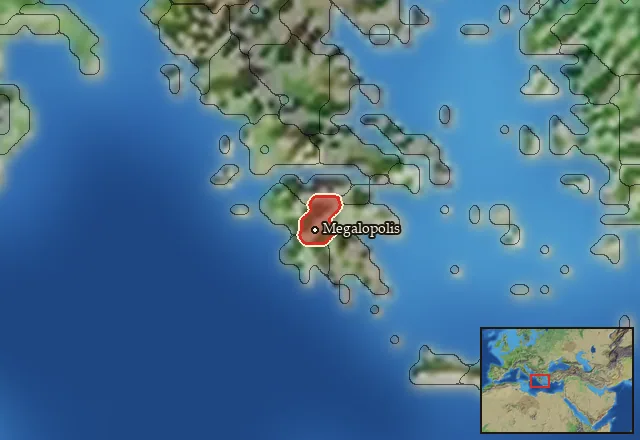
| Zone | Provinces | ||||||
|---|---|---|---|---|---|---|---|
| Arcadian | 1 |