
Gortynian Hippeis
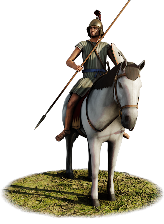
Class: heavy · Category: cavalry · Men per unit: 30
Reforms: No longer recruitable after Gortynian Reforms · Becomes a newer unit with Gortynian Reforms
Description
"And the Cretans had as leader Idomeneus, famed for his spear, even they that held (...) Gortyn, famed for its walls.” – (Hom. Il. 2.645)
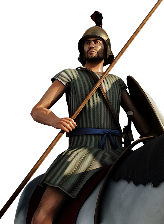
These horsemen are the wealthy citizens of Gortyn, the foremost city on Crete. As is standard for Greek cavalry, they wear Boiotian helmets (usually plumed) and carry a xyston (lance). Less typical is the use of javelins as a secondary weapon, while the Aspis shield of the Hoplite is only used by cavalry on Crete. At the same time, the Gortynians have done away with body armour in exchange for greater agility and pace, while their finely manufactured golden belts, which depict hunting scenes, are evidence of their noble origin. In the aristocratic society of Gortyn, the richest citizens are thought of as the best citizens, and only they can pay for horses and their upkeep. Well equipped for skirmishes, melee and relentless pursuits, they form the polis’ greatest asset in war.
Historical background
Gortýn (Γορτύν) or Górtyna (Γόρτυνα) was founded on the Lethaios river in the Messara plain at some point during the Minoan period (Levi, La villa rurale minoica di Gortina (1959)). Legend has it that Gortys, son of Rhadamantos, himself a son of Zeus and the mythical first lawgiver of Crete, established the settlement (Paus. 8.53.4). By the time of Homer (8th century BC?), it had become a Dorian city with strong fortifications (Hom. Il. 2.645, Od. 3.294; cf. Plat. Nom. 708a). Not much is known about the history of archaic Gortyn, but, like elsewhere in the Greek world, social conflicts between peasants and nobles, poor and rich, city and countryside, seem to have been common. These led to the codification of complex laws by the end of the 7th century BC (Koerner, Inschr. Gesetzestexte (1993), nos. 116-162). Other than in Athens, on many of the islands or in neighbouring Lyttos, however, the nobles prevented the rise of democracy. The famous Gortyn Code from the 5th century BC still stands in situ within the impressive ruins of Gortyn today and is a remarkable and unique witness to the legal basis of a noble ancient Greek society. It regulates anything from divorces to inheritances, adultery or procedural law. Remarkably, the Gortynians even forbade the rape of wives or slave girls – possibly a first in world history (cf. Willetts, The Law Code of Gortyn (1967); Metzger, Untersuchungen zum Haftungs-und Vermögensrecht von Gortyn (1973); Vasilakis, Die große Inschrift des Gesetzeskodex von Gortyn (2005)).
By the time of the Peloponnesian War, Gortyn had engaged in friendly relations with Athens (Thuc. 2.85.5), but its ties with the Dorian cities of the Peloponnese would remain strong. Around 272 BC, shortly before the start of the RIS campaign, king Areus I of Sparta (r. 309-265 BC: you can play him when you choose Sparta) was campaigning on Crete to defend Gortyn against unnamed enemies – possibly Knossos (Plut. Pyrrhus 27.1). Gortyn and Sparta prevailed, by the looks of it, for just one year later, we find both of them joining the coalition of Chremonides of Athens against the Antigonids of Macedon (IG II3 1 912). Despite the size of the alliance – Athens, Sparta, the Ptolemies, the Achaian League, Gortyn, other Cretan, various Arcadian cities, and Elis were all members – the Chremonidean War (267-261 BC) ended in a Macedonian victory. While the repercussions for Athens in particular were devastating, the consequences for the Cretans will have been minimal. Instead, a rapprochement between Knossos and Gortyn came about, and the two powerful poleis with their respective allies began dividing Crete into two spheres of power. Eventually, they set up a Cretan Koinon under their dual leadership, which all major cities but Lyttos joined (Polyb. 4.53.4). Located in the mountains of eastern central Crete, Lyttos was a traditional enemy of Knossos, which also controlled much of the northeastern coast of the island (see the descriptions of the Lyttian units for more info). It was probably also a democracy, which also differentiated Lyttos from Gortyn and Knossos. In 221 BC, the pair decided that enough was enough and began a war that would change Crete forever: the Lyttian War.
The grand alliance soon showed its first cracks: after a matter of weeks or months, Polyrrhenia, Keraia, Lappa, Horion, and Arkadia, disgusted by the cruelty of the war, abandoned the Koinon (Polyb. 4.53.5). The news led to an outcry in Gortyn, where the younger citizens openly expressed their sympathies for Lyttos. They seemingly felt the support of Knossos was going to far, and that destroying Lyttos would make the city of Minos too strong. When their elder compatriots reminded them that they were bound to Knossos by a treaty of alliance, a stasis broke out – no less than civil war (Polyb. 4.53.6). The Knossians reacted by requesting reinforcements from their Cretan and Aitolian allies, and, after the arrival of 1,000 Aitolian soldiers, they marched on Gortyn. The older citizens opened the gates and together, they seized the citadel and executed the leaders of the young men (Polyb. 4.53.6). Having brought Gortyn into line, the Knossians now advanced towards Lyttos and found that its army was away in the field. In a dramatic battle, Lyttos, the oldest city on Crete, was stormed and burned to the ground (Polyb. 4.54.1-6).
The destruction of Lyttos was a watershed moment in the history of Crete. Even today, every Cretan knows of this triumph or tragedy – depending on whoever you side with – and the author of these lines saw the ashes of Lyttos in the Archaeological Museum of Heraklion. Yet, the war did not end here: Lappa and Polyrrhenia welcomed the surviving Lyttians and the younger Gortynians and sent envoys to the Achaian League and to Philip V, king of Macedon. As enemies of Aitolia, they were only too happy to intervene on the island, and immediately dispatched 700 picked soldiers (Polyb. 4.55.1-2). The allies now proceeded to besiege Eleutheria, Kydonia, and Aptera, forcing them to leave the Knossian Koinon (Polyb. 4.55.4). The surviving Gortynian youngsters, meanwhile, were equipped with weapons, horses, and money and took the ancient settlement of Phaistos, which lies on a high plateau west of Gortyn, by surprise. The formidable fortress town, home of the mysterious Phaistos disk (which only Mickey Mouse ever deciphered), was in a great position to resume the war against Gortyn itself, and soon, the harbours of Lebena and Matalon were under the control of the pro-Lyttians (Polyb. 4.55.6; Chaniotis, Das antike Kreta (2004), p. 82). The Achaian League seems to have sent more soldiers soon after, for Arcadians on the side of Lyttos appear in the course of the war, among them Philopoimen, the later leader of the Koinon (Plut. Philopoimen 7.1-2; Plut. Aratos 50.5). Soon after, Gortyn seems to have fallen into their hands, and the Knossians were all but defeated. In 216 BC, Philip V declared Crete a Macedonian protectorate and he was accepted as the leader (prostatēs) of a new Cretan Koinon (Polyb. 7.14.4). Knossos, its remaining allies, the Ptolemaic Itanos and some smaller towns remained outside of this coalition, but Gortyn now acted as the sanctioned leader of the Cretans (Chaniotis, Federalism on Crete (2015), p. 381).
Peace only prevailed for eleven years before Gortyn’s position was once again challenged: Rhodes, Pergamon, and Aitolia had formed an anti-Macedonian federation, and during the ensuing Cretan War (205-200 BC), Polyrrhenia, Kera, Rhaukos, Kydonia, Lappa, and Knossos joined their cause (Karafotias, Crete in search of a new protector (1966), p. 107). The Achaians remained faithful to Gortyn, by the looks of it, for Philopoimen returned to Crete and probably brought Arcado-Achaian troops with him (Plut. Philopoimen 13.1-6). However, the war went badly, and the Rhodian troops prevailed on the island. Despite all of this, the Cretan koinon of Gortyn remained intact, and would enter the 2nd century BC in reduced, but robust form (Chaniotis (2015), p. 381).
Until this period, Gortynian cavalry fought in the form seen here. Being situated in the wide and fertile Messara plain, Gortyn commanded one of the best spaces for horse breeding on Crete and its cavalry may thus have been better than that of other Cretan poleis. Synonymous with ancient Crete are its archers, and while the existence of slingers, javelinmen, and infantry has never been doubted, most historians are sceptical that cavalry played a major role in the various Cretan wars (i.e., Perlman, Imagining Crete (2005), p. 308). They feel vindicated because exactly this was claimed by Plato (Leg. 625c–d). And yet, such a view ignores the testimony of Ephoros of Kyme (ca. 400-330 BC), one of the most respected and famous historians of antiquity. According to him (FGrHist 70 F149§18), the Hippeis (“horse owners”) of Crete, unlike those of Sparta, were cavalrymen. This is further confirmed by the many horsemen in archaic Cretan art (most of them are now in the Archaeological Museum of Crete where I saw them) and by the fact that several Cretan poleis provided cavalry to Eumenes II of Pergamon (r. 197-159 BC) in the early 2nd century BC (IC IV179). On a stela from the shrine of Glaukos and Kounabi in Elytna, possibly in Gortynian territory, a rider carries a rimmed Aspis shield, uncharacteristic for Greek cavalry before the 2nd century BC (see the description of Aspidophoroi). The image could hail from the 3rd century, however, as the archaeologists imply in the description of the object in the basement of the Archaeological Museum of Heraklion. While the horseman wears only a quilted tunic, he is equipped with a Boiotian helmet, a spear, and two javelins. This is how we have armed the Gortynian Hippeis in RIS, who also serve as the bodyguard unit for the Gortyn faction. Their equipment changed around 200 BC, as you will see in the reformed unit, and around that time, Thureophoroi cavalry, too, was introduced in Gortyn. Another stela from Eltyna, also in the Archaeological Museum of Heraklion, shows a rider in quilted tunic with a rimmed Thureos shield, two javelins, as well as headgear that could be interpreted as a Kausia or Petasos hat or a Boiotian helmet.
Stats
| Rank in roster | ||
|---|---|---|
| Men per unit | 30 | █········· 8% |
| Attack | 15 | ███████··· 72% |
| Charge bonus | 22 | ████████·· 77% |
| Defence | 30 | ████······ 43% |
| · armour | 11 | ██████···· 64% |
| · defence skill | 14 | ██········ 18% |
| · shield | 5 | ██████···· 57% |
| Morale | 10 | ███······· 29% |
| Discipline | Normal | |
| Training | Highly trained | |
| Recruitment cost | 1,776 dn | ████······ 35% |
| Upkeep per turn | 715 dn | ███████··· 68% |
| Turns to recruit | 3 |
Weapons
| Primary | Secondary | Primary | Secondary | Primary | Secondary | Primary | Secondary | ||||
|---|---|---|---|---|---|---|---|---|---|---|---|
| Attack | 15 | 10 | Charge bonus | 22 | 27 | Type | thrown · blade | melee · blade | Damage | piercing | piercing |
| Projectile | javelin | — | Range | 50 | — | Ammunition | 2 | — | Properties | Used just before charging into combat | — |
Defence
| Primary | Secondary | Primary | Secondary | Primary | Secondary | Primary | Secondary | ||||
|---|---|---|---|---|---|---|---|---|---|---|---|
| Total | 30 | — | Armour | 11 | — | Defence skill | 14 | — | Shield | 5 | — |
Condition and terrain
| Hit points | 1 | Mount | light horse | Ground: scrub / sand / forest / snow | 0 / -1 / -4 / -1 | Charge distance | 40 |
| Formations | Square |
Technical stats
| Time between blows (primary / secondary) | 2.5 s / 2.5 s | Extra fatigue in hot climates | 2 | Spacing between men: close / loose | 2 × 4.8 m / 3 × 7.2 m | Default ranks | 5 |
In battle: Very good stamina
Who can recruit it
A core roster unit for one faction, which can raise it anywhere it holds the right building:
Any faction holding one of the provinces below can field it.
Exactly what a settlement must have, route by route (5)
| Building | Also requires | Building | Also requires | Building | Also requires | Building | Also requires |
|---|---|---|---|---|---|---|---|
| Any settlement | Tier 2 Military Industrial Complex · Gortynian area of recruitment · Any Government (Dependency, Indirect Rule or Direct Rule) · Tier 2 Colony not built · Requires resource horses or horses supplied factionwide | Indirect Rule | Tier 2 Military Industrial Complex · not Gortynian Reforms · Tier 1 Colony · Requires resource horses or horses supplied factionwide | Direct Rule | Tier 2 Military Industrial Complex · not Gortynian Reforms · Tier 1 Colony · Requires resource horses or horses supplied factionwide | Homeland | Tier 2 Military Industrial Complex · not Gortynian Reforms |
| Any settlement | Tier 2 Military Industrial Complex · Gortynian area of recruitment · Dependency or Indirect Rule · Tier 1 Colony not built |
Areas of recruitment
| Zone | Provinces | ||||||
|---|---|---|---|---|---|---|---|
| Gortynian | 0 |