
Italiote Epibatai
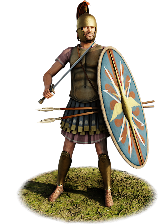
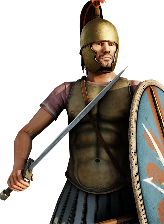
Class: heavy · Category: infantry · Men per unit: 40
Description
The Italiote Epibatai are marines from the navies of the various Greek cities in Italy. Disembarked from their ships, they can also be used in land warfare. They wear Montefortino, Pilos, and Attic helmets, and their bodies are protected by linothorakes, muscle cuirasses, and thureos shields. Armed with xiphos swords and javelins, these men make for great assault units in any army.
Historical background
Italy was the perfect land for the seafaring Greeks to colonise: resembling a long leg that steps down into the Mediterranean Sea, it is essentially just one big coastline. Thus, most colonies that were founded by the Greeks, starting from the 8th century BC, were port cities. The first ones were Kyme and Pithekoussai in Campania, founded by Euboians around 750-725 BC, then Sybaris and Kroton in Southern Italy between 725 and 700 BC founded by the Achaians, next Taras by the Spartans (c. 706 BC), and Rhegion by the Chalkidians. These were followed by Lokroi Epizephyrioi (around 660 BC), Siris (ca. 630 BC), Neapolis 507 BC, Thourioi in the later 440s BC, as well as several minor cities, including Hipponion, Medma, Kaulonia, Terina, Laos, Poseidonia, and lastly Herakleia in 433/32 BC replacing Siris (Fischer-Hansen, Nielsen, and Ampolo, Italia and Kampania (2004), p. 251f).
Since most of these cities were located on the coast, they were very involved in naval struggles, either with each other or with other major powers. During the Peloponnesian War (431-404 BC), several Italiote cities joined either Syracuse/Sparta or Athens. Thus, Rhegion offered its port and part of its fleet (18 vessels) to Athens, opposed by Lokroi, Taras, and Messana (Thuk. III.88; IV.1; IV.25). In the later part of the war, the cities of Metaponton and Thourioi sent help to the Athenians in the form of soldiers and ships (Thuk. VII.33-35), though the latter contributed 10 ships to the Spartan fleet after Athens lost its army and fleet in Sicily (Thuk. VIII.35). After that war, the Italiote cities drew the attention of the Syracusan tyrant Dionysios I (ca. 430 – 367 BC), who had recently risen to power. While Lokroi joined him and was awarded with the first quinquereme that Syracuse constructed, embellished with silver and gold furnishing, Rhegion opposed Syracuse with an army of 6,000 infantry, 600 cavalry, and 50 triremes (Diod. Sic. XIV.40.3). In 399 BC, Kroton joined Rhegion with 60 ships, so Dionysios concluded an alliance with the local Lucanians, a native Oscan tribe neighbouring the Italiote cities (Diod. Sic. XIV.100). In 388 BC, after several attempts, Dionysios I managed to besiege and conquer Rhegion after an 11-month siege, enslaving 6,000 Rhegians, though in 351 BC, they were liberated (XVI.45.9). In the 270s BC, Rhegion was again conquered by a rogue Campanian army under the command of Decius Vibellius, which had been sent out by Rome as protection against Pyrrhos of Epeiros (ca. 319 – 272 BC) (Pol. 1.6-1.7, Diod. 22.1.2). Rome besieged them, executed the rogue army, and returned their city to the Rhegians (Pol. 1.8.2). From that point onward, Rhegion was under permanent Roman "protection". Kroton had already been captured in 284 BC (St. Jerome, Chronicon B284), while Taras and the other southern Italiote cities came under Roman control by 272 BC at the latest, after Pyrrhos of Epeiros had been thrown out of Italy (Liv. Per. 15e).
Thereafter, Rome regularly made use of the Italiote navies. For the first engagements against Carthage in the First Punic War (264–241 BC), they used pentekonters and triremes from Taras, Lokroi, Elea, and Neapolis (Pol. I.20.14). During the Second Punic War (218 – 201 BC), after Taras, Thourioi, and Metaponton had already switched sides to Hannibal, Rome gathered a fleet of 20 ships from Rhegion, Elea, and Paestum. At Sapriportis near Tarentum, it came to a battle with 20 Tarentine ships under Demokrates, where Rome lost that fleet (Liv. XXVI.39). During the Syrian War (192-188 BC), C. Livius, commander of the Roman fleet, picked up 50 vessels from the Neapolitan coast, then 6 from Carthage, and several ships from Rhegion and Lokroi (Liv. XXXVI.42), and during the Third Macedonian War (171-169 BC), Marcus Lucretius took command of the ships provided by allies, among them one trireme from Rhegion and 2 from Lokroi (as well as 4 of the Sallentines of Uria, 10 of Epidamnos, and 12 from Issa, Liv. XL.48).
Italiote Epibatai are armed with a typically Southern Italic panoply. Greek muscle cuirasses are found quite often, provenanced near the sites of ancient Taras and Metaponton at Conversano (Tomb 10, 325-300 BC, in: Bari inv.20893-4, which also contained greaves, javelins, and spears), Ginosa (Tomb 13.I.1935, 480-450 BC, in: Taranto inv.73003-73004, also contained greaves), Metaponto (400-300 BC, in: Basel inv.Ka223; three javelins/spears from tomb 17/71 (500-490 BC), four from tomb 18 (320-280 BC), and San Giorgio Lucano (350-300 BC, also with a short straight sword with the same dating). Pseudo-Corinthian helmets were found at Pomarico (Type III, The British Museum, Inv. No. 2832. 1856.12-26.669, 5th-4th c. BC, near ancient Metapontum), two from Taranto (undated) and four from Rutigliano near Taranto (Tomb 3 and graves 11, 19, 77). At the battle of Sapriportis (210 BC), Livy (XXVI.39) describes the epibatai’s combat in the following manner:
"They fought at such close quarters that they not only discharged missiles, but even used their swords in hand-to-hand fighting. […]. The vessels were so crowded together that hardly any missile failed to reach its aim or fell into the water. They pressed forward front to front like a line of infantry, and the combatants made their way from ship to ship."
Stats
| Rank in roster | ||
|---|---|---|
| Men per unit | 40 | ███······· 30% |
| Attack | 11 | ███······· 34% |
| Charge bonus | 10 | ████······ 35% |
| Defence | 37 | ██████···· 64% |
| · armour | 11 | ██████···· 64% |
| · defence skill | 22 | ██████···· 61% |
| · shield | 4 | █████····· 48% |
| Morale | 11 | ████······ 39% |
| Discipline | Normal | |
| Training | Trained | |
| Recruitment cost | 1,792 dn | ████······ 36% |
| Upkeep per turn | 656 dn | █████····· 54% |
| Turns to recruit | 2 |
Weapons
| Primary | Secondary | Primary | Secondary | Primary | Secondary | Primary | Secondary | ||||
|---|---|---|---|---|---|---|---|---|---|---|---|
| Attack | 11 | 10 | Charge bonus | 10 | 11 | Type | thrown · blade | melee · blade | Damage | piercing | piercing |
| Projectile | javelin | — | Range | 60 | — | Ammunition | 5 | — | Properties | Thrown | — |
Defence
| Primary | Secondary | Primary | Secondary | Primary | Secondary | Primary | Secondary | ||||
|---|---|---|---|---|---|---|---|---|---|---|---|
| Total | 37 | — | Armour | 11 | — | Defence skill | 22 | — | Shield | 4 | — |
Condition and terrain
| Hit points | 1 | Ground: scrub / sand / forest / snow | 0 / -1 / 0 / -1 | Charge distance | 30 | Formations | Square |
Technical stats
| Time between blows (primary / secondary) | 2.5 s / 2.5 s | Extra fatigue in hot climates | 2 | Collision mass per man (1.0 is normal) | 1.19 | Spacing between men: close / loose | 1 × 1.2 m / 2 × 2.4 m |
| Default ranks | 5 |
In battle: Can sap · Very good stamina
Who can recruit it
A core roster unit for one faction, which can raise it anywhere it holds the right building:
Any faction holding one of the provinces below can field it.
Exactly what a settlement must have, route by route (4)
| Building | Also requires | Building | Also requires | Building | Also requires | Building | Also requires |
|---|---|---|---|---|---|---|---|
| Any settlement | Trade Port · Garrison Building or Tier 1 Military Industrial Complex · Italiote area of recruitment · Any Government (Dependency, Indirect Rule or Direct Rule) · Tier 2 Colony not built | Indirect Rule | Trade Port · Garrison Building or Tier 1 Military Industrial Complex · Tier 1 Colony | Direct Rule | Trade Port · Garrison Building or Tier 1 Military Industrial Complex · Tier 1 Colony | Homeland | Trade Port · Garrison Building or Tier 1 Military Industrial Complex |
Areas of recruitment
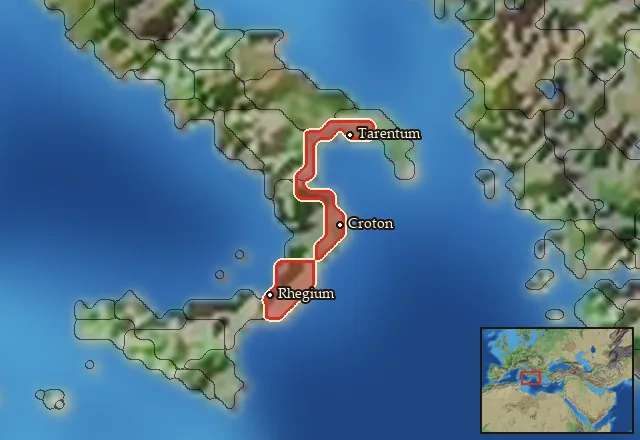
| Zone | Provinces | ||||||
|---|---|---|---|---|---|---|---|
| Italiote | 3 |